

Cart
1

Table of Contents
- The Ethics of Lab Grown Diamonds: A Complex Answer
- Environmental Impact of Lab Grown Diamonds: Energy vs. Earth
- Lab Grown Diamond Certification Standards: Your Proof of Ethics
- Lab Grown vs Natural Diamond Ethics: A Side-by-Side Look
- The Human Rights Question: Mining, Labor, and Social Impact
- How to Verify Ethical Sourcing When You Buy
- Frequently Asked Questions
Last Updated: September 16, 2026
The Ethics of Lab Grown Diamonds: A Complex Answer
Are lab grown diamonds ethically sourced? The short answer is: usually, but not automatically. A lab grown diamond is created in a controlled facility rather than extracted from the earth, which removes the mining-related risks that have long shadowed the traditional diamond trade. That distinction matters. But "grown in a lab" describes where a stone comes from, not how the people who made it were treated or how much energy the process consumed.
This guide from Native Jewel examines the full picture, from carbon footprint and certification to the labor questions that lab-grown marketing tends to skip. Below, we'll show you exactly how to tell an ethically sourced stone from one that simply carries the label.
What "Ethically Sourced" Actually Means
Ethical sourcing is the practice of verifying that a gemstone's origin, labor conditions, and environmental costs meet defined standards of responsibility. For lab grown diamonds, that means looking at three things: how the stone was produced, who produced it, and whether an independent body verified the claims.
A common mistake is treating "lab grown" and "ethical" as synonyms. They aren't. A diamond can be grown in a facility powered by coal, in a jurisdiction with weak labor oversight, and still be sold as "conflict-free." The label describes one risk removed, not every risk resolved.
That's the tension running through this entire topic. Lab-grown diamonds solve the mining problem. They do not automatically solve the labor or energy problem.
Environmental Impact of Lab Grown Diamonds: Energy vs. Earth
The environmental impact of lab grown diamonds is real, and it is mostly about electricity. Growing a diamond means replicating the heat and pressure that form stones underground, which takes substantial power. Two production methods dominate the industry:
- HPHT (High Pressure High Temperature): dissolves a carbon source in a metal flux and recrystallizes it under roughly 1,300-1,600°C and 50,000-60,000 atmospheres, mimicking the geological conditions that create natural diamonds
- CVD (Chemical Vapor Deposition): grows a diamond layer-by-layer from a carbon-rich gas (typically methane) in a vacuum chamber at lower pressure and roughly 700-1,200°C
Both methods consume significant energy, and the two are not equivalent. HPHT generally runs at higher pressure and often higher total power draw; CVD runs at lower pressure but for longer growth cycles. The critical variable is not the method alone but where the energy comes from. A facility running on renewable energy has a very different footprint than one running on a regional grid dominated by fossil fuels.
Carbon Footprint and Energy Consumption
Mined diamonds move enormous volumes of rock. Lab grown diamonds move none. That is the central trade-off, and it is why the carbon footprint comparison is more nuanced than either side admits.
A mined stone's footprint comes from excavation, hauling, processing, and the resource depletion left behind. A grown stone's footprint comes almost entirely from energy consumption during synthesis. The U.S.
- Functional unit: Is the comparison per carat, per stone, or per gram? A per-carat figure can hide the fact that growing a larger stone takes disproportionately more energy.
- System boundary: Does the study cover only synthesis, or does it include gas production, chamber manufacturing, cutting, polishing, and shipping?
- Energy source: Is the facility modeled on a specific grid, a power purchase agreement, or a renewable energy certificate? These are not the same claim.
- Allocation method: If a facility grows many stones at once, how was the energy divided among them?
Watch Out
"Eco-friendly" and "sustainable" are unregulated marketing terms for diamonds. If a brand cannot show you an energy source, a certification, or an LCA, treat the claim as unverified. The consequence of ignoring this is paying a premium for a label with nothing behind it.
Key Takeaway
The single most useful question you can ask a lab-grown brand is not "are your diamonds eco-friendly?" It is "what powers the facility that grew this stone, and can you show me the LCA?" A brand with a real answer will have it ready.
Lab Grown Diamond Certification Standards: Your Proof of Ethics
Certification is where ethics stop being a story and start being verifiable. There are two distinct layers, and most buyers conflate them: grading, which confirms what a stone is, and sustainability certification, which speaks to how it was made.
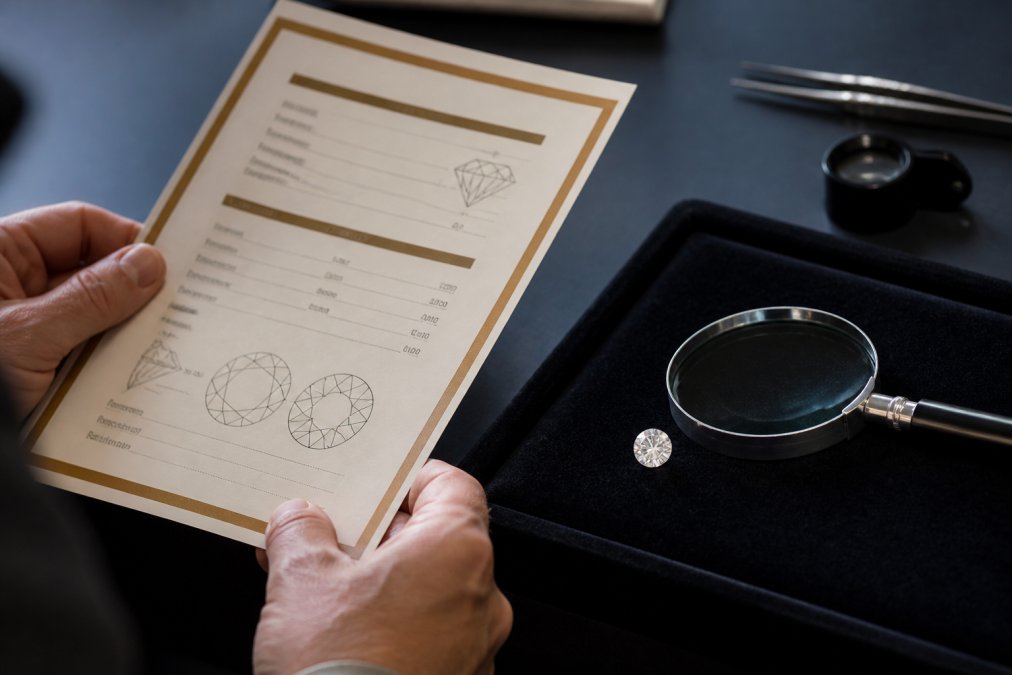
What IGI Certification Means for Your Purchase
The most widely recognized grading standard for lab grown diamonds is the International Gemological Institute (IGI), which documents a stone's carat weight, color, clarity, and cut, and confirms it is lab grown. An IGI report is an independent verification of what a diamond actually is. It does not come from the seller. That independence is the whole point, and it is the difference between a documented stone and a claim.
Oval Lab Grown Diamond Engagement Ring →
Sustainability Certification: SCS-007 and What It Actually Covers
The leading standard for the ethics of a lab-grown diamond is SCS-007, developed by SCS Global Services. It is a certification specifically for lab-grown diamonds that scores a producer across environmental, social, and governance criteria rather than grading the stone itself. The framework addresses areas such as:
- Energy and climate: the facility's energy sources, greenhouse gas intensity, and efforts to reduce them
- Water and waste: how the production process manages water use and chemical byproducts
- Labor and human rights: worker safety, fair wages, and freedom of association in the facility
- Supply chain traceability: whether the producer can document a stone's path from growth to market
- Business ethics: governance, transparency, and disclosure practices
How to Verify an Ethical Claim
Certification standards for ethics go further than grading, and the verification path is straightforward if you know what to ask for:
- Ask for the grading report number and confirm it with the grading lab
- Ask whether the producer holds SCS-007 or another sustainability certification, and request the certificate
- Ask for the certificate's scope, does it cover the specific facility that grew your stone, or only the parent company?
- Ask for the certificate's expiration date; certifications lapse and are not permanent
- Cross-check any LCA data against the certificate's stated energy sources
- Confirm the retailer will put the origin and certification claims in writing on the invoice
Pro Tip
When you receive your ring, match the certificate number on the IGI report against the laser inscription on the diamond's girdle. Most jewelers will show you this under a loupe. If the numbers don't match, the stone and the paperwork don't belong together.
Lab Grown vs Natural Diamond Ethics: A Side-by-Side Look
The lab grown vs natural diamond ethics debate usually gets reduced to a slogan. It deserves better than that. Mined diamonds carry documented risks around labor, land, and geopolitics. Lab grown diamonds carry documented risks around energy and disclosure. Neither is automatically clean.
| Factor | Lab Grown Diamonds | Natural Mined Diamonds |
|---|---|---|
| Land disruption | Minimal | Significant excavation |
| Primary footprint | Energy consumption | Extraction and hauling |
| Labor risk | Facility-based, lower risk | Mining regions, higher risk |
| Traceability | Easier to document | Harder to trace to origin |
| Certification | IGI and similar labs | GIA and similar labs |
| Greenwashing risk | High (energy claims) | High (conflict-free claims) |
The Human Rights Question: Mining, Labor, and Social Impact
Human rights concerns in the mining industry are the reason lab grown diamonds exist as a category. The U.S. Department of Labor's reporting on child labor and forced labor in mining documents the regions where extraction has been tied to exploitative labor. That is the problem lab-grown production sidesteps.
How to Verify Ethical Sourcing When You Buy
Verification is a process, not a feeling. Use this checklist before you commit to any lab-grown diamond purchase:
- Confirm the stone is IGI-certified and get the certificate number
- Verify the certificate number directly with the grading lab
- Ask the retailer where the diamond was grown
- Ask what energy source powers the growing facility
- Request any Life Cycle Assessment data the brand publishes
- Check whether the brand discloses its supply chain at all
- Confirm the return and warranty terms in writing
SHOP RINGS
Frequently Asked Questions
Can a jeweler tell if a diamond is lab or natural?
Yes, a trained gemologist can distinguish lab-grown from natural diamonds using specialized equipment. The most common method is spectroscopy, which analyzes the diamond's internal structure and trace elements. Natural diamonds often contain tiny amounts of nitrogen or other impurities that lab-grown stones do not. However, both types are chemically and optically identical, so a standard jeweler's loupe is not enough. Always ask for a certificate from a recognized lab like IGI, which clearly states the diamond's origin and grading.
Do lab grown diamonds have the same resale value as natural diamonds?
Lab-grown diamonds generally have lower resale value than natural diamonds because their production costs continue to fall. Natural diamonds have a established secondary market and retain more value over time. However, if you are buying a diamond for its beauty and ethical appeal rather than as an investment, lab-grown stones offer exceptional value at the point of purchase. Many buyers choose them to get a larger, higher-quality stone for the same budget, which can be more meaningful than resale potential.
How does the environmental impact of lab grown diamonds compare to mining?
Lab-grown diamonds avoid the large-scale land disruption, water pollution, and habitat destruction associated with diamond mining. However, they are energy-intensive to produce. An industry report shows that lab-grown diamonds using renewable energy can have a carbon footprint up to 10 times lower than mined diamonds, but those powered by fossil fuels may have a higher footprint. The key is transparency: look for brands that disclose their energy sources and follow certification standards for environmental stewardship.
What is the most ethical diamond?
The most ethical diamond is one with verified traceability, fair labor practices, and minimal environmental harm. Lab-grown diamonds from certified producers like those with IGI certification often meet these criteria because they bypass traditional mining risks. However, ethics also depend on the company's transparency. Look for brands that share supply chain details, use renewable energy, and support community development. Native Jewel's IGI-certified lab-grown diamonds, for example, offer a conflict-free, traceable option for conscious buyers.


