Lab Diamond Lifespan: The Material vs. the Jewelry
A lab diamond lifespan is not a countdown clock. The diamond itself is chemically identical to an earth-mined stone and does not decay, yellow, or expire. What does have a lifespan is the jewelry holding it: the prongs, the band, the setting. At Native Jewel, we explain this distinction to every customer who asks whether their stone will "last," because the honest answer is that the diamond outlives all of us while the ring around it needs occasional attention.
A lab diamond is a diamond grown in a laboratory using controlled heat and pressure, with the same carbon crystal structure as a mined diamond. Identical material means identical physical behavior: the same hardness, the same resistance to scratching, and the same ability to hold a polish for generations.
That is the core of the lab diamond lifespan question. The material is permanent. The wearable piece is not, and treating those two things as one is where most online answers go wrong.
The Gemological Institute of America's guide to laboratory-grown diamonds confirms that lab-grown diamonds share the same optical, chemical, and physical properties as natural diamonds.
Lab-Grown Diamond Durability: Hardness, Toughness, and Wear
Lab-grown diamond durability rests on three separate properties that people routinely merge into one word: hardness, toughness, and stability. Hardness resists scratches. Toughness resists chipping and breaking. Stability describes how the material holds up against heat, light, and chemicals over time. A diamond scores at the very top of the scale for hardness, high but not unlimited for toughness, and effectively permanent for stability. Understanding which property does what is the difference between a stone that lasts generations and a stone that chips on a car door.
Diamond sits at 10 on the Mohs scale, the highest rating, and it is roughly four times harder than the next mineral down, corundum. The Mohs scale is a ranking of relative scratch resistance, not a linear measurement, so the gap between diamond and corundum is far larger than the gap between corundum and quartz. Nothing you encounter in daily life scratches a diamond except another diamond.
That means keys, coins, metal clasps, and countertops will not mark the stone. They will mark the gold band long before they touch the diamond. This is why a diamond can be worn daily for decades and still show a factory-fresh surface while the metal around it accumulates visible scratches.
Toughness: How Diamonds Resist Chipping and Cracking
Hardness is not the same as indestructibility, and this is where most lifespan answers go wrong. A diamond has cleavage planes, directions in its crystal structure where carbon atoms are bonded less strongly than in other directions. A sharp, well-placed blow along a cleavage plane can split the stone. A hard strike against a counter edge, a car door, or a weight bench can chip a girdle or corner, particularly on a pear, marquise, or princess cut where points are exposed.
The Mohs rating tells you a diamond will not be scratched by a kitchen knife. It tells you nothing about whether the stone will survive being slammed into a granite countertop. Those are different failure modes, and only toughness governs the second one. A diamond's toughness is high, but it is not infinite, and the shape of the cut changes the risk profile substantially.
Watch OutA chipped diamond is not a manufacturing defect. It is impact damage, and it is not covered by a craftsmanship warranty. Have a jeweler check your prongs annually, because a loose or worn prong is the most common path from a small knock to a real chip.
Stability: Heat, Light, and Chemicals
Diamond is chemically inert and thermally stable at the temperatures and conditions of normal wear. It does not fade in sunlight, does not cloud with age, and does not react with household cleaners, chlorine, or skin oils. The material itself is effectively permanent. What changes over time is the jewelry around it, not the stone.
This is the precise distinction between a diamond's material lifespan and a jewelry piece's usable lifespan. The diamond can remain intact for generations while prongs, settings, and other components wear out or need repair. The stone is permanent; the wearable piece is a maintenance item.
Practical Damage Scenarios and How to Prevent Them
Damage almost never comes from wearing a ring. It comes from the moments you forget you are wearing it. The four scenarios below account for most repairs we see.
Gym and sports. Dumbbells, kettlebells, and barbells strike the ring at exactly girdle height. Remove rings before lifting or any contact sport.
Housework and cleaning. A ring catching on a drawer handle or counter edge applies sideways force to the setting.
Gardening and yard work. Soil hides small stones underfoot, and a ring knocked against a trowel or fence post takes a direct hit.
Swimming and hot tubs. Chlorine and hot water do not harm the diamond, but they can loosen prongs and dull the metal over time.
Prevention is simple: a designated dish by the sink, a ring holder in the gym bag, and a habit of removing jewelry before physical work. One honest limitation: no care routine makes a ring indestructible. A well-set stone in a protective setting reduces risk, but it does not eliminate it.
Lab-Grown Diamond Care: Cleaning, Inspection, and Maintenance
Lab-grown diamond care is a short routine, not a project. Most of what keeps a diamond looking its best takes five minutes at home, plus a professional check once a year.
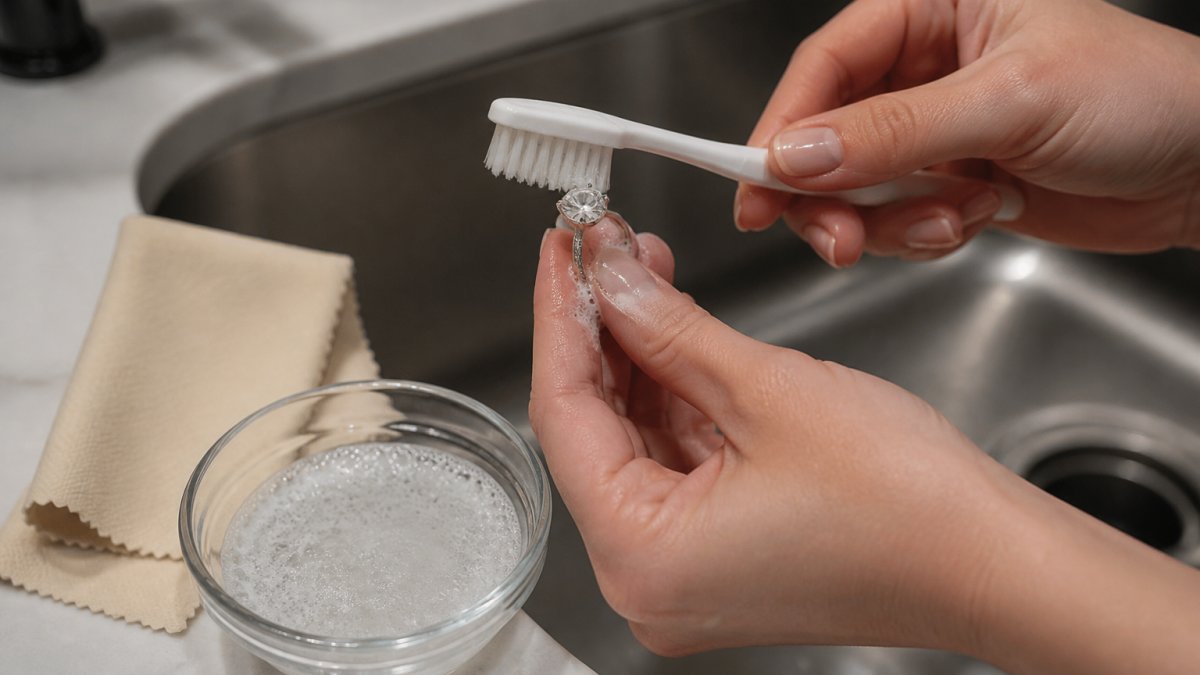
Close-up of hands gently cleaning a diamond engagement ring with a soft brush and mild soapy water over a sink, with a soft cloth and small bowl nearby
Home cleaning routine:
Mix a few drops of mild dish soap in a bowl of warm water
Soak the ring for 10 to 15 minutes
Brush gently with a soft-bristled toothbrush, focusing on the underside of the stone
Rinse under warm running water with the drain covered
Pat dry with a lint-free cloth
Skip harsh chemicals, bleach, and abrasive cleaners. They will not damage the diamond, but they can dull or discolor the metal over repeated exposure.
Professional maintenance: Have a jeweler inspect prongs, tighten any loose stones, and clean the piece with ultrasonic equipment once a year. This is also the moment to catch a worn prong before it fails.
Engagement rings worn daily: annual inspection, home cleaning every two to four weeks.
Occasional pieces: clean before and after each wear, inspect every 12 to 18 months.
Delicate settings with pavé or small side stones: inspect twice a year, since tiny stones loosen faster than a single center stone.
14K gold bands: expect light surface scratches over time. A jeweler can polish them out during a routine service.
Set a recurring calendar reminder for the same month each year to have your rings inspected. It is the single habit that prevents almost every expensive repair we see.
Do Lab-Grown Diamonds Lose Their Sparkle Over Time?
No. A lab diamond does not lose its sparkle, because sparkle is a function of cut and light performance, not age. What dulls is the surface of the stone, and that is reversible.
The clarity, color, and brilliance you buy on day one remain the same decades later. What changes is a film of soap residue, lotion, skin oil, and dust that builds on the underside of the stone and blocks light from entering. A five-minute cleaning restores full brilliance.
Two real-world exceptions exist. First, a stone can appear duller if it has been chipped and the damaged area scatters light. Second, heavy wear can scratch the metal around the setting, which changes how the ring reflects light even though the diamond is untouched. Neither is aging in the diamond. Both are cosmetic and both are fixable.
Lab-Grown Diamond Resale Value: What to Expect
Lab-grown diamond resale value is lower than the original retail price, and anyone promising otherwise is not giving you a straight answer. This is true of natural diamonds as well, though the gap is wider for lab-grown stones because production costs continue to fall as growers scale capacity and improve yields.
The key distinction is that resale value has nothing to do with physical longevity. A lab diamond does not degrade, so its material lifespan is effectively infinite. Its market value, however, is set by supply, demand, and the cost of producing a new equivalent stone. Those are separate questions, and conflating them is why so many buyers feel misled after the fact.
Here is the practical framing we give customers: buy a diamond for the ring, the moment, and the years of wear, not as a financial instrument. If resale is your priority, lab-grown diamonds are the wrong category entirely. If wearability and size-per-dollar are your priorities, they are the strongest category available.
Where lab-grown stones hold up better is on the front end. A larger, higher-graded stone costs significantly less than its mined equivalent, so you get more diamond for the same budget. That upfront advantage is real and permanent, even though the resale advantage is not. Our Federal Trade Commission guidance on jewelry advertising requires accurate disclosure of a diamond's origin, which is why every Native Jewel stone ships with documentation stating it is lab-grown.
Factor
Effect on Value
Diamond material
Does not degrade or age; material lifespan is effectively infinite
Metal setting
Wears, scratches, needs servicing; drives most repair costs
Resale market
Lower than retail for lab-grown; driven by falling production costs
Insurance replacement
Based on current market pricing, not original purchase price
Physical longevity and resale value are unrelated. A lab diamond will outlast the setting it sits in and the person wearing it, but its resale price will still track the falling cost of growing a new one. Judge the purchase on wear, not on resale.
Conclusion: A Lifetime of Brilliance with Proper Care
The lab diamond lifespan question has a clean answer: the stone lasts indefinitely, and the jewelry around it lasts as long as you maintain it. Buy the diamond you love, clean it regularly, and have it inspected once a year.
Native Jewel builds every piece around that reality. Our rings feature IGI-certified lab-grown diamonds, handcrafted 14K gold settings, and a lifetime warranty on craftsmanship, so a loose prong or a worn setting is our problem to solve, not yours. Every order includes complimentary resizing and 30-day returns.
Yes, a lab diamond's material lifespan is effectively unlimited. Like natural diamonds, lab-grown diamonds are pure carbon with a crystal structure that does not degrade over time. They will not yellow, cloud, or break down from age. The ring setting and metal may wear, but the diamond itself can last for generations with basic care and occasional professional inspection.
Are lab-grown diamonds as durable as natural diamonds?
Lab-grown diamonds have the same chemical composition, crystal structure, and hardness as natural diamonds. They rank 10 on the Mohs scale and resist scratching from everyday materials. The main difference is origin, not durability. Both can chip if struck at a vulnerable angle, so a protective setting and routine prong checks matter more than whether the diamond was grown in a lab or mined.
Do lab-grown diamonds lose their sparkle over time?
No, the diamond itself does not lose sparkle. Any dullness comes from surface buildup like soap, lotion, or skin oils, which block light. A gentle cleaning with mild soap and a soft brush restores brilliance. For everyday rings, clean monthly and schedule a professional cleaning and inspection once a year to keep the stone looking its best.
How much can I sell a 1 carat lab diamond for?
Resale values for lab-grown diamonds are lower than for natural diamonds of similar size and quality. A 1-carat lab diamond might resell for a fraction of its original retail price. The exact amount depends on the current market, certification, and setting. Many buyers choose lab diamonds for the upfront savings and wear them as long-term pieces rather than investments.