

Cart
1
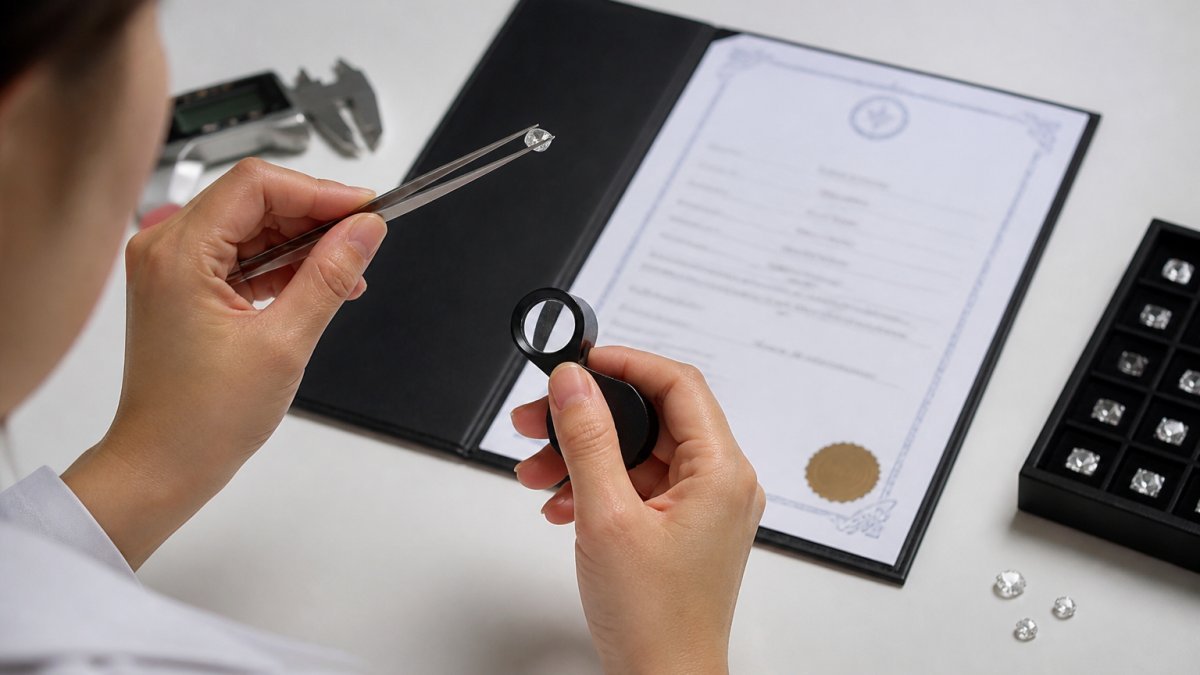
Table of Contents
- What Certification Do Lab-Grown Diamonds Get?
- How to Read a Lab-Grown Diamond Certificate
- Lab-Grown Diamond Grading Report vs Certificate: What's the Difference?
- IGI vs GIA Lab-Grown Diamonds: Which Grading Lab Should You Trust?
- How to Verify a Diamond Certificate Number
- Why Certification Matters for Your Diamond's Value and Longevity
- Frequently Asked Questions
Last Updated: October 12, 2026
What Certification Do Lab-Grown Diamonds Get?
What certification do lab-grown diamonds get? They are certified by independent gemological laboratories, most commonly the International Gemological Institute (IGI), which issues a grading report documenting the stone's exact specifications.
A lab-grown diamond certificate is a third-party grading report verifying a stone's identity, measurements, and quality grades.
A diamond without independent certification is an unverified claim: you have the seller's word on color, clarity, and carat weight, and nothing else. When you're spending thousands on an engagement ring, "trust me" is not a grading standard.

Below, we'll walk through exactly how to read a lab-grown diamond certificate, how to verify the report number, and why the grading lab you choose affects both your stone's value and how confidently you can insure it.
How to Read a Lab-Grown Diamond Certificate
Every grading report follows the same basic architecture; once you know the layout, you can read any lab's report in about two minutes.
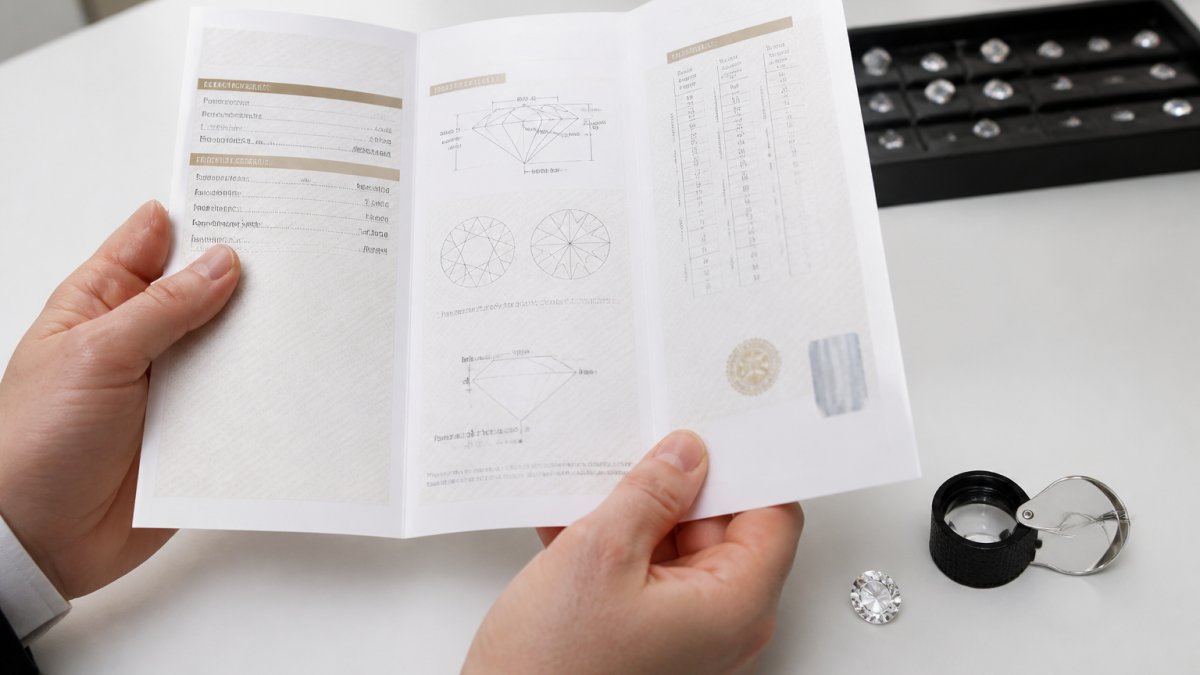
Start with the top block: the report number, measurements in millimeters, and carat weight. Then move to the grading section, which determines price.
The Four Cs on Your Grading Report
The Four Cs, carat weight, color, clarity, and cut, each get their own line. Carat is a weight measurement to two decimal places.
Color runs from D (colorless) down the alphabet as tint increases; clarity runs from Flawless through grades like VS1 and VS2, describing how visible inclusions are under magnification.
Cut is the one most buyers skim past, and it's a mistake.
Pro Tip
Ask for the report's cut grade specifically, not just the color and clarity. Many listings lead with color and clarity because those grades sound impressive, while cut quietly determines whether the stone actually sparkles.
Growth Method and Treatment Disclosures
Lab-grown diamonds are produced by high pressure high temperature (HPHT) or chemical vapor deposition (CVD), and a proper report states which method produced the stone.
The report also discloses any post-growth treatments, since some lab-grown stones are treated to improve color, that should be documented, not discovered later.
Lab-Grown Diamond Grading Report vs Certificate: What's the Difference?
The two terms describe the same document and the industry uses them interchangeably.
A grading report is a laboratory's documented assessment of a diamond's characteristics, produced by trained gemologists using standardized equipment and scales.
Buyers get tripped up assuming the report guarantees authenticity forever. It doesn't, it describes one specific stone at one point in time, identified by a unique report number.
IGI vs GIA Lab-Grown Diamonds: Which Grading Lab Should You Trust?
Both IGI and GIA are respected independent laboratories producing legitimate lab-grown diamond reports. The practical difference comes down to market positioning.
GIA built its reputation on natural diamond grading and is often treated as the stricter standard. IGI grades a very large share of the world's lab-grown diamonds, having scaled that segment early. Either lab's report is trustworthy. What to avoid is a stone with no third-party report at all, or one graded only by the seller's in-house team, that is not certification, that is marketing.
What a Credible Report Must Document
Regardless of which lab issues it, a proper lab-grown diamond report should include:
- Report number: A unique identifier that can be verified against the lab's database.
- Measurements: Dimensions in millimeters, which confirm the stone matches its listing.
- Carat weight: Weight to two decimals, which directly affects price.
- Color grade: D through the tinted range, on the established scale.
- Clarity grade: Flawless through included, describing how visible inclusions are under magnification.
If any of these lines are missing, the report is incomplete and you should ask why.
How the Two Labs Differ in Practice
The differences are less about accuracy than market positioning:
- GIA is often preferred for natural diamonds and is sometimes viewed as the stricter grader. Its lab-grown reports are widely accepted but less common in the lab-grown segment.
- IGI dominates lab-grown grading volume. Its reports are the most frequently encountered in lab-grown inventory, which means buyers see more IGI-graded stones and more comparable pricing data.
A stone graded by one lab may receive slightly different grades from the other. This is not fraud; it reflects differences in grading philosophy and equipment. The practical takeaway: compare stones graded by the same lab when comparing prices.
Red Flags in Lab-Grown Diamond Paperwork
- A report that cannot be verified online.
- A report number that returns different specifications than the document.
- A stone with no laser inscription matching the report number.
- A report issued by a lab with no public verification tool.
- A seller who refuses to show the inscription under magnification before purchase.
| Report Feature | What It Tells You | Why It Matters |
|---|---|---|
| Report number | Unique identifier for the stone | Enables verification against the lab's database |
| Measurements | Dimensions in millimeters | Confirms the stone matches its listing |
| Carat weight | Weight to two decimals | Directly affects price |
| Color grade | D through the tinted range | Affects appearance and value |
| Clarity grade | Flawless through included | Affects appearance and value |
| Cut grade | Light performance rating | Drives brilliance more than color or clarity |
| Growth method | HPHT or CVD | Confirms how the stone was produced |
| Treatment disclosure | Any post-growth treatment | Affects long-term appearance and value |
Pro Tip
When comparing two lab-grown diamonds, check whether they were graded by the same lab. Cross-lab grade comparisons are approximate, not exact, and a one-grade difference between labs can translate into a meaningful price difference.
How to Verify a Diamond Certificate Number
Verification takes about three minutes and should happen before any money changes hands. Every legitimate report carries a unique number, and the issuing lab maintains a lookup tool on its website.
4.05ct Oval Lab Diamond Engagement Ring | 3ct Center | D/VS1 IGI Certified →
Here's the process:
- Locate the report number on the document, usually printed near the top
- Go to the issuing laboratory's official website and find its report verification tool
- Enter the number and confirm the returned specifications match your document exactly
- Check that the carat weight, measurements, and grades on screen match what you were quoted
- Save a copy of the verification result alongside your purchase records
If the number returns no result, or returns a stone with different specifications, stop. That's a serious red flag.
Matching the Inscription to the Report
Most certified lab-grown diamonds carry a microscopic laser inscription on the girdle, the thin edge around the stone's widest point, typically including the report number.
Your jeweler can show you the inscription under magnification, and it should match the report number exactly. This is the physical link between paper and stone; without it, you're relying on the seller's word that the report belongs to your diamond.
Watch Out
Never accept a report that arrives separately from the stone or "will be mailed later." The report and the diamond should be presented together, with the inscription verified in front of you. A missing or mismatched inscription is one of the most common ways buyers end up with a stone that doesn't match its paperwork.
Why Certification Matters for Your Diamond's Value and Longevity
Certification does not make a diamond last longer. Diamonds are the hardest natural material on earth, and a lab-grown diamond has the same carbon crystal structure as an earth-mined one, neither degrades, clouds, or wears away with normal wear. But "lasts forever" describes the stone, not the jewelry around it, and most guides blur that line.
The Stone vs. the Setting: Two Different Lifespans
A diamond's material lifespan is effectively permanent: carbon crystal does not rot, rust, or fade on any human timescale, and a lab-grown diamond will look the same in 100 years as today, absent physical damage.
A jewelry piece's usable lifespan is much shorter: prongs bend, settings loosen, and metal wears thin. A daily-wear ring may need prong retipping within 5 to 10 years and a full setting rebuild within 20 to 30, while an occasional pendant may go decades without service.
Hardness Is Not Toughness: Why Diamonds Still Chip
Diamonds rank 10 on the Mohs hardness scale, which measures scratch resistance, not impact resistance. Hardness and toughness are different properties, and conflating them is the most common durability mistake buyers make.
A diamond is hard enough to scratch almost anything, but not indestructible: a sharp blow at the wrong angle can chip or cleave it along its cleavage planes.
Toughness, resistance to chipping and breaking, is lower in diamonds than in some softer stones.
Practical Damage Scenarios and Prevention
Most diamond damage is preventable, and the causes are consistent:
- Impact: Knocks against countertops, car doors, and gym equipment. Remove rings for lifting, manual labor, and contact sports.
- Extreme heat: A house fire or a jeweler's torch can cause thermal shock. This is rare in normal wear but relevant to storage and insurance planning.
- Household chemicals: Chlorine and bleach can degrade some setting metals and loosen prongs over time. Remove jewelry before cleaning with harsh chemicals or swimming in chlorinated pools.
- Setting damage: Bent prongs are the leading cause of stone loss. A loose stone is a lost stone waiting to happen.
Care by Jewelry Type and Wear Frequency
Generic "clean your diamond regularly" advice is not useful. A realistic schedule depends on wear frequency:
- Daily-wear rings (engagement, wedding): Inspect prongs monthly by feel and under a loupe; professional cleaning and inspection every 6 months; ultrasonic cleaning is fine for most diamonds but should be avoided if the setting has glued elements or fragile side stones.
- Frequently worn pendants and earrings: Inspect every 3 to 6 months; clean with warm water, mild dish soap, and a soft brush.
- Occasional pieces: Inspect before each wear; clean after wear to remove skin oils and lotion residue.
A simple at-home test: hold the piece near your ear and tap the stone gently. A tight stone gives a clear ring; a loose stone gives a dull thud. If it thuds, stop wearing it until a jeweler checks the setting.
Aging, Clouding, and Resale Value
Lab-grown diamonds do not fade, yellow, or cloud with age.
Resale value is a separate question. Lab-grown diamond resale values are lower than natural diamond resale values across the market, regardless of grading lab.
That is the practical case for certification.
At Native Jewel, every piece ships with IGI certification, including our 4.05ct Oval Lab Diamond Engagement Ring and our Heart Cut Lab Diamond Pendant Necklace.

Key Takeaway
Certification does not extend a diamond's life, because a diamond does not have an expiration date. It protects the value of the jewelry piece around it, which is the part that actually wears out, and it separates physical longevity from resale value, which move on different timelines.
Frequently Asked Questions
Do lab-grown diamonds come with a certificate?
Yes, most lab-grown diamonds sold through reputable jewelers arrive with a grading report from an independent lab. The two most common issuers are IGI (International Gemological Institute) and GIA (Gemological Institute of America). These reports document the diamond's carat weight, color, clarity, cut, measurements, and growth method. A certificate confirms your stone has been independently examined, which matters when you are spending thousands on an engagement ring or fine jewelry piece.
How can I verify a lab-grown diamond certificate number?
Every grading report carries a unique certificate number. To verify it, visit the grading lab's official website (IGI or GIA) and enter that number into their online report-check tool. You should see the full report details match what you were given. Then check the diamond itself: a laser inscription on the girdle should match the certificate number. If the inscription and the report do not align, ask the seller to explain before you buy.
Is IGI certification good for lab-grown diamonds?
IGI is one of the most widely used grading labs for lab-grown diamonds and is well respected in the industry. IGI grades the same Four Cs that GIA does: color, clarity, cut, and carat weight, plus growth method and any treatments. Many jewelers, including Native Jewel, sell IGI-certified lab-grown diamonds because IGI provides consistent, independent grading at a reasonable cost. The key is that the report comes from an independent lab, not the seller.
What is the difference between a lab-grown diamond grading report and a certificate?
In practice, the terms are used interchangeably. A grading report is the formal document issued by a gemological laboratory after examining your diamond. A certificate is the same document, just called by a different name. Both contain the diamond's specifications, a unique report number, and the lab's assessment. When a jeweler says a diamond is "certified," they mean it comes with a grading report from an independent lab such as IGI or GIA.


