

Cart
1
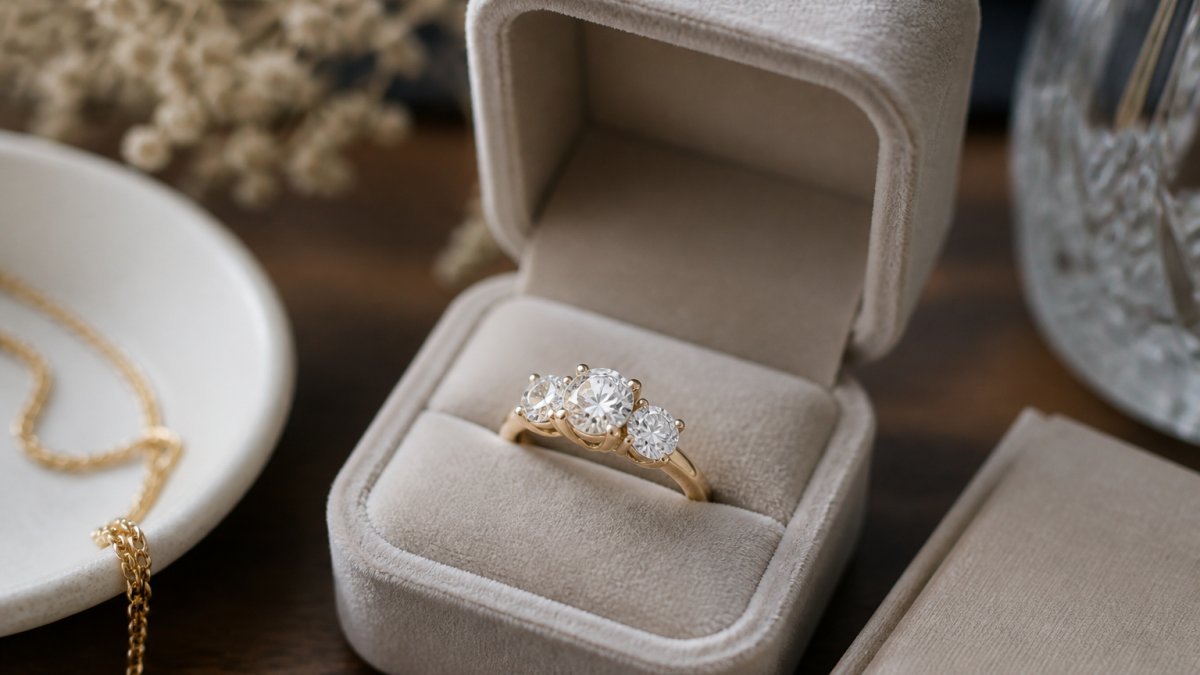
Table of Contents
- What Is a Three-Stone Engagement Ring and Why It Matters
- Three-Stone Engagement Ring Pros and Cons
- Three-Stone vs. Solitaire Engagement Ring: A Side-by-Side Value Comparison
- Three-Stone Engagement Ring Cost: What Drives the Price
- How to Choose a Three-Stone Engagement Ring: Stone Proportion and Visual Performance
- Is a Three-Stone Engagement Ring Worth It? A Decision Framework
- Frequently Asked Questions
Last Updated: October 13, 2026
What Is a Three-Stone Engagement Ring and Why It Matters
A three-stone engagement ring sets three diamonds or gemstones side by side, usually a larger center stone flanked by two smaller side stones. Deciding whether a three stone engagement ring is worth it comes down to three things: what the design means to you, how the proportions look on the hand, and whether the added cost of side stones fits your budget.
The format is old, but its appeal keeps renewing. It is written both as "three-stone" and "three stone", both refer to the same setting.
The Past, Present, and Future Symbolism
Each stone carries a meaning in the most common reading of the design:
- The side stone on one end represents the past you bring to the relationship
- The center stone represents the present, the commitment being made now
- The side stone on the other end represents the future you plan together
That structure is why the style shows up so often in anniversary gifts and second-marriage proposals. The symbolism is flexible, though: some couples treat the three stones as partners, children, or shared milestones.
Three-Stone Engagement Ring Pros and Cons
Weighing the three-stone engagement ring pros and cons means separating what the design does well from what it asks of you.
Advantages: Sparkle, Symbolism, and Visual Impact
Three stones mean more reflective surface. Two well-matched side stones frame the center and amplify its presence, so a modest center stone can read larger and brighter than its carat weight suggests.
The symbolism is the other draw: a solitaire says one thing beautifully, while a three-stone setting says three things at once.
Disadvantages: Cost, Maintenance, and Style Fit
Side stones are not free. Two extra stones of matching quality add to the total, and matching cut, color, and clarity across three stones takes more sourcing effort than picking one.
Maintenance is the trade-off most buyers underestimate: three stones mean more edges, prongs, and places for lint, lotion, and fabric to catch. The wider footprint is either loved or found busy next to a wedding band.
Watch Out
Keep side stones at roughly one-third to one-half the center stone's size unless you specifically want a flatter, more uniform look.
Three-Stone vs. Solitaire Engagement Ring: A Side-by-Side Value Comparison
The three-stone vs. solitaire engagement ring comparison comes down to where you want your money to work: a solitaire puts the entire budget into one stone, while a three-stone spreads it across three, trading center-stone size for total sparkle and symbolism.
| Factor | Three-Stone | Solitaire |
|---|---|---|
| Budget focus | Split across three stones | Concentrated in one stone |
| Perceived size | Center reads larger with side stones | Depends entirely on center stone |
| Sparkle | More total reflective surface | One strong focal point |
| Maintenance | More prongs and edges to clean | Fewer surfaces to maintain |
| Style fit | Statement look, wider footprint | Clean, classic, minimal |
| Best for | Symbolism and visual impact | Maximum center stone per dollar |
Sparkle and Perceived Size
A solitaire wins on raw center-stone size for a fixed budget because every dollar goes into one stone. A three-stone setting wins on perceived size and brilliance because the side stones create a continuous band of light across the finger. Want the biggest single diamond your budget allows? Solitaire. Want the ring to look and sparkle bigger than its center stone?
Cost and Total Cost of Ownership
Purchase price is only part of the math. Three-stone rings carry a higher upfront cost because of the extra stones, and a slightly higher long-term cost in cleaning and inspection. A solitaire is cheaper to buy and simpler to maintain. For a closer look at how certification and sourcing affect long-term value, the Federal Trade Commission guidance on jewelry advertising is worth reading before you buy.
Three-Stone Engagement Ring Cost: What Drives the Price
Three-stone engagement ring cost is driven by the same four factors that price any diamond ring, multiplied by three stones: cut, carat weight, color, and clarity.
The multiplication is what buyers underestimate: split a solitaire budget three ways and the center stone shrinks; keep the center the same size and add two matched side stones and the total rises.
Side stones are usually priced as a pair, and matched pairs carry a premium over two loose stones of similar grade because the supplier must find stones matching in cut, color, and clarity.
Natural vs. Lab-Grown vs. Gemstone Economics
This is where the three-stone format gets interesting for budget-minded buyers. A lab-grown center stone frees up budget for better-matched side stones, which is exactly what the design needs.
The economics work like this:
- All-natural, all-matched: highest cost, most traditional resale story, hardest to source a perfectly matched trio.
- Lab-grown center, lab-grown sides: the most common value play. You get a larger, better-cut center and closely matched sides for less than an all-natural trio.
- Lab-grown center, gemstone sides: lowest total cost, but the sides read as a different material in some lighting. Sapphire sides add color; moissanite sides add dispersion (rainbow flash) that can out-sparkle a diamond side.
A common pattern: buyers with a fixed budget get a better-looking ring by putting lab-grown stones in all three positions and spending the savings on cut quality and matching, while buyers who care about resale or tradition accept a smaller center to keep all three stones natural.
Total Cost of Ownership, Not Just Purchase Price
The sticker price is only the first line item. Over the life of the ring, these costs add up:
| Cost | What to expect |
|---|---|
| Purchase | Highest single cost; driven by the three-stone matching premium |
| Resizing | Common after engagement; simple resizing is routine, but a three-stone band with a wider footprint can be harder to resize cleanly than a plain solitaire band |
| Cleaning and inspection | Recommended at least once a year; many jewelers offer it free, but shipping or travel is a cost if you buy online |
| Prong tightening and repairs | More prongs means more chances one loosens; a lost side stone is the most common repair on this style |
| Insurance | Priced on replacement value, which is higher for three matched stones than for one |
| Replacement risk | If a side stone is lost and the original match is discontinued, replacing it can mean replacing the pair to keep the ring balanced |
The replacement risk is the one buyers rarely plan for. With a solitaire, a lost stone is a single replacement; with a three-stone ring, a lost side stone can force a pair replacement to keep the design symmetrical.
Pro Tip
If your budget is fixed, put the money into the center stone's cut first, then side-stone matching, then carat weight. A well-cut center with precisely matched side stones outperforms a larger, poorly matched trio every time you look at it in daylight.
For a closer look at how certification and sourcing affect long-term value, the Federal Trade Commission guidance on jewelry advertising is worth reading before you buy.
How to Choose a Three-Stone Engagement Ring: Stone Proportion and Visual Performance
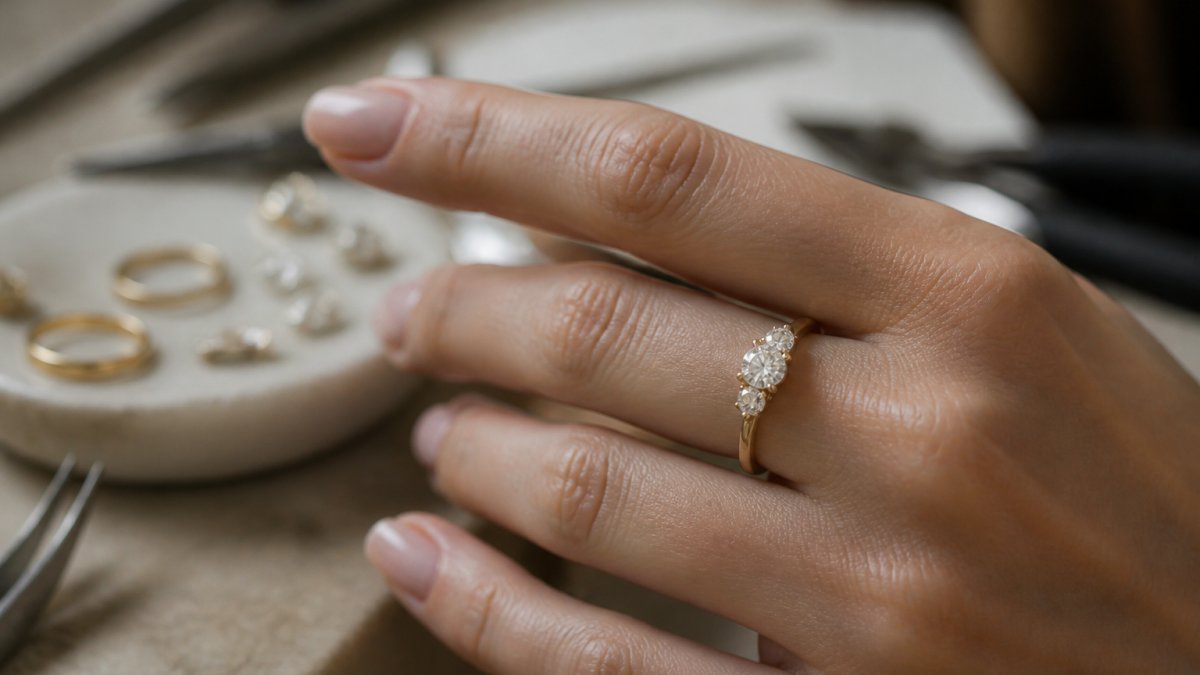
Choosing a three-stone engagement ring is mostly a proportion decision. Get the ratio between center and side stones right and the ring looks intentional. Get it wrong and no amount of carat weight fixes it.
Center and Side Stone Shapes
Shape pairing changes the whole character of the ring:
- Round center with round sides: the classic, maximum brilliance
- Oval center with round sides: elongates the finger, very flattering
- Emerald or radiant center with tapered baguettes: architectural and clean
Matching the side stone shape to the center keeps the design cohesive. Mixing shapes works, but it is a deliberate choice, not a default.
Durability by Setting and Lifestyle
Durability depends less on the stones than on the setting and how you wear it. Prong settings expose more of each stone to light but also to knocks. Bezel-set side stones trade a little sparkle for protection, which suits nurses, mechanics, and anyone hard on their hands. For everyday wear, 14K gold is a practical choice: it holds its shape well, resists scratching better than softer alloys, and stands up to daily use.
Key Takeaway
Proportion, not carat weight, decides whether a three-stone ring looks expensive. Match side stones to roughly one-third to one-half of the center stone, match their color and clarity closely, and choose a setting that fits how you actually wear the ring.
Is a Three-Stone Engagement Ring Worth It? A Decision Framework
If you are asking is a three stone engagement ring worth it, the answer is yes if you value symbolism and total sparkle over maximizing a single center stone. It is not worth it if your priority is the largest possible center diamond for your budget, or the lowest-maintenance ring you can buy. Most buyers land in between, so use the framework below.
The Three-Question Verdict
Answer these in order. The first question you answer "yes" to usually decides it.
- Do you want meaning built into the design? Three stones, three meanings, past, present, future. If that story matters to you, the style earns its place, and the added cost is buying symbolism, not just stones.
- Do you want maximum sparkle and perceived size per dollar? Side stones amplify the center. If visual impact matters more than one big stone, three-stone wins.
- Do you want the largest single diamond your budget allows? If yes, a solitaire is the efficient choice. Every dollar goes into one stone.
If you answered yes to 1 or 2, a three-stone ring is worth it for you. If you answered yes to 3 and nothing else, a solitaire serves you better.
Side-by-Side Value Comparison
Here is how the three main styles stack up on the axes that actually affect value:
| Factor | Three-Stone | Solitaire | Halo |
|---|---|---|---|
| Center-stone size per dollar | Smaller center, more total stones | Largest center per dollar | Smaller center, halo adds apparent size |
| Perceived size | Center reads larger with side stones | Depends entirely on center stone | Halo makes center read larger than it is |
| Sparkle | More total reflective surface | One strong focal point | Halo adds a ring of small stones |
| Maintenance | More prongs and edges to clean | Fewest surfaces to maintain | Many small stones and prongs to inspect |
| Durability risk | Side stones can loosen or be lost | Lowest risk, one stone, few prongs | Highest risk, many small stones |
| Style fit | Statement look, wider footprint | Clean, classic, minimal | Glamorous, vintage-leaning |
| Resale and tradition | Traditional, symbolic | Most traditional | Trend-sensitive |
| Best for | Symbolism and visual impact | Maximum center stone per dollar | Maximum apparent size on a smaller budget |
The Honest Trade-Offs
Three-stone rings are not the best choice for everyone.
- Choose three-stone if: you want symbolism, you want the ring to read bigger than its center stone, and you are willing to inspect prongs and clean the ring more often.
- Choose solitaire if: you want the biggest single diamond your budget allows, you want the simplest maintenance, or you want the most classic, timeless look.
- Choose halo if: you want maximum apparent size on a smaller center-stone budget and you accept the higher risk of losing a small stone.
Lifestyle Check
Durability depends less on the stones than on the setting and how you wear it. Prong settings expose more of each stone to light but also to knocks.
If you are hard on your hands or want minimal upkeep, a lower-profile three-stone setting or a solitaire is the safer call; if you want a statement ring and will maintain it, three-stone delivers.
Key Takeaway
A three-stone ring is worth it when symbolism and total sparkle matter more to you than maximizing one center stone. It is not worth it when the largest possible center diamond or the lowest maintenance is your top priority. Match the style to your priority, not to the trend.
For couples who want the symbolism without the traditional markup, Native Jewel handcrafts three-stone settings in 14K gold with IGI-certified lab-grown diamonds, backed by a lifetime warranty on all diamond jewelry and 30-day hassle-free returns. You can verify diamond grading standards through the International Gemological Institute before you commit.
Frequently Asked Questions
Is a three-stone engagement ring worth the extra cost compared to a solitaire?
It depends on what you value. A three-stone ring typically costs more because it uses additional stones, but it offers more sparkle, visual size, and symbolic meaning. If you want a ring that tells a story and stands out, the extra cost can feel justified. If you prefer a classic, understated look and want to put more budget into one high-quality center stone, a solitaire may be the better value. There is no universal answer; it comes down to personal priorities.
How much does a three-stone engagement ring cost?
Pricing for a three-stone engagement ring depends on the size, quality, and type of the center and side stones, as well as the metal and setting design. Lab-grown diamonds and gemstones generally cost less than natural diamonds of similar size. Because there is no fixed price, it is best to check current pricing directly with a jeweler or on the brand's website. Many retailers offer customization options that affect the final cost.
Are three-stone engagement rings practical for everyday wear?
Yes, with the right setting. Three-stone rings can be worn daily, but side stones may be more prone to snagging if they are set high or have sharp edges. A low-profile setting or a bezel-set side stone reduces snag risk. Durability also depends on the metal; 14K gold is a common choice because it balances strength and scratch resistance. Regular cleaning and occasional professional checks help keep the ring secure and sparkling.
What do the three stones in an engagement ring symbolize?
The three stones traditionally represent the past, present, and future of a relationship. The center stone often stands for the present moment, while the side stones represent the journey that brought you together and the life ahead. This symbolism is personal and can be adapted to your own story. Many couples choose a three-stone ring specifically because it carries this meaningful narrative.
Choosing a three-stone engagement ring is a real decision, not a default one, and the pressure of getting it right can stall the process for months. If the symbolism and the sparkle are what you keep coming back to, that is your answer. Native Jewel builds customizable three-stone rings with IGI-certified lab-grown diamonds, ethically sourced 14K gold, and a lifetime warranty on every diamond piece. Start with our ring collection and design the trio that tells your story.


