

Cart
0
Last Updated: October 22, 2026
Quick Summary
Style a marquise cut engagement ring by choosing orientation first: north-south elongates the finger, while east-west adds width and a modern look. Protect both pointed tips with V-prongs, then pair a curved band that follows the setting's contour.
- A long marquise covers more finger per carat than a round diamond of the same weight.
- A V-prong wraps each pointed tip and absorbs impact that would otherwise chip the stone.
- A halo follows the pointed outline and makes the whole shape look larger.
- Measure the gap with a straight band before choosing between curved, straight, and custom.
- Avoid a second marquise in one stack because two pointed shapes fight for attention.
Table of Contents
- Why the Marquise Cut Deserves a Second Look
- Marquise Diamond Orientation: North-South vs. East-West
- Choosing the Best Marquise Engagement Ring Settings
- Marquise Wedding Band Pairing: Curved, Straight, and Custom
- Building a Marquise Diamond Ring Stack
- Wearability, Snagging, and Protecting the Points
- Matching the Cut to Your Hand and Lifestyle
- Conclusion
- Frequently Asked Questions
Why the Marquise Cut Deserves a Second Look
The marquise cut is the most flattering diamond shape most buyers overlook. Its elongated outline makes a finger look longer and a stone look bigger than its carat weight suggests.
A marquise cut engagement ring is a diamond cut into an elongated oval with two pointed ends. The shape creates a slim, continuous line of brilliance from tip to tip. French King Louis XV reportedly commissioned it around 1745, and it has never really left style.

Here is what most guides get wrong: they treat the marquise as a novelty shape. In practice, it is one of the most space-efficient cuts you can buy. A long stone covers more of the finger per carat than a round diamond of the same weight.
That single fact drives every styling decision below.
Key Takeaway
The marquise cut is a shape choice, a size strategy, and a style statement at once. Get the proportions right and the rest follows.
Marquise Diamond Orientation: North-South vs. East-West
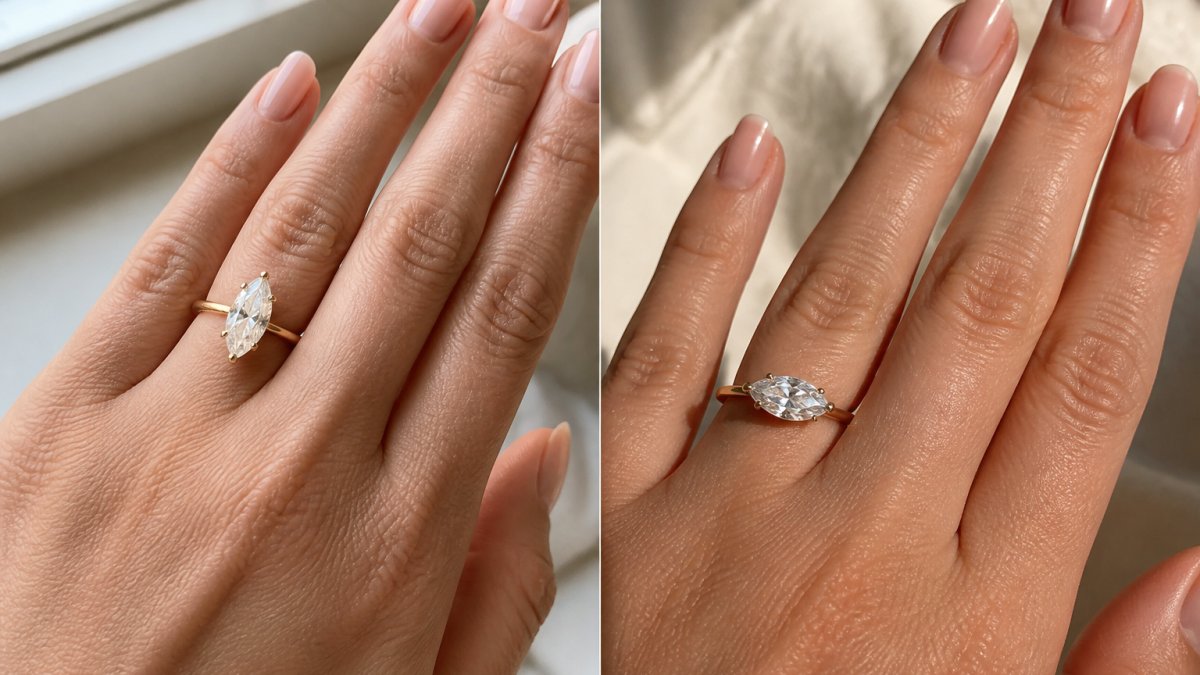
Orientation is the first styling decision, and it changes the entire look. Set north-south, the points run along the finger and stretch it visually. Set east-west, the stone lies across the finger and reads wider, more modern, and more unexpected.
Neither is better. They solve different problems.
- North-south: maximizes the elongating effect, classic and elegant, works on almost every hand
- East-west: widens a long or narrow hand, feels contemporary, shows off the pointed tips as a design feature
- Low-profile north-south: subtle, easy to wear daily, less likely to catch on fabric
Our 2.75ct Marquise Lab Diamond Engagement Ring can be set east-west or north-south, so you can decide which read suits your hand before committing.

Choosing the Best Marquise Engagement Ring Settings
The right setting protects the pointed tips and decides how much the shape dominates the ring. Start with protection, then choose how much accent sparkle you want around the center stone.
Prong and V-Prong Settings for Pointed Tips
A prong setting holds the diamond with small metal claws. For a marquise, the two end prongs matter most. A standard round prong at the tip leaves the point exposed. A V-prong wraps the point in a V-shaped claw and gives maximum protection.
This is the setting detail we would never skip. Pointed tips chip when they take a direct hit, and a V-prong absorbs that impact. It also keeps the tip visually sharp rather than rounded off.
Halo and Three-Stone Designs
A halo setting rings the center stone with small diamonds. On a marquise, a halo follows the pointed outline and makes the whole shape look larger. It suits anyone who wants maximum sparkle from a smaller center stone.
Three-stone designs place accent diamonds on either side. Round side stones soften the sharp silhouette and add width across the finger.
| Setting | Protection Level | Visual Effect | Best For |
|---|---|---|---|
| Solitaire with V-prongs | High | Clean, elongated | Classic style, larger center stones |
| Halo | Medium | Larger, more sparkle | Maximum brilliance |
| Three-stone | Medium to high | Wider, balanced | Adding width to a long finger |
| Pavé band solitaire | High | Continuous light line | Modern, refined look |
Our 3 Carat Marquise Solitaire Engagement Ring uses a prong-set solitaire in 14K yellow gold, a clean frame for the elongated shape. If you want extra brilliance, the 3.75ct Marquise Lab Diamond Engagement Ring adds 0.75ct of pavé diamonds along the band.
Watch Out
Skipping V-prongs to save money is the most common marquise mistake. A chipped point usually means replacing the stone, not repairing it.
Marquise Wedding Band Pairing: Curved, Straight, and Custom
A curved band is the safest pairing for most marquise rings, but the reason matters more than the recommendation.
Before you choose a band style, measure the gap. Slide a straight band against the engagement ring on a flat surface and look at the daylight between them.
You have three practical options, each with a real trade-off:
- Curved band: follows the contour of the ring and sits flush, the most popular choice. Trade-off: the curve is cut for a specific setting height, so it may not sit flush if you later reset the stone or change the head.
- Straight band: works if the center stone sits high enough to clear the band. Trade-off: a high setting that clears a straight band is also a high setting that catches on sleeves and knits, the pairing decision and the wearability decision pull in opposite directions.
- Custom band: shaped to your exact ring, the best fit but the longest lead time. Trade-off: custom contouring usually means a non-returnable piece and a multi-week build, so confirm the contour against the finished engagement ring, not a CAD render.
Two pairing details specific to the marquise shape:
3.75ct Marquise Lab Diamond Engagement Ring | 3.00ct Center | 14K Yellow Gold →
- Match the contour to the points, not the middle. The band should nest against the widest part of the setting and clear both pointed ends. A band that hugs the middle but grazes a tip will rub the V-prong over time.
- Decide orientation before you order the band. A north-south marquise presents a narrow profile to the band; an east-west marquise presents its full width. The same curved band will not nest the same way against both.
Try the band on with the engagement ring before you buy, and try it on the hand you will actually wear it on. Gap size depends on the setting height and the finger's curve, not on the band style alone.
Pro Tip
If you are undecided between curved and straight, buy the straight band first. It is easier to resize and return, and you can add a contoured band later once you know how the ring actually sits on your hand.
Building a Marquise Diamond Ring Stack
A marquise diamond ring stack works best when the shapes contrast rather than compete. The marquise already brings a strong silhouette, so the bands around it should support it quietly.
- Thin plain band next to the ring: lets the center stone lead
- Pavé band on the outer edge: adds sparkle without repeating the shape
- Contour band on the opposite side: mirrors the curve and balances the stack
- Avoid a second marquise in the same stack: two pointed shapes fight for attention
Keep total band width modest. Three thin bands usually look more elegant than two thick ones, and they sit more comfortably between the fingers.
Pro Tip
Build the stack one band at a time and wear it for a week before adding the next. Stack height that looks balanced on a screen can feel bulky after a full day of typing.
Wearability, Snagging, and Protecting the Points
Protection is the one styling trade-off you cannot ignore. The marquise has two exposed points, and those points are where wearability problems start.
A high-set marquise catches on knitwear, hair, and gloves. A lower setting with V-prongs solves most of it. So does a bezel or semi-bezel edge, which covers the tip entirely.
Check these before you commit:
- Both points sit inside V-prongs or a bezel edge
- The stone sits low enough to clear a sweater sleeve
- The band edges are smooth, with no sharp corners near the points
- The ring fits snugly so it does not rotate and expose a tip
For anyone who works with their hands, we recommend a lower profile and a bezel-protected tip. Style should never cost you a stone.
Matching the Cut to Your Hand and Lifestyle
Most guides stop at "a marquise flatters short fingers." That is true, but it does not tell you which marquise, in which orientation, on which setting, for your hand and your week.
Step 1: Read your finger length and width.
- Short fingers (under about 3 inches from base to tip): a north-south marquise with a longer length-to-width ratio adds the most visual length. Keep the band slim so the elongation is not interrupted.
- Long, narrow fingers: a north-south marquise can over-elongate. An east-west set or a three-stone design adds width and balances the hand.
- Wide hands or broad knuckles: a north-south marquise draws the eye vertically and slims the hand. A wider band (2.5-3 mm) keeps the ring from looking lost on a larger hand.
- Prominent knuckles: a low-profile setting that sits close to the finger reads more proportional than a high halo, which can make the knuckle look more pronounced.
Step 2: Choose the length-to-width ratio. A longer ratio (roughly 1.85-2.0) stretches the finger more and looks more dramatic.
Step 3: Match the setting to your week.
- Hands-on work, gym, gardening, or young children: low profile, V-prongs on both points, and a bezel or semi-bezel tip. This is the combination that survives daily contact.
- Office and everyday wear: solitaire or pavé band at medium height. Enough presence without the snag risk of a high halo.
- Special occasions only: high-set halo, maximum sparkle. Accept that a high setting catches on fabric and hair.
- Stacking plans: start with a slim band and build slowly. A marquise stack gets bulky fast because the center stone already occupies vertical space on the finger.
Step 4: Weigh the trade-offs honestly. Every choice trades something. A high setting shows more of the stone and catches more sleeves. A bezel protects the points and hides a sliver of the outline.
Best For
Anyone with short fingers or a wide hand who wants a stone that looks larger than its carat weight, and anyone with a hands-on week who needs the points protected without giving up the marquise silhouette.
Conclusion
Choosing a marquise cut engagement ring comes down to three decisions: orientation, setting, and protection. Get those right and the styling follows naturally.
At Native Jewel, every piece uses IGI-certified lab-grown diamonds in handcrafted 14K gold, with a lifetime warranty on craftsmanship and 30-day returns. Complimentary resizing and free shipping on orders over $1999 make the process simple.
Gemological Institute of America diamond cut guide and Federal Trade Commission jewelry advertising guidance are useful references as you shop. Start with our marquise collection and find the silhouette that feels like yours.
Frequently Asked Questions
How should you wear a marquise-cut engagement ring?
Wear it with the pointed ends running vertically along the finger for the classic elongating effect, or horizontally (east-west) for a modern, distinctive look. Vertical orientation makes the finger appear longer and slimmer, while east-west settings create a wider, more contemporary silhouette. Consider your hand shape and personal style when deciding. A 3ct marquise solitaire in 14K yellow gold, priced at $3,200, shows how a vertical setting maximizes the stone's length.
What wedding band looks best with a marquise engagement ring?
A curved or contoured band that hugs the marquise shape sits flush and protects the pointed ends. A straight band works if the setting is high enough to clear the points, but it may leave a small gap. For a seamless marquise wedding band pairing, consider a custom curved band or an open-band design. A pavé band in matching metal, like the 14K white gold option on the 2.75ct marquise ring at $2,500, adds sparkle without competing with the center stone.
How do you keep a marquise diamond from snagging?
Choose a setting with V-prongs that cover the pointed tips, and avoid exposed sharp corners. A bezel or semi-bezel setting offers even more protection. Remove the ring during activities like cleaning, gardening, or working with fabrics. Regular inspections by a jeweler can catch loose prongs early. Native Jewel's lifetime warranty on craftsmanship covers structural issues, and complimentary resizing helps ensure a secure fit.
Should a marquise diamond be set vertically or horizontally?
Vertical (north-south) is the traditional choice because it elongates the finger and emphasizes the stone's graceful line. Horizontal (east-west) is a bolder, modern option that makes the marquise diamond orientation feel fresh and unexpected. East-west settings can make a smaller carat weight appear wider, while vertical settings maximize the illusion of length. Try both orientations on your hand if possible, or visualize with a ring sizer.


