

Cart
1
Last Updated: October 29, 2026
Quick Summary
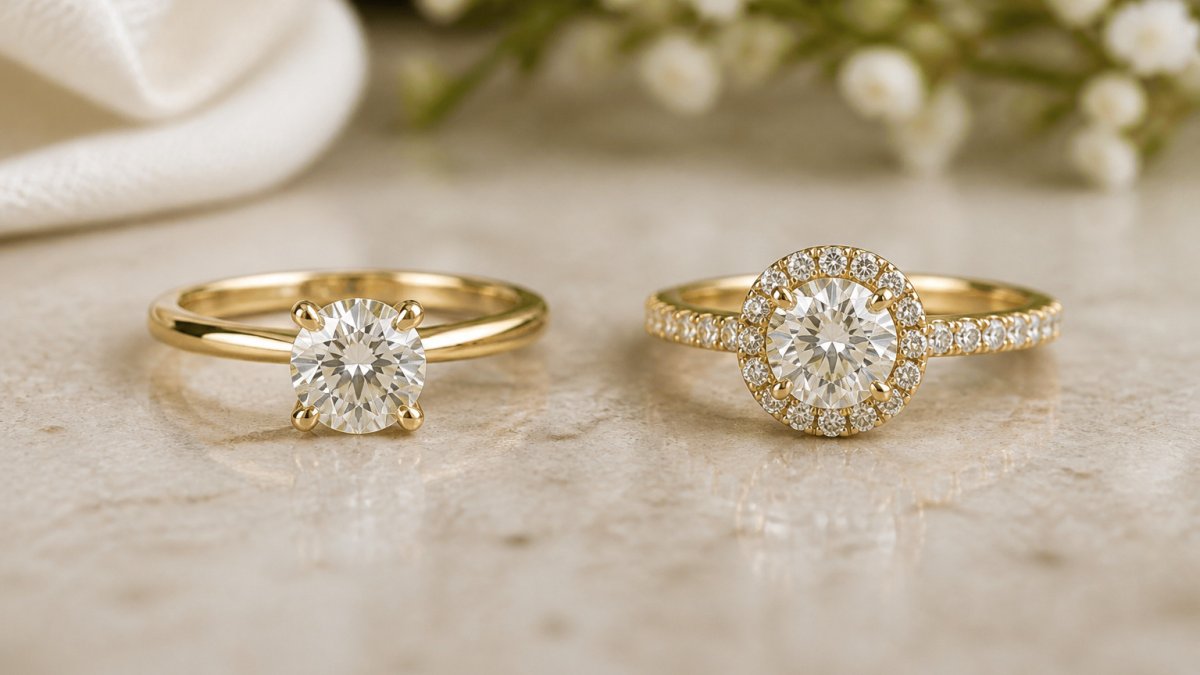
Solitaire vs halo comes down to whether you want the center diamond alone or framed for a larger look. A solitaire keeps all attention on one stone and sits lower on the finger, while a halo surrounds the center with accent stones that add sparkle and visual size.
- A halo often looks larger than a solitaire with the same carat weight.
- Solitaires have fewer stones to clean and typically sit lower on the finger.
- A narrow halo that follows the center stone's outline gives the strongest size illusion.
- At a matched center size, a halo generally costs more than a solitaire.
- Have either setting's prongs inspected every six months and after any hard knock.
Table of Contents
- Solitaire vs Halo Engagement Ring: Quick Comparison
- What Is a Solitaire Engagement Ring?
- Solitaire Engagement Ring Pros and Cons
- Halo Engagement Ring Pros and Cons
- Does a Halo Make a Diamond Look Bigger?
- Cost, Wearability and Maintenance Compared
- How to Clean a Halo Engagement Ring
- Choosing Your Setting and Booking Your Ring
- Frequently Asked Questions
Solitaire vs Halo Engagement Ring: Quick Comparison
When weighing solitaire vs halo engagement rings, the core question is whether you want the center diamond to stand alone or framed to look larger? The answer depends on what matters most to the wearer.
A solitaire suits buyers who want simplicity and a clean profile. A halo suits buyers who want maximum visual impact from a smaller carat weight.
| Factor | Solitaire | Halo |
|---|---|---|
| Center stone focus | Full attention on one diamond | Shared with accent stones |
| Perceived size | Depends on carat and cut | Often looks larger |
| Profile height | Typically lower | Typically higher |
| Style | Classic, minimal | Glamorous, detailed |
| Maintenance | Fewer stones to clean | More stones to clean |
What Is a Solitaire Engagement Ring?
A solitaire engagement ring is a ring with one center diamond held in a setting with no side stones. The stone sits on prongs or a bezel above a plain or lightly detailed band.
Our 2ct Round Lab Diamond Solitaire Engagement Ring is a good example. It pairs a 2.00-carat round lab-grown diamond graded D color and VS1 clarity with 14K yellow gold.
Solitaire Engagement Ring Pros and Cons
Pros:
- Clean, timeless look that suits almost any style
- Full focus on the center stone's cut, color, and clarity
- Lower profile, which many wearers find more comfortable for daily activity
Cons:
- A center stone of the same carat weight may look smaller than a halo version
- Less sparkle from the setting itself
- Little room for decorative detail
Best for: Buyers who value simplicity and want their budget focused on the center diamond. Skip if: You want the ring to look as large as possible at a lower carat weight.
Halo Engagement Ring Pros and Cons
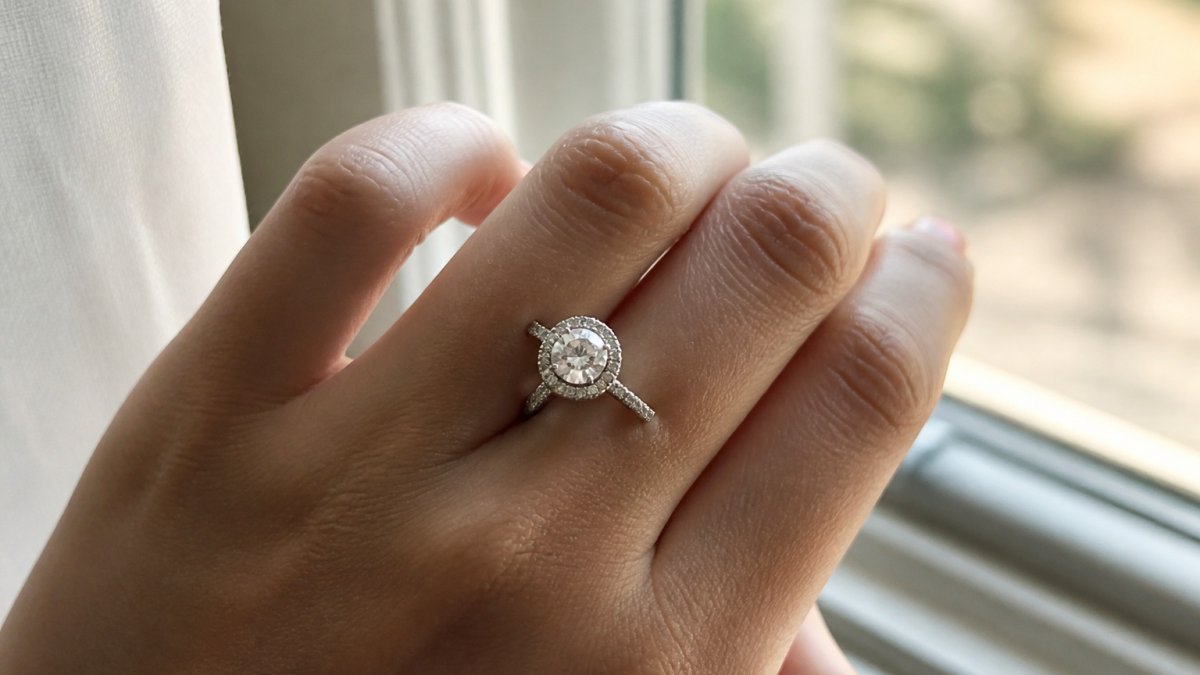
A halo ring places a ring of smaller diamonds around the center stone. Our 4.05 TCW Round Diamond Engagement Ring uses a 3.00-carat center with 1.05 carats of pavé accents in 14K white gold.
Pros:
- Makes the center stone appear larger than its carat weight
- Adds sparkle and brilliance from multiple light sources
- Many style options, from classic to modern
Cons:
- Costs more than a solitaire of the same center size, because of the extra stones
- More surfaces that can collect dirt and need periodic cleaning
- The raised profile can catch on fabrics or other surfaces
Best for: Buyers who want visual size and sparkle from a smaller center stone. Skip if: You prefer a minimal look or plan to wear the ring with very active hands every day.
Does a Halo Make a Diamond Look Bigger?
A halo can make the center diamond read as larger than its carat weight, though the effect varies with the stone's shape. Whether a halo flatters a stone or swallows it depends on halo width, the outline of the center stone, and how the two are proportioned.
How the effect actually works
The halo is a ring of small accent stones set around the center stone's girdle. Because those accents sparkle at the same visual plane as the center, the eye reads the outer edge of the halo, not the edge of the center stone, as the size of the diamond. The center stone's carat weight and grading do not change; only the perceived footprint does.
Two things generally affect how strong that effect is:
3 Carat Round Solitaire Engagement Ring | 14K Yellow Gold | D/VS1 IGI Certified →
- Halo width. A narrow halo (roughly 1 to 1.5 mm of accent stones) adds a subtle size bump and keeps attention on the center. A wider halo adds more visual mass but starts to compete with the center stone.
- Contrast and outline. A halo that follows the center stone's exact outline reads as one larger shape. A halo in a contrasting metal or a mismatched outline reads as a separate frame, which can look intentional but does not create the same seamless size illusion.
Shape-by-shape proportions
Halo proportions are not one-size-fits-all. The same halo width that flatters a round stone can overwhelm a pear or a small oval.
- Round. The most forgiving shape for a halo. A round center with a round halo reads as a clean, larger circle. Narrow halos keep it classic; wider halos push it toward vintage.
- Oval. A halo that follows the oval's elongated outline adds length as well as width, which can make the stone look noticeably larger. Watch the ratio: an overly wide halo on a slender oval can make it look rounder than intended.
- Cushion. Cushion cuts already have a soft, pillowy outline, and a halo that echoes it can look very substantial. Keep the halo narrow so the cushion's corners stay visible.
When a halo helps, and when it overwhelms
A halo is most effective when the center stone is large enough to anchor it.
Key Takeaway
A halo does not make a diamond bigger, it makes the diamond read bigger. The illusion works best with a narrow halo that follows the center stone's outline, and it works least well when the halo is wide relative to a small or unusually shaped center.
How to judge it for yourself
Compare the same center carat weight in a solitaire and a halo side by side, ideally in the same shape and metal. Look at the ring from arm's length, not just up close, the perceived-size effect is strongest at normal viewing distance and fades under a loupe. If you are shopping online, ask for a photo of the two settings with matched center stones so the comparison is honest.
Cost, Wearability and Maintenance Compared
A halo generally costs more than a solitaire at the same center size, and the two styles differ in upkeep. Neither holds up once you compare like with like. The real differences show up in three places: how the setting is priced at a matched budget, what each style costs to own over time, and how each behaves on a real hand doing real work.
Like-for-like pricing at a matched budget
A halo adds accent stones, extra setting labor, and more prong work, so at the same center-stone carat weight a halo typically costs more than a solitaire. The fair comparison is not "halo vs. solitaire" in the abstract, it is what each style buys you at the same total spend.
- Same center, different total. Our 2ct Round Lab Diamond Solitaire Engagement Ring is priced at $2,200.00. Our 2.75ct Round Lab Diamond Pavé Engagement Ring, which pairs a 2ct center with pavé accents, is priced at $2,600.00.
- Same budget, different center. A buyer with $2,600.00 to spend can put all of it into a solitaire's center stone or split it between a slightly smaller center and a halo. The solitaire wins on carat weight per dollar; the halo wins on perceived size per dollar.
- Where the money goes. On a solitaire, the overwhelming share of the price sits in the center diamond and the metal.
Pro Tip
When you compare two rings, hold the center stone constant first, then hold the total budget constant. The style that wins the first comparison is rarely the style that wins the second, and the second is the one you actually shop.
Total cost of ownership
The sticker price is not the whole number. Both styles need periodic professional inspection, but the halo carries more small parts that can loosen, chip, or need replacement.
- Prong and pavé checks. A solitaire has four to six center prongs to inspect. A halo can have a ring of a dozen or more small accent stones, each in its own tiny setting, plus the pavé on the band if you choose it. More settings means more checkpoints at each inspection.
- Accent-stone replacement. Small accent diamonds are inexpensive individually but not free to source, set, and refinish. A lost pavé stone on a halo is a routine repair; a lost center stone on a solitaire is a rare but far more expensive event, which is why insurance and prong checks matter on both.
- Rhodium and refinishing. White gold halos often show wear at the high-traffic edges of the halo and band, and re-plating is a recurring cost that solitaire owners in yellow gold or platinum may never face.
Real-world wearability by routine
Style aside, the setting has to survive your hands. The practical questions are height, snag risk, and how often the ring comes off.
- Active hands and gym use. A low-set solitaire in a bezel or a low four-prong basket sits closer to the finger and snags less on equipment, straps, and pockets. A raised halo presents a wider edge that can catch on fabric and knits.
- Gloves and repeated handwashing. Healthcare, food service, and lab work mean frequent glove changes and washing. A lower-profile solitaire is easier to glove over and less likely to trap moisture under the setting. A halo can be worn, but it needs more drying attention underneath.
- Desk and keyboard work. Both styles are fine, but a tall halo can scrape on a keyboard edge and rotate on the finger. A lower solitaire tends to sit more stably.
Watch Out
Whichever style you choose, have the setting inspected every six months and after any hard knock. Loose prongs and loose pavé are cheap to fix early and expensive to fix after a stone is lost.
The short version
Choose a solitaire if you want the most center-stone carat per dollar and the lowest-maintenance profile for active hands. Choose a halo if you want the largest perceived size per dollar and accept a bit more cleaning, inspection, and small-stone upkeep. Neither is cheaper in every case, the honest comparison depends on whether you are matching the center stone or matching the budget.
How to Clean a Halo Engagement Ring
Clean a halo ring at home with warm water, a few drops of mild dish soap, and a soft brush. Soak for about 20 minutes, brush gently around the stones and under the setting, then rinse and dry with a lint-free cloth. Avoid harsh chemicals, and check the prongs and stones for looseness after each cleaning.
Choosing Your Setting and Booking Your Ring
Start by deciding whether you want simplicity or visual size. If you want the center diamond alone, browse our 3 Carat Round Solitaire Engagement Ring | 14K Yellow Gold | D/VS1 IGI Certified. If you want a larger look with pavé detail, view the 4.05 TCW Round Diamond Engagement Ring | 3 Carat Center | 14K White Gold Pavé | D/VS1 IGI Certified. Every ring includes complimentary resizing, a lifetime warranty on craftsmanship, and 30-day returns, so you can choose with confidence.


Frequently Asked Questions
What are the pros and cons of a solitaire engagement ring?
A solitaire puts the full attention on one center stone, which makes it a clean, timeless choice that suits almost any lifestyle. Its main advantages are simplicity, easy resizing, and a setting that rarely dates. The drawbacks are that a single stone can look smaller than a halo-framed stone of the same carat weight, and the prongs holding the diamond are more exposed to snagging on fabric. Solitaires are also a practical fit for buyers who want to spend the budget on carat weight and quality rather than on decorative accent stones.
Does a halo make a diamond look bigger?
Yes, a halo usually makes the center diamond appear larger because the surrounding accent stones extend the sparkling area and visually widen the face of the ring. The effect depends on the halo's width and the center stone's shape, so a thin halo adds less apparent size than a wide one. A halo does not change the actual carat weight, so a 2-carat halo ring and a 2-carat solitaire weigh the same, but the halo version typically looks bigger from above.
Which engagement ring setting is easier to clean?
A solitaire is generally easier to clean because it has fewer crevices where dirt, lotion and oils can build up. A halo has more small stones and tight gaps around the center diamond, so it needs more regular attention with a soft brush and warm water. Cleaning every few weeks at home keeps both settings bright, and a professional cleaning and prong check once or twice a year helps protect the stones.
Are halo engagement rings more expensive than solitaire rings?
At the same center-stone size and quality, a halo ring usually costs more because it includes additional accent diamonds and more labor to set them. For example, the 3 Carat Round Solitaire Engagement Ring in 14K Yellow Gold is listed at $3,200.00, while the 4.05 TCW Round Diamond Engagement Ring with a 3 Carat Center and 14K White Gold Pavé is listed at $3,500.00. The price gap reflects the added pavé diamonds and setting work, so comparing like-for-like center stones makes the difference clear.
Which setting is better for an active lifestyle?
A solitaire is usually the more practical choice for an active lifestyle because its single stone and low profile are less likely to catch on clothing, gloves or equipment. A halo sits higher and has more stones that can loosen over time with heavy wear, so it benefits from periodic prong and stone checks. Either setting works for daily wear with a 14K gold band, but buyers who work with their hands often lean toward the simpler solitaire design.


