

Cart
0

Last Updated: October 30, 2026
Quick Summary
Mixing gold and silver jewelry works when you anchor the look with one dominant metal and repeat both tones at least twice across your outfit. Aim for a ratio of roughly two to one, giving the dominant metal about two-thirds of the visible pieces and the secondary metal the remaining third.
- Pick the metal covering the most surface area as your anchor before you get dressed.
- A 1:1 split only works when a two-tone piece bridges the two metals.
- Count visible pieces like rings, bracelets, necklaces, studs and watches for the ratio.
- Keep at least two inches between layered necklace lengths so chains never tangle.
- Store gold and silver separately because silver tarnishes faster when it contacts other metals.
Table of Contents
- Why Mixing Gold and Silver Jewelry Works
- How to Mix Gold and Silver Jewelry Without Clashing
- The Gold and Silver Jewelry Ratio That Looks Intentional
- Gold and Silver Jewelry Layering Techniques That Hold Together
- Mixed Metal Jewelry Outfit Ideas for Real Occasions
- Metal Quality, Plating, and Skin Sensitivity
- Build Your Mixed-Metal Collection at Native Jewel
- Frequently Asked Questions
Why Mixing Gold and Silver Jewelry Works
Mixing gold and silver jewelry is the practice of wearing both metal tones in one look, and it works because contrast, not uniformity, is what makes an outfit read as styled rather than assembled.
This guide covers the ratio, the layering rules, the outfit combinations, and the metal-quality questions that decide whether your gold and silver pieces wear well together over time.
The Warm and Cool Balance
Gold reads warm. Silver reads cool. Put them side by side and each makes the other look more like itself, which is why a single silver ring beside a gold chain draws the eye in a way two gold pieces never would.
That contrast is the entire point. A balanced look uses it as visual interest rather than fighting it.
How to Mix Gold and Silver Jewelry Without Clashing
To mix gold and silver jewelry without clashing, anchor the look with one dominant metal and repeat both tones at least twice across the outfit. Two rules carry most of the work, and everything else is detail.
Anchor With One Dominant Metal
Pick the metal that covers the most surface area and let it lead. If your engagement ring and wedding band are white gold, white gold is your anchor, and gold elements become accents. Giving both metals equal visual weight in three or four places at once can read as indecision rather than style.
Decide the anchor before you get dressed, not after. It takes ten seconds and prevents the whole outfit from feeling unresolved.
Repeat Both Metals Across Your Outfit
One gold piece and one silver piece looks like a mistake. One gold piece and three silver pieces, with gold returning at the wrist or ear, looks like a decision.
Repeat each metal at least twice. The repetition is what turns a metal combination into a layered look, and it gives the eye a pattern to follow from neckline to hand.
The Gold and Silver Jewelry Ratio That Looks Intentional
The most reliable gold and silver jewelry ratio is roughly two to one. Give the dominant metal about two-thirds of the visible pieces and the secondary metal the remaining third.
| Ratio | What It Looks Like | Best For |
|---|---|---|
| 2:1 dominant | Two gold pieces, one silver accent | Everyday wear, office |
| 3:1 dominant | Three silver pieces, one gold accent | Minimalist personal style |
| 1:1 balanced | Equal amounts of each metal | Two-tone pieces as the bridge |
| 4:1 accent | Mostly one metal, single contrast piece | Formal occasions |
A 1:1 split only works when something else ties the two together, usually a two-tone watch, a mixed-metal chain, or a piece that contains both tones in one design. Without that bridge, equal amounts tend to look unresolved.
How to Count Pieces for the Ratio
The ratio is about visible pieces, not total weight or value. Count each distinct item a viewer would register: a ring, a bracelet, a necklace, a pair of studs, a watch. A pair of earrings counts as one piece if the two earrings match.
A common pattern is to count only what shows above the waist for necklaces and earrings, then count wrist and hand pieces separately.
A Beginner's Decision Framework
Use this repeatable sequence before you get dressed:
- Pick the anchor metal. Choose the metal of the piece you never take off, usually a ring or watch. That metal gets the larger share.
- Count your visible pieces. Tally necklaces, earrings, bracelets, rings, and watches you plan to wear.
- Assign the ratio. Aim for roughly two-thirds anchor metal and one-third contrast metal. If you are between counts, round toward the anchor.
- Place the contrast where it gets seen. Put the secondary metal near the face or at the wrist, not hidden under a sleeve.
- Add a bridge if the split is close to even. A two-tone watch, a mixed-metal chain, or a piece with both tones resolves a 1:1 look.
Troubleshooting an Unbalanced Look
If a mixed-metal outfit feels off, the cause is usually one of three things:
- Too many equal-weight focal points. Two or three pieces of similar size in different metals compete. Make one piece clearly larger or smaller than the rest.
- The contrast metal appears only once. A single silver ring among gold everything reads as an accident. Repeat the silver at the wrist or ear.
- The bridge is missing. When the split is close to even and nothing contains both tones, add a two-tone piece or shift one item to the dominant metal.
A quick fix that most stylists use: remove one piece rather than adding one. Fewer pieces with a clear ratio almost always look more intentional than a crowded stack.
Pro Tip
Before buying a new piece to fix a ratio problem, lay out what you already own on a flat surface and count by metal. Most people find they already have the contrast piece they need.
Gold and Silver Jewelry Layering Techniques That Hold Together
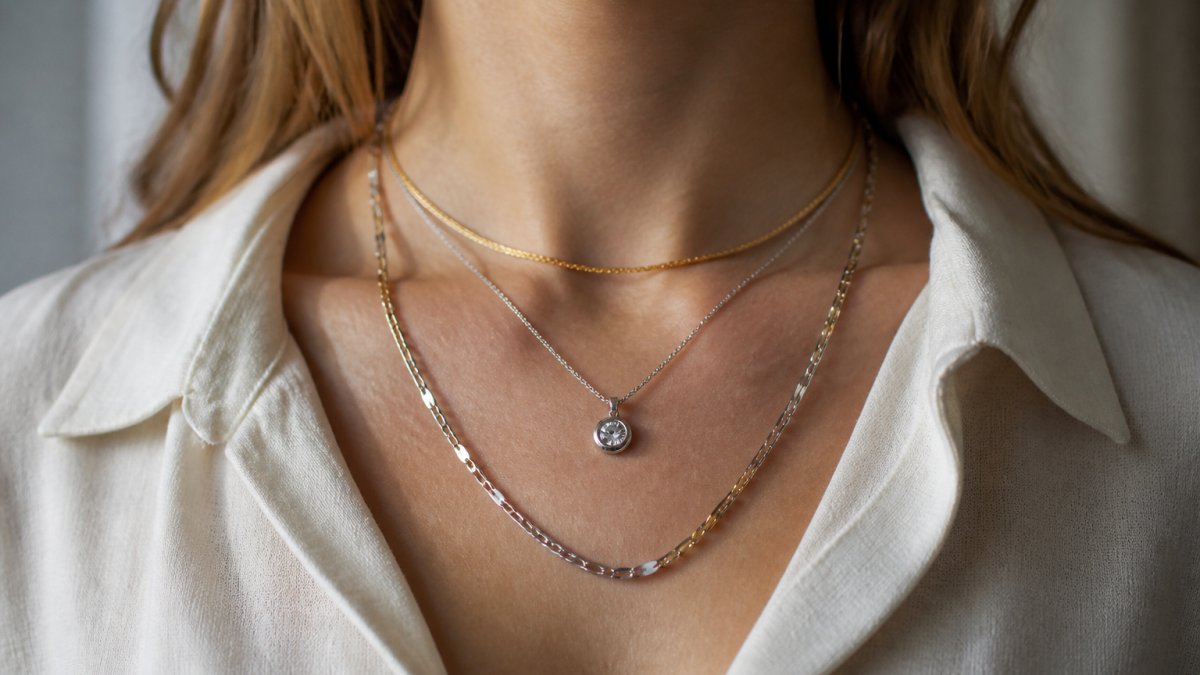
Gold and silver jewelry layering works when each layer has a job: a choker or short chain at the collarbone, a mid-length pendant as the focal point, and a long necklace to finish the line.
Necklace Layering by Length
Start with a choker or 16-inch chain, add an 18-inch pendant, then finish with a 20-inch or longer chain. Keep at least two inches between each length. If two chains sit at the same point, they compete and tangle.
Alternate the metals as you go: gold, silver, gold. That rhythm reads as intentional styling rather than an accident of whatever was in the jewelry box.
Stacking Rings and Bracelets
A ring stack holds together when the bands share a similar size and style but differ in metal. Keep bands within about 2mm of each other in width, and put the contrast piece in the middle of the stack rather than at the edge.
Bracelet stacks follow the same logic. Pair a gold chain bracelet with a silver one of comparable weight, and add a watch as the anchor piece.
12.50ct Diamond Tennis Bracelet | 4mm Diamonds | 14K White Gold | 7 Inch →
Mixed Metal Jewelry Outfit Ideas for Real Occasions
Mixed-metal jewelry outfit ideas work best when you match the metal mix to the formality of the occasion. A gold and silver combination suits a plain white tee as easily as an evening dress, but the pieces and the proportions change. The combinations below assume a two-to-one ratio with the anchor metal listed first.
Work and Office
- Anchor gold: a 16- to 18-inch gold chain, small gold hoops, a gold ring, and a silver accent at the wrist such as a thin silver bangle or a two-tone watch.
- Anchor silver: silver studs, a silver chain, a silver ring stack with one gold band, and a gold accent bracelet.
Keep the contrast piece small and close to the body. Office lighting is flat, so high-contrast pieces read louder than they do outdoors. A two-tone watch is the easiest bridge because it contains both metals in one item.
Formal Events and Evening
- Anchor gold: a gold statement necklace or a gold tennis bracelet, gold drop earrings, and one silver piece such as a silver cuff or a silver ring.
- Anchor silver: a silver tennis bracelet or silver drop earrings, a silver ring, and one gold piece such as a gold chain or a gold band.
Evening looks tolerate a higher contrast because the lighting is directional and the pieces are fewer. Use one focal piece and let the contrast metal appear once or twice as an accent. A 4:1 ratio often looks more polished at a formal event than a 2:1 ratio because the eye has fewer competing points.
Casual and Weekend
- Anchor gold: a gold chain bracelet, a gold ring, and a silver ring stack of two or three thin bands.
- Anchor silver: a silver chain necklace, silver hoops, and a gold ring or gold chain bracelet.
Casual outfits can carry a closer ratio because the clothing is simpler. A 1:1 split works here if a two-tone piece, such as a mixed-metal chain or a watch with both tones, ties the look together.
Travel
Pack one anchor metal and one contrast piece rather than a full set of each. A two-tone watch or a mixed-metal chain lets you shift the ratio without packing extra items. Choose pieces you can wear in the shower and at the beach only if they are solid gold or sterling silver; plated and vermeil pieces should come off before swimming and showering.
Matching the Mix to Dress Code
- Business formal: keep the contrast metal to one or two small pieces and favor a 3:1 or 4:1 ratio.
- Business casual: a 2:1 ratio with a two-tone watch as the bridge works in most offices.
- Smart casual: a 1:1 or 2:1 ratio with visible contrast at the wrist and neck.
If you're building everyday looks you can wear indefinitely, luxury everyday fine jewelry pieces to wear forever is worth reading before you buy.
Key Takeaway
The occasion changes the ratio more than it changes the metals. Formal settings reward fewer, larger pieces with a strong anchor; casual settings can carry a closer split if a two-tone piece bridges the look.
Metal Quality, Plating, and Skin Sensitivity
Metal quality decides whether a mixed-metal look survives daily wear.
Skin sensitivity matters here too. For guidance on gold that's safe for sensitive skin and won't tarnish, see best gold jewelry for sensitive skin that won't tarnish.
If you're deciding between solid gold and a plated finish, this comparison of 14K gold vs gold vermeil for everyday jewelry lays out the durability trade-off directly.
Watch out: buying a plated piece for a daily-wear stack is the most common way a mixed-metal collection degrades.
Caring for Mixed-Metal Pieces
Store gold and silver separately, or in individual pouches, because silver tarnishes faster when it contacts other metals. Remove pieces before swimming, showering, and cleaning, and wipe them with a soft cloth after wear rather than polishing aggressively.
Stacked rings and layered chains scratch each other more than single pieces do. For practical prevention, these tips on how to prevent scratches on gold jewelry apply directly to any mixed-metal stack.
Build Your Mixed-Metal Collection at Native Jewel
Building a mixed-metal collection starts with one anchor piece you'll wear constantly, then one contrast piece in the other tone.
A yellow gold tennis bracelet pairs naturally with white gold rings and gives you the warm accent a mostly white-gold collection lacks. The 12.50ct diamond tennis bracelet in 14K yellow gold and the white gold version come in warm and cool metal tones.


Product listings note a lifetime warranty on craftsmanship, 30-day returns, and free shipping on eligible orders. If you're starting with the ring that everything else coordinates around, our 2.75ct elongated emerald lab diamond ring in 14K white gold is IGI-certified, and complimentary resizing is included after purchase.

Frequently Asked Questions
Can I wear both gold and silver together?
Yes. Mixing gold and silver is a deliberate styling choice, not a mistake, and it has been a steady trend in fine jewelry for years. The trick is to make the combination look intentional rather than accidental. Pick one metal as your anchor, then add the second in smaller amounts through a bracelet, a ring, or a two-tone chain. Repeating both metals somewhere else in your outfit, such as a gold buckle and silver earrings, ties the whole look together.
What is the best ratio between gold and silver?
A 70/30 split is the easiest starting point. Wear roughly 70 percent of one metal and 30 percent of the other, so the look reads as one dominant tone with a deliberate accent. If you prefer a more even mix, a 60/40 ratio still looks balanced. Avoid a strict 50/50 unless your pieces share a similar size and style, because equal amounts of two very different metals can compete for attention instead of working together.
How do you mix gold and silver jewelry without clashing?
Match size and style before you match metal. Thin gold chains sit comfortably next to thin silver chains, while a chunky silver cuff pairs better with a substantial gold ring. Use a two-tone piece, like a bracelet with both metals in the clasp or links, as a bridge between the two. Also check the undertone of your metals: bright yellow gold and cool sterling silver contrast sharply, while softer 14K yellow gold and brushed silver feel calmer together.
Can you wear a gold necklace with a silver necklace?
You can, and layering is one of the best ways to do it. Keep the chains at different lengths so they do not tangle, for example a 16-inch choker in silver with a 20-inch gold pendant below it. Vary the thickness too, so one chain leads and the other supports. A two-tone or mixed-metal pendant in the middle layer makes the transition between the gold and silver look purposeful rather than random.
How do you layer gold and silver rings?
Start with one anchor ring on your index or middle finger, then build outward with thinner bands in the other metal. Keep the stack to three or four rings per hand so the proportions stay balanced. Mixing a plain 14K gold band with a pavé diamond band, such as the 0.75ct Pavé Diamond Wedding Band in 14K White Gold, gives you a two-tone stack.
Does mixed-metal jewelry tarnish or wear faster?
Solid 14K gold and sterling silver do not tarnish each other, but plated or costume pieces can. When two different plated metals rub against each other, the plating wears through faster, especially on rings and bracelets that see daily friction. Store mixed-metal pieces separately in soft pouches, and put jewelry on last after lotions and perfume to limit buildup.
The hardest part of mixing metals isn't the styling rule. It's building a collection where every piece is good enough to wear every day, in both tones, for years. Native Jewel makes that simpler with handcrafted 14K gold designs, IGI-certified lab-grown diamonds, a lifetime warranty on all diamond jewelry, and 30-day hassle-free returns. Get started with Native Jewel and build a mixed-metal collection you'll actually wear.


