

Cart
0
Last Updated: October 31, 2026
Quick Summary
To store fine jewelry without scratches, give each piece its own separate, lined compartment, pouch, or ring roll so nothing rubs against metal or stones. Clasp chains and hang them where possible, keep gold and silver apart, and store the box in a dry room away from humidity.
- Scratches mostly come from pieces contacting each other, friction from sliding chains, and trapped grit.
- Use felt, velvet, or microfiber linings and replace any worn lining that sheds fibers.
- Clasp every necklace before storing it, then hang it or lay it flat in its own pouch.
- Keep gold and silver in separate compartments, because silver tarnish can transfer to nearby gold.
- Avoid paper towels or tissues as liners, and never store jewelry in the bathroom.
Table of Contents
- Why Fine Jewelry Scratches in Storage and What Causes It
- Choosing the Best Jewelry Storage for Fine Jewelry
- How to Store Necklaces to Prevent Tangling and Scratches
- How to Store Gold and Silver Jewelry Separately
- Step-by-Step Packing Routine for Fine Jewelry
-
Storage Mistakes That Cause Scratches
- Mistake: tossing rings and chains into one dish
- Mistake: leaving chains loose in a drawer
- Mistake: overcrowding compartments
- Mistake: using paper towels or tissues as a liner
- Mistake: storing jewelry in the bathroom
- Mistake: putting gold and diamonds together without padding
- Mistake: exposing clasps and prongs
- How to Travel with Fine Jewelry Without Scratches
- Checking Stored Jewelry and Booking Your Next Care Step
- Frequently Asked Questions
Why Fine Jewelry Scratches in Storage and What Causes It
Fine jewelry scratches most often when pieces rub against each other inside a drawer or box, and this is the most common way to damage a store fine jewelry collection. Gold is soft, so even light contact can leave fine marks over time. A beautiful 14K gold chain tossed in with a diamond ring can come out with tiny surface lines over time.
Gold jewelry is an alloy. 14K gold is mixed with harder metals like copper and silver, which makes it sturdier than 24K gold. Diamonds are extremely hard, yet they can chip a softer metal setting or scrape a neighboring piece.
Most scratches come from three everyday causes:
- Contact: pieces touching each other in a drawer
- Friction: chains sliding back and forth when a drawer opens and closes
- Grit: dust or small particles trapped between pieces
Once you understand these causes, prevention becomes much simpler. The goal is to keep each piece separate, still, and clean.
Choosing the Best Jewelry Storage for Fine Jewelry
The right storage depends on what you own and how often you wear it, but the material of the storage itself matters as much as the layout. A box with perfect compartments can still scratch jewelry if the lining is abrasive or the wood is untreated. Use this guide to choose storage that protects each piece rather than merely holding it, whether you are organizing a home collection or a store fine jewelry display.
Match storage to what you own
- Everyday pieces (14K gold chains, studs, simple bands): a lined box with individual slots and a closing lid is the most practical choice.
- Delicate chains and pendants: hooks or a hanging bar keep links from rubbing; a soft pouch works for travel.
- Rings with raised settings: ring rolls or deep slots so the stone never rests against metal or another stone.
- Pearls, opals, and other soft or porous stones: their own soft pouch, never loose in a shared compartment.
- Silver and gold-plated pieces: anti-tarnish-lined compartments or bags, kept apart from other metals.
Choose safe storage materials
The lining and structure of a box can cause scratches on their own. Compare the common options:
- Felt, velvet, and microfiber linings: soft and cushioning. Check that the lining is smooth, not pilled or gritty; worn lining sheds fibers that trap grit.
- Untreated wood: can release acids and moisture over time and may tarnish silver. If you love a wooden box, confirm the interior is lined rather than bare wood.
- Plastics and acrylic trays: fine for short-term sorting, but hard plastic edges and seams can scuff soft gold. Avoid bare plastic compartments for daily storage of polished pieces.
- Anti-tarnish fabrics and strips: useful for silver and gold-plated jewelry, but they do not cushion. Pair them with a soft pouch or lined slot so the piece is protected from contact as well as tarnish.
- Paper towels, tissues, and cotton balls: common DIY liners that leave lint and trap grit. Skip them.
Watch Out
Abrasive or shedding liners cause the same fine surface lines as pieces rubbing together. If a lining feels rough or leaves fibers on your fingers, replace it before storing anything valuable in that compartment.
Features worth paying for
- Soft, smooth lining that cushions each piece
- Separate slots or ring rolls so stones and metal never touch
- Hooks or bars for necklaces
- A closing lid that blocks dust and slows tarnish
- Removable trays or pouches so you can reconfigure storage as your collection changes
Avoid bare metal trays, loose tangled bags, and overcrowded compartments. Those are the most common sources of surface damage. A simple lined box with individual slots is often the best value for everyday pieces, and a set of soft pouches covers the rest without a dedicated box.
How to Store Necklaces to Prevent Tangling and Scratches
Necklaces tangle fast, and tangled chains rub against each other and leave marks. Hang them whenever you can, using a hook or a bar inside the box. For longer chains, lay each one flat in its own soft pouch.
Follow these steps:
- Clasp the necklace closed before storing it, so it doesn't snag.
- Hang it on a hook or lay it in a separate compartment.
- Keep pendants away from other chains.
- Check the clasp occasionally to make sure it still holds.
These small habits keep chains smooth and prevent the friction that causes most necklace scratches.
How to Store Gold and Silver Jewelry Separately
Gold and silver should never share the same compartment. Silver tarnishes when it reacts with sulfur in the air, and that tarnish can transfer to nearby gold. Gold is more resistant to tarnish, but it still scratches when it rubs against silver.
Store them apart by:
- Using separate compartments or pouches for each metal
- Placing silver in an anti-tarnish bag or with an anti-tarnish strip
- Keeping gold in a lined section away from silver pieces
This separation protects both metals and keeps your collection looking its best. For a deeper look at mixing metals safely, see our guide on mixing gold and silver jewelry.
Step-by-Step Packing Routine for Fine Jewelry
A consistent routine prevents most storage damage. Try this method every time you take off a piece.
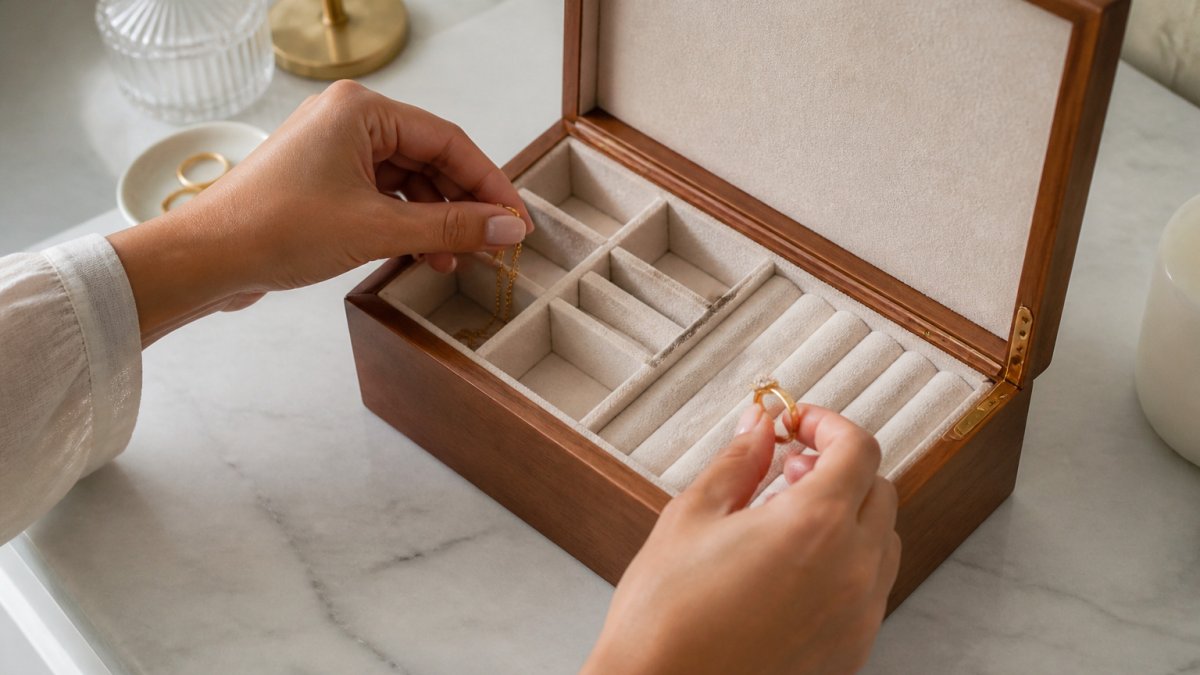
![Hands placing a gold chain and a ring into individual compartments of a lined wooden jewelry box on a vanity table]
- Clean the piece. Wipe it with a soft, dry cloth to remove oils and lotion.
- Dry it fully. Moisture speeds up tarnish, so let it air dry before storing.
- Clasp chains. Close necklaces and bracelets to prevent snagging.
- Place it in its own slot. Give every piece a separate compartment or pouch.
- Close the lid. Keep dust and humidity out.
Doing this takes less than a minute and protects your pieces for years.
Storage Mistakes That Cause Scratches
Most storage scratches come from a handful of habits that seem harmless. Each one has a specific mechanism and a specific fix.
Mistake: tossing rings and chains into one dish
What happens: metal rubs against metal every time the dish is touched, and a diamond can scrape the gold band beside it. Fix: give each piece its own slot, ring roll, or pouch. If you use a dish for a single ring overnight, keep it to one piece.
Mistake: leaving chains loose in a drawer
What happens: loose chains tangle, and the friction of links sliding against each other dulls the surface. A clasp can also snag a neighboring chain and bend it. Fix: clasp every chain before storing, then hang it or lay it flat in its own pouch.
Mistake: overcrowding compartments
What happens: pieces press against each other and grit trapped between them acts like sandpaper when the box moves. Fix: leave space between pieces. If a compartment is full, add a pouch rather than squeezing in one more item.
Mistake: using paper towels or tissues as a liner
What happens: paper fibers and trapped grit create fine scratches, and tissue can leave lint on polished surfaces. Fix: use felt, velvet, or microfiber, and replace worn lining.
Mistake: storing jewelry in the bathroom
What happens: steam and humidity speed up tarnish on silver and gold-plated pieces, and moisture left on metal encourages surface damage. Fix: store jewelry in a dry room away from the shower and sink.
Mistake: putting gold and diamonds together without padding
What happens: a diamond is hard enough to chip a softer gold setting or scrape a neighboring piece. Fix: give stones their own slot, and keep diamond pieces from resting against gold.
Mistake: exposing clasps and prongs
What happens: an exposed clasp can snag fabric or another chain, and a loose prong can catch on lining and bend. Fix: clasp chains, tuck pendants into their own space, and check prongs periodically for looseness.
Pro Tip
Do a quick audit once a month: open the box, look for pieces touching, grit in the lining, or a clasp left open. Fixing one of these takes seconds and prevents most surface damage.
For more on what to avoid with gold pieces, read our article on preventing scratches on gold jewelry. A guide to cleaning diamond jewelry safely can also help if your stored pieces look dull.
The most common storage habits that cause scratches, with the fix for each.
| Mistake | Cause | Fix |
|---|---|---|
| Tossing rings and chains into one dish | Metal rubs against metal | Give each piece its own slot, ring roll, or pouch |
| Leaving chains loose in a drawer | Links slide and tangle | Clasp chains, then hang them or lay flat in a pouch |
| Overcrowding compartments | Pieces press together and trap grit | Leave space between pieces or add a pouch |
| Using paper towels or tissues as a liner | Paper fibers and trapped grit | Use felt, velvet, or microfiber and replace worn lining |
| Storing jewelry in the bathroom | Steam and humidity speed up tarnish | Store in a dry room away from the shower and sink |
| Putting gold and diamonds together without padding | Diamond is hard enough to chip softer gold | Give stones their own slot and keep them off gold |
| Exposing clasps and prongs | Clasps snag fabric and loose prongs catch lining | Clasp chains, tuck pendants away, and check prongs |
How to Travel with Fine Jewelry Without Scratches
Travel raises the risk of scratches because pieces move around in luggage. Pack smart to keep them safe.
- Use a hard travel case with individual compartments
- Put each piece in its own soft pouch inside the case
- Carry rings in a ring roll so they can't rub together
- Pack chains hanging or flat, never loose
Keep your most valuable pieces in your carry-on bag rather than checked luggage.
Checking Stored Jewelry and Booking Your Next Care Step
Check your stored pieces every few months. Look for new scratches, dullness, or loose clasps. Wipe pieces gently with a soft cloth, and replace any worn lining that could damage metal.
For guidance on caring for the jewelry you already own, contact us. Browse our fine jewelry collection to explore current pieces.
Frequently Asked Questions
How should fine jewelry be stored to prevent scratching?
Store each piece separately so metal and stones never touch. Use a lined jewelry box with individual compartments, cushioned ring slots, or soft pouches for delicate items. Keep the box closed, away from direct sunlight, heat and bathroom humidity. Harder stones such as diamonds can scratch softer metals and other gems, so give each diamond piece its own space. Check the lining periodically, since worn fabric can trap grit that causes scratches.
Should fine jewelry be stored in separate bags or compartments?
Yes. Separate bags or compartments are the most reliable way to prevent scratching. Soft pouches protect delicate chains and earrings, while individual compartments keep rings from rubbing against bracelets or brooches. Avoid tossing pieces into one dish together, because even gentle contact over time leaves fine surface marks on polished gold and silver.
Can diamonds scratch other jewelry?
Yes. Diamonds rank 10 on the Mohs hardness scale, which is harder than gold, silver and most gemstones. When a diamond ring rests against a softer metal or stone, it can leave fine scratches over time. Store diamond pieces apart from gold and silver, and keep rings in separate slots so their prongs do not rub against other jewelry.


