

Cart
0

Last Updated: November 1, 2026
Quick Summary
Recycled gold jewelry reuses gold already above ground, so it reduces demand for newly mined gold and supports a circular economy in precious metals. The metal keeps the same purity and karat as mined gold, but recycled claims can be hard to verify without seller documentation.
- Gold can be melted, purified, and reshaped endlessly without losing quality.
- Recycled gold avoids the extraction stage entirely, though refining still uses energy and chemicals.
- Ask who refined the gold and request a written statement of recycled content.
- Choose the karat first, since it drives durability and cost.
- 14K gold is 58.5% pure gold mixed with alloys like copper, silver, or zinc.
Table of Contents
- What Recycled Gold Jewelry Actually Is
- Recycled Gold Jewelry Pros and Cons
- Recycled Gold vs Mined Gold: How They Compare
- Is Recycled Gold Sustainable? A Balanced Look
- How to Verify Recycled Gold Claims Before You Pay
- How to Buy Recycled Gold Jewelry by Piece and Budget
- Choosing Your Recycled Gold Piece at Native Jewel
- Frequently Asked Questions
What Recycled Gold Jewelry Actually Is
Recycled gold jewelry is fine jewelry made from gold that already exists above ground, recovered from old pieces, scrap, and industrial waste, then refined and reused. No new mining happens for that metal.
That distinction matters because gold never wears out. It can be melted, purified, and reshaped endlessly without losing quality. A wedding band from 1970 and a newly refined bar can be chemically identical.
Recycled, Reclaimed, and Responsibly Mined: The Differences
Recycled gold is metal recovered from existing sources and put back into the supply chain. Reclaimed gold usually refers to gold pulled from specific old items, like heirloom jewelry or estate pieces. Responsibly mined gold is newly extracted gold, sourced under stricter environmental and labor standards.
These terms are not interchangeable, and no single US rule defines them all. Ask which one a seller means.
Recycled Gold Jewelry Pros and Cons
The benefits of recycled gold jewelry are real, but so are the limits. What separates a useful pros-and-cons list from a marketing one is specificity: what each benefit actually delivers, and what each drawback actually costs you. Here is the honest balance, with the mechanisms behind each point.
The Real Benefits
-
It reuses a metal that never degrades. Gold can be melted, purified, and reshaped repeatedly without losing quality. A 1970 wedding band and a newly refined bar can be chemically identical at the same karat.
-
It reduces demand for newly mined gold. Every ounce of recycled gold put back into jewelry is an ounce that does not need to be extracted, which lowers pressure on mining at the margin.
-
It supports a circular economy in precious metals. Old jewelry, scrap, and industrial waste become feedstock instead of sitting in drawers or entering waste streams.
-
It keeps old jewelry in use. Repair, resale, trade-in, and recycling pathways extend the useful life of metal that already exists.
The Real Drawbacks
- "Recycled" claims can be hard to verify. No single federal rule defines the label for jewelry, and enforcement depends on the seller's own documentation.
- No universal certification covers the label. Some sellers use third-party audits; many do not, and the absence of a standard makes comparison difficult.
- Refining still uses energy and chemicals. The benefit is avoiding extraction, not eliminating impact.
Watch Out
The label is only as good as the seller behind it. A recycled claim without documentation is a marketing statement, not a verified fact.
Recycled, Reclaimed, and Responsibly Mined: What Each Label Does and Does Not Guarantee
This is where most buyers get lost, because the three labels are often used interchangeably and none of them means the same thing.
- Recycled gold means metal recovered from existing sources, old jewelry, scrap, industrial waste, or e-waste, and put back into the supply chain. It guarantees the metal is not newly mined. It does not guarantee a specific refiner, a low-impact refining method, or a verified chain of custody.
- Reclaimed gold usually refers to gold pulled from specific old items, such as heirloom jewelry or estate pieces. It is a narrower term than recycled and often implies a known prior owner or source. It does not guarantee ethical handling at the refiner.
- Responsibly mined gold is newly extracted gold sourced under stricter environmental and labor standards, often verified by third-party programs. It guarantees the gold is new, not recycled, and that some standard was applied. It does not mean the mining had no impact.
A practical way to read a seller's claim: ask which of the three labels applies, who refined the metal, and what documentation backs the claim. If the answer is vague, treat the label as marketing rather than fact.
How to Weigh the Trade-Offs
For most buyers, the pros outweigh the cons when three conditions hold: the seller documents the recycled content in writing, the piece carries a clear karat stamp, and the price reflects the sourcing rather than a premium for the label alone. When those conditions are missing, the cons, unverifiable claims and limited traceability, should carry more weight in your decision.
Recycled Gold vs Mined Gold: How They Compare
Recycled gold and mined gold are the same element. The difference is origin, not quality.
Where they diverge is impact. Newly mined gold requires digging, blasting, and chemical processing. Recycled gold skips all of that by reusing metal already in circulation.
| Factor | Recycled Gold | Newly Mined Gold |
|---|---|---|
| Material quality | Same purity, same karat | Same purity, same karat |
| New mining required | None | Yes |
| Energy source | Refining only | Mining plus refining |
| Traceability | Often limited | Varies by mine |
| Typical cost | Often lower | Often higher |
For couples weighing a recycled gold vs mined gold decision, the metal itself performs the same. The choice comes down to sourcing values.
Is Recycled Gold Sustainable? A Balanced Look
Recycled gold is generally the lower-impact choice compared with newly mined gold, but "sustainable" is not the same as "zero impact." The honest answer depends on what you compare, how the metal was refined, and where the original gold came from.
What Recycling Avoids
The environmental case for recycled gold rests on what does not happen. Newly mined gold requires exploration, drilling, blasting, hauling, and chemical processing to move and treat enormous volumes of rock for a very small yield of metal.
The U.S. Environmental Protection Agency's guidance on responsible materials frames source reduction and reuse as core ways to lower resource demand, and recycled gold fits that model: the metal stays in circulation instead of triggering new extraction.
What Recycling Still Costs
Recycling is not impact-free. Refining recycled gold still consumes energy and, depending on the feedstock and refiner, can involve acids and other chemicals to separate gold from alloys and plating. A few practical points matter:
- Refining method matters. Ask which process a refiner uses if you want a fair comparison.
- Feedstock matters. Industrial scrap and e-waste can carry different contamination profiles than estate jewelry, which affects how much processing is needed.
- Transport and logistics matter. Metal often moves between collection points, refiners, and manufacturers, and that movement carries its own footprint.
A common pattern is that recycled gold's advantage is largest when the feedstock is clean, the refiner is efficient, and the supply chain is short. It narrows when metal travels far or requires heavy processing.
A Lifecycle Comparison With Transparent Assumptions
No single number captures the difference, because results depend on refining methods and sourcing. But the directional comparison is consistent:
| Lifecycle stage | Recycled gold | Newly mined gold |
|---|---|---|
| Extraction | None, metal already above ground | Exploration, drilling, blasting, hauling |
| Chemical processing | Refining only (acids, heat, electrolysis) | Mining reagents plus refining (often cyanide or mercury in some operations) |
| Water use | Primarily refining and cooling | Mining, processing, and dust control |
| Waste and tailings | Refining byproducts | Waste rock, tailings, and potential acid drainage |
| Habitat impact | Minimal new land disturbance | Land disturbance at mine sites |
| Energy | Refining and transport | Mining, processing, refining, and transport |
Key Takeaway
The fair claim is not that recycled gold is impact-free. It is that recycled gold avoids the extraction stage entirely, and that its remaining footprint is dominated by refining and transport, both of which vary by refiner and supply chain.
The Caveats Worth Knowing
- "Recycled" does not guarantee low-impact refining. A recycled claim says nothing about the refiner's energy source or chemical handling.
- Traceability is often limited. For most pieces, the chain of custody stops at the refiner, so you cannot always confirm the original source of the metal.
- Recycling does not fix mining's social footprint by itself. It reduces demand for new mining, but it does not remediate existing mine sites or labor conditions.
So is recycled gold sustainable? Yes, with caveats. It lowers environmental harm compared with new mining by skipping extraction, but it is not impact-free, and the size of the benefit depends on refining and sourcing. Treat it as the better option, not a perfect one, and ask sellers to back the claim with specifics rather than adjectives.
How to Verify Recycled Gold Claims Before You Pay
Verification starts with paperwork, not promises. A trustworthy seller should document where the metal came from and who refined it.
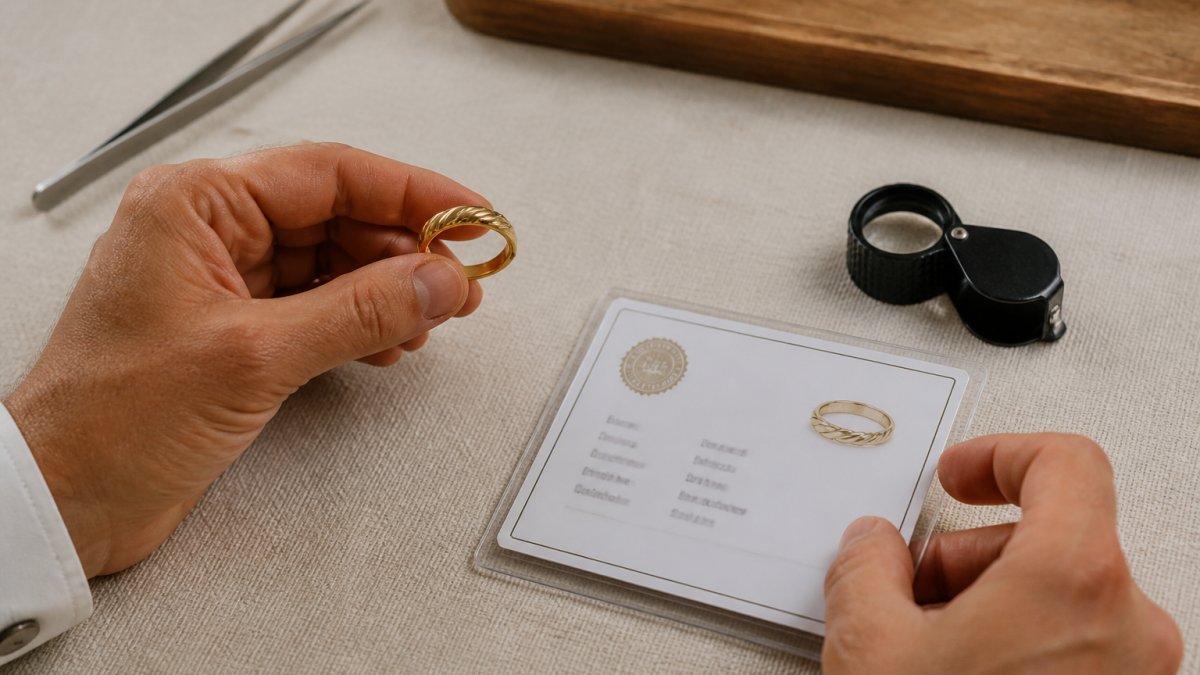
Ask these questions before you buy:
- Who refined the gold, and can they name the refiner?
- Is there a written statement of recycled content?
- Does the piece carry a clear karat stamp?
If a seller dodges these, walk away. For a step-by-step walkthrough, see our guide on how to identify recycled gold jewelry.
How to Buy Recycled Gold Jewelry by Piece and Budget
Match the piece to how you will wear it, then set your budget around karat and design, not the recycled label alone. A simple band and an elaborate setting can use the same metal but land at very different prices.
Start with these buying rules:
- Choose the karat first, since it drives durability and cost
- Pick the piece by wear pattern: daily vs occasional
- Confirm the return window before ordering
For a deeper comparison before you commit, read recycled gold vs mined gold for engagement rings.
Alloys, Allergies, and 14K Durability
14K gold is 58.5% pure gold mixed with alloys like copper, silver, or zinc. Those alloys make it harder and more scratch-resistant than 24K, which is why it suits everyday wear.
Nickel is the usual allergy culprit in gold alloys. Our guide to 14K gold durability for everyday wear covers how the metal holds up over years, and our breakdown of the best gold jewelry for sensitive skin covers tarnish and irritation.
Choosing Your Recycled Gold Piece at Native Jewel
The benefits of recycled gold jewelry come down to one idea: you can own real, lasting gold without adding new mining to the world.
At Native Jewel, we build our collection around that standard. Our pieces use ethically sourced materials and handcrafted design.
When you are ready to choose, browse our 14K gold jewelry collection and buy with the paperwork in hand.
Frequently Asked Questions
Is recycled gold jewelry as good as newly mined gold?
Yes. Gold is an element, so refining does not change its purity or properties. Recycled gold is refined back to the same standard as newly mined gold and can be alloyed to any karat, including 14K. What differs is the supply chain behind it, not the metal itself. Ask for the karat stamp and, for diamond pieces, the certification details so you know exactly what you are buying.
Does recycled gold look different from newly mined gold?
No. Once refined, recycled gold looks identical to newly mined gold of the same karat and alloy. Color comes from the alloy mix, not the source: 14K yellow gold, white gold, and rose gold each get their tone from metals like copper, silver, or palladium. Any visual difference you see between two rings comes down to alloy recipe, finish, and craftsmanship, not whether the gold was recycled.
How can you tell if gold jewelry is recycled?
You cannot tell by looking, so verification comes from documentation. Ask the seller for the refiner's name, a statement of recycled content, and chain-of-custody details. Reputable brands publish sourcing policies and provide certificates with the piece. If a seller claims recycled content but cannot name the refiner or show paperwork, treat the claim as marketing rather than a verified fact.
Can recycled gold be used to make 14K jewelry?
Yes. Recycled gold is refined to fine gold and then alloyed down to 14K, which is 58.5% gold mixed with metals such as copper, silver, or zinc. That makes 14K recycled gold a practical choice for everyday rings and necklaces: it holds up to daily wear better than softer high-karat alloys while keeping a rich color. Confirm the karat stamp and ask about the alloy mix if you have metal sensitivities.
Buying fine jewelry online asks for trust, and trust should be earned with proof. Native Jewel backs every piece with IGI-certified diamonds, ethically sourced 14K gold, a lifetime warranty on diamond jewelry, and 30-day hassle-free returns. Get started with Native Jewel and choose a recycled gold piece you can verify, wear, and keep for years.


