

Cart
0
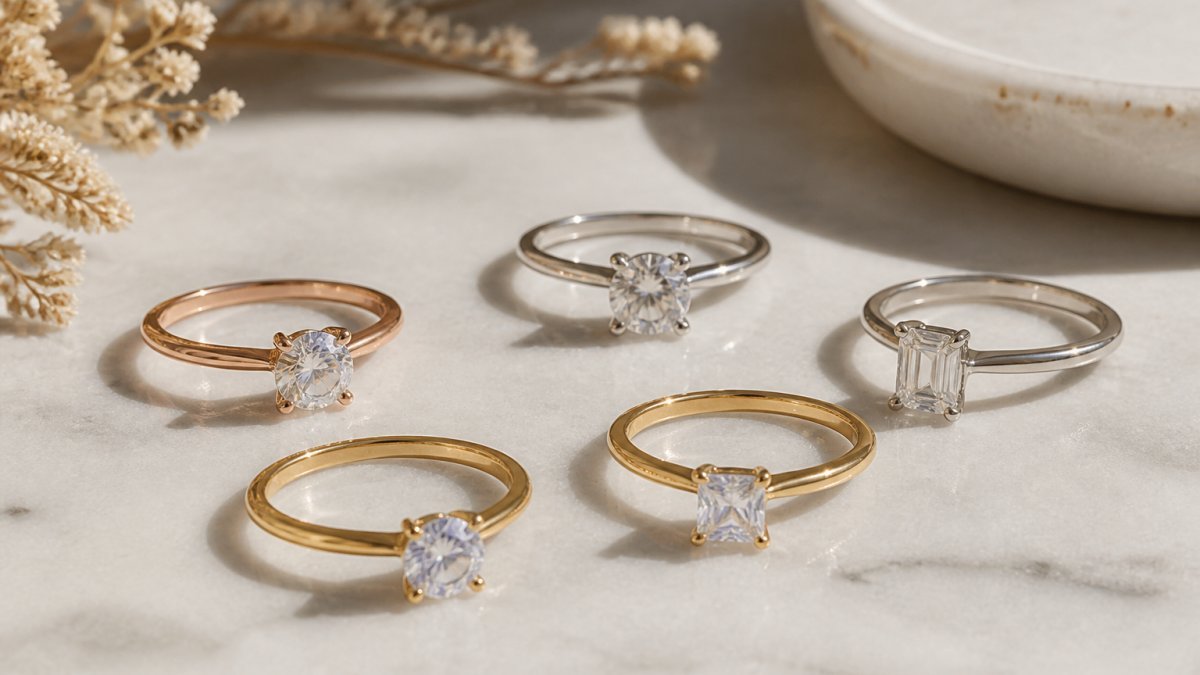
Table of Contents
- What Counts as an Affordable Diamond Solitaire Alternative
- Side-by-Side Cost Comparison of Alternative Stones
- Moissanite Engagement Rings: Maximum Sparkle for the Money
- White Sapphire Engagement Rings: Quiet, Neutral, and Budget-Friendly
- Lab-Grown Diamond Solitaire Rings: The Closest Match to Mined Diamond
- Engagement Ring Gemstone Durability on the Mohs Scale
- Vintage, Recycled, and Colored Stone Options Worth Knowing
- Long-Term Wear, Maintenance, and Repair Costs
- Frequently Asked Questions
Last Updated: October 5, 2026
What Counts as an Affordable Diamond Solitaire Alternative
An affordable alternative to a diamond solitaire ring keeps the single-stone silhouette while swapping the mined center stone for something cheaper. At Native Jewel, we build around one stone, one setting, and no pavé.
The Four Factors That Decide the Price
Four variables drive the price: stone type, carat weight, metal, and setting style.
Stone type matters most: lab-grown diamond, moissanite, white sapphire, and colored gemstones all sit in the same solitaire silhouette at very different prices. Carat weight compounds this, since price climbs faster than size. Metal follows, with 14K gold, 18K gold, and platinum in different tiers. Setting style closes the gap: a plain solitaire uses less metal and labor than a halo.
Why a Solitaire Setting Keeps Costs Down
A solitaire is the cheapest way to make a large stone look expensive: nothing else on the ring costs money.
No pavé means no rows of tiny diamonds to source, set, and inspect; no halo means no second ring of stones. That leaves one prong setting, one band, and one focal point, so the money goes into the center stone instead of the decoration.
Key Takeaway
The setting is where budgets quietly disappear. Two rings with identical center stones can differ by hundreds of dollars purely because one has a pavé band and the other does not.
Side-by-Side Cost Comparison of Alternative Stones
The table compares the main stone options on price and wear. Our solitaire prices are exact; other figures are general market positioning, not quoted retail prices.
| Option | Typical Cost Position | Hardness (Mohs) | Best For |
|---|---|---|---|
| Lab-grown diamond | Lower than mined, same look | 10 | Buyers who want a true diamond |
| Moissanite | Below lab-grown | 9.25 | Maximum sparkle per dollar |
| White sapphire | Below moissanite | 9 | Neutral, understated look |
| Colored gemstone | Varies widely by stone | 7-9 | Buyers wanting color |
| Mined diamond | Highest | 10 | Traditional preference |
Our own lab-grown solitaires sit at defined prices: the 2ct emerald and 2ct radiant start at $2,000, the 2ct oval at $2,100, the 2ct round and 2ct cushion at $2,200, and the 3ct round, marquise, princess, cushion, and radiant at $3,200.

That spread is the point: a buyer can move from a 2-carat emerald-cut solitaire to a 3-carat round solitaire and see exactly what the extra carat and shape cost.
What a Complete Ring Actually Costs at Each Budget
What matters is the total on the receipt: center stone plus setting plus metal plus finishing. Here is how the main paths stack up across three budgets, using general market ranges.
Under $500. Moissanite and white sapphire territory. A 1-carat-equivalent moissanite solitaire in sterling silver or 10K gold commonly lands at $200 to $450; white sapphire sits slightly lower, often $150 to $400.
$1,500 to $3,500. Lab-grown diamonds take over. Our 2-carat solitaires start at $2,000 and the 3-carat range sits at $3,200, putting a certified, well-graded stone within reach of a budget that would buy a much smaller mined diamond.
The Hidden Line Items That Change the Total
Two rings with the same center stone can differ by hundreds of dollars once you add the parts buyers forget to price.
- Metal. Sterling silver is cheapest and softest; 14K gold is the durability-and-price sweet spot; 18K gold and platinum push the total up. Platinum costs more per gram and is denser, adding several hundred dollars over the same design in 14K gold.
- Setting labor. A plain four-prong solitaire is the least labor-intensive head to set. Add a halo, pavé band, or hidden halo and labor and small-stone costs climb quickly.
- Sizing and finishing.
- Certification. A graded, laser-inscribed lab-grown diamond carries a documentation cost an ungraded moissanite does not, small relative to the stone, but real.
Key Takeaway
The sticker price is the center stone. The receipt is the center stone plus metal plus setting labor plus sizing plus certification. Compare complete rings, not stones, or the comparison is meaningless.
How to Compare Two Quotes Like-for-Like
With two quotes in front of you, line up five things: stone type and carat weight, cut grade (or equivalent), metal and karat, setting style, and documentation. A 2-carat lab-grown diamond in 14K gold with an IGI report is not the same product as a 2-carat moissanite in 14K gold with no report. Ask each seller for the same five data points, then compare.
Moissanite Engagement Rings: Maximum Sparkle for the Money
Moissanite engagement rings deliver more visible fire than almost any stone at their price, which is why they dominate budget searches. The trade-off is character: moissanite throws rainbow flashes that read differently from a diamond's white brilliance.
Durability is not the concern: at 9.25 on the Mohs scale, moissanite resists everyday scratches. The real decision is aesthetic.
A common mistake is buying moissanite expecting it to pass as a diamond to a partner who has handled real stones. Be honest about the choice up front. It is a strong one on its own terms.
White Sapphire Engagement Rings: Quiet, Neutral, and Budget-Friendly
White sapphire engagement rings trade sparkle for a clean, neutral look at a lower price.
White sapphire's lower refractive index shows dullness faster, so it needs more frequent cleaning: a quick soak and soft brush every couple of weeks keeps it sharp.
For buyers who want a colorless stone without diamond pricing and do not need maximum flash, white sapphire is a sensible pick. For buyers chasing brilliance, it will feel flat.
Lab-Grown Diamond Solitaire Rings: The Closest Match to Mined Diamond
A lab-grown diamond solitaire ring is the closest match to a mined diamond because the stone is chemically, optically, and physically identical.
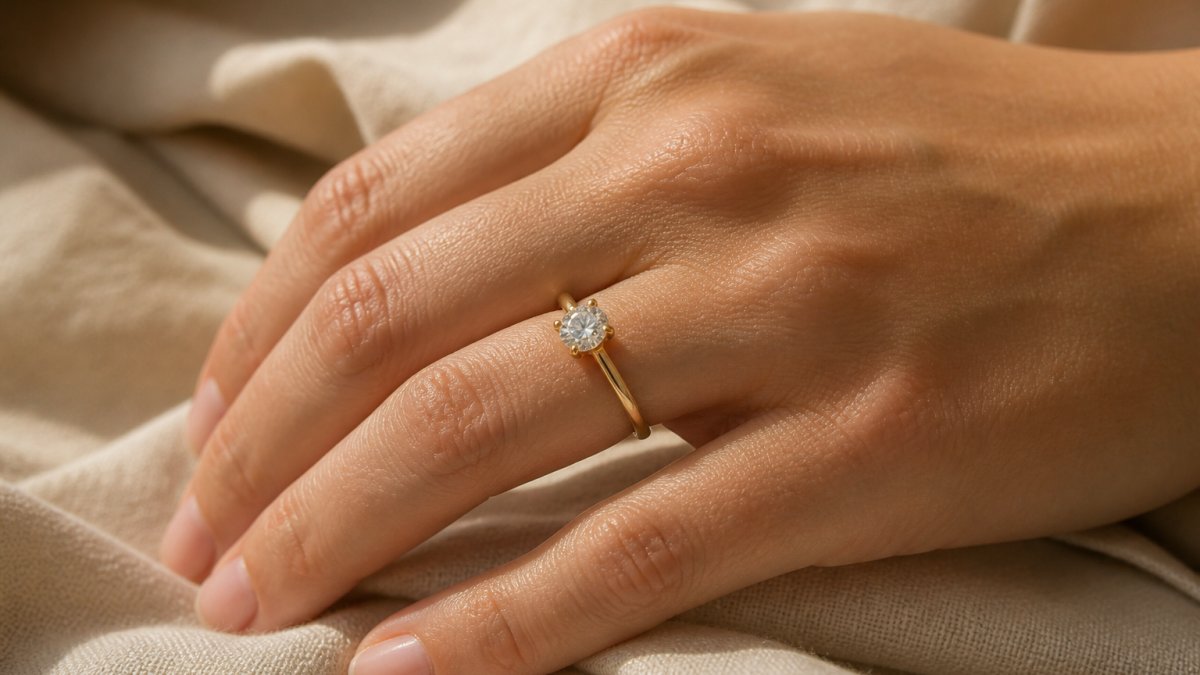
This is where a diamond solitaire stops being a compromise. Our 3.00ct Round Lab Diamond Solitaire in 14K yellow gold carries a D colorless, VS1, excellent-cut stone with IGI certification, and ships with the grading report in the box.
Verification is what buyers ask about most. Every Native Jewel diamond is IGI certified, laser-inscribed, and traceable through the IGI online portal using its unique registry number.
3.00ct Round Lab Diamond Solitaire Engagement Ring | 14K Yellow Gold | D/VS1 →
Pro Tip
Ask for the grading report number before you buy, then look it up yourself on the IGI verification portal. A cert you can independently confirm is worth more than any claim printed on a product page.
Engagement Ring Gemstone Durability on the Mohs Scale
Engagement ring gemstone durability comes down to hardness, ranked by the Mohs scale from 1 to 10. Diamond sits at 10, moissanite at 9.25, sapphire at 9, and most colored gemstones between 7 and 9.
Hardness is not toughness. A hard stone resists scratches; a tough stone resists chipping.
For a daily-wear ring, anything at 9 or above is low-maintenance. Between 7 and 8, expect to be more careful.
The Gemological Institute of America's guide to the Mohs scale explains how the scale measures relative scratch resistance rather than overall durability, which is a distinction most buyers miss.
Hardness, Toughness, and What Actually Breaks a Stone
Hardness and toughness are different properties, and confusing them disappoints buyers. Hardness is resistance to scratching; toughness is resistance to fracturing. A stone can be hard and brittle at once.
- Diamond (10). The hardest natural material, but it has cleavage planes. A sharp blow at the wrong angle can chip it, which is why a well-protected setting matters even for the hardest stone.
- Moissanite (9.25). Hard and reasonably tough, with no cleavage in the same way diamond has. It handles daily wear well and is one of the most forgiving alternatives.
- Sapphire and ruby (9). Corundum is both hard and tough, which is why sapphire is common for daily-wear rings. It resists scratching and chipping better than most colored stones.
- Emerald (7.5 to 8). Hard enough to resist most scratches but heavily included, so it chips and cracks more easily than its number implies. Protective settings and gentle wear are the norm.
- Opal, pearl, and other soft stones (below 7). These scratch easily and are poor choices for a ring worn every day.
Maintenance, Cleaning, and Repair Over a Decade
Long-term cost is where cheap rings stop being cheap.
Cleaning. Most stones need a soak in warm water with mild dish soap and a soft brush every couple of weeks.
Prongs and settings. Prongs wear down with daily contact and typically need re-tipping or tightening every few years.
Rhodium plating. White gold is plated with rhodium for a bright white finish. That plating wears through with daily wear and typically needs re-plating every year or two.
Stone replacement. Replacing a colored gemstone is difficult if the cut or color is unusual, because matching an existing stone is harder than sourcing a new one.
Watch Out
Skipping an annual prong check is the single most expensive mistake ring owners make. A loose prong takes seconds to tighten and a lost center stone costs the price of the stone to replace.
What This Means for Lifetime Value
A stone's Mohs number tells you how it will look after years of wear, not just in the case. A 9-or-above stone in a simple solitaire setting is the lowest-maintenance combination: it resists scratches, holds its polish, and needs little beyond routine cleaning and an annual prong check. Softer stones and elaborate settings shift cost into maintenance and repair.
Every Native Jewel solitaire includes a lifetime warranty on craftsmanship, complimentary resizing, and 30-day returns. Free shipping applies on orders over $1999. That combination removes most of the surprise costs that catch buyers off guard.
Vintage, Recycled, and Colored Stone Options Worth Knowing
For buyers who want a colorless center stone with a documented, consistent grade and a warranty behind it, a new lab-grown solitaire is the simpler path.
Long-Term Wear, Maintenance, and Repair Costs
Prongs wear down, white gold rhodium plating fades and needs re-plating every year or two, and a stone that loosens and drops out costs far more to replace than maintenance would.
Every Native Jewel solitaire includes a lifetime warranty on craftsmanship, complimentary resizing, and 30-day returns. Free shipping applies on orders over $1999. That combination removes most of the surprise costs that catch buyers off guard.
Choosing an affordable alternative to a diamond solitaire ring means deciding what you value: maximum sparkle, a true diamond, a neutral look, or color.
Frequently Asked Questions
What is the most affordable diamond alternative that still looks elegant?
White sapphire and moissanite are the two most affordable stones that still read as fine jewelry. White sapphire costs less but has softer light return, while moissanite delivers more fire and brilliance in the same price band. If you want a stone that matches a mined diamond's optical profile, lab-grown diamonds start around $2,000 for a 2-carat solitaire at Native Jewel, which is still well below mined diamond pricing for the same carat weight and grading.
Is moissanite a good alternative to a diamond solitaire?
Yes, for buyers who want maximum sparkle at a low price. Moissanite engagement rings rank 9.25 on the Mohs scale, so they resist scratching well for daily wear. The trade-off is optical: moissanite shows more rainbow fire than a diamond, which some people love and others find obvious. If you want a colorless stone that behaves like a diamond under all lighting, a lab-grown diamond solitaire is the closer match.
How do moissanite and white sapphire compare for an engagement ring?
Moissanite wins on brilliance and hardness at 9.25 Mohs, while white sapphire sits at 9 Mohs and offers a more subdued, neutral look. White sapphire engagement rings cost less and suit buyers who prefer a quiet, glassy appearance. Moissanite suits buyers who want visible sparkle. Neither matches a diamond's refractive index, so if light performance is the priority, compare both against a lab-grown diamond before deciding.
Which gemstones are durable enough for an engagement ring?
Stones rated 8 or higher on the Mohs scale hold up to daily wear: diamond and moissanite at 9.25 to 10, sapphire and ruby at 9, and spinel around 8. Emeralds, opals, and pearls sit lower and need protective settings or occasional wear only. Engagement ring gemstone durability matters more than carat weight for a ring worn every day, so check the hardness rating before you fall in love with a softer stone.
Are lab-grown diamonds more affordable than mined diamonds?
Yes. Lab-grown stones carry the same chemical, optical, and physical properties as mined diamonds but avoid mining costs, so the same carat weight and grading costs far less. At Native Jewel, a 2-carat round lab diamond solitaire in 14K yellow gold with D color, VS1 clarity, and IGI certification runs $2,200, and a 3-carat version runs $3,200. Both include a lifetime craftsmanship warranty and complimentary resizing.


