

Cart
1

Table of Contents
- Why Buying Engagement Rings Online Is Worth It in 2026
- Lab-Grown Diamond Certification: What IGI Reports Actually Tell You
- How to Measure Ring Size at Home Without Guesswork
- Engagement Ring Return Policy Tips Before You Check Out
- Choosing Metal, Setting, and Stone Shape for the Long Term
- The Buy Stone, Set Locally Workflow: A Hybrid Option
- Secure Shipping, Insurance, and Post-Purchase Logistics
- Resale Value and Liquidity: What Buyers Should Realistically Expect
- Frequently Asked Questions
Last Updated: September 29, 2026
Why Buying Engagement Rings Online Is Worth It in 2026
Buying engagement rings online has moved from novelty to norm, and the reasons are practical: wider selection, transparent pricing, and the ability to compare certified stones without a salesperson hovering. What used to feel risky now feels routine, provided you know what to check.
The stakes are high, though. A ring is a high-ticket purchase, and the difference between a smooth experience and a stressful one comes down to preparation. Below, we'll walk through certification, sizing, return terms, and the logistics most guides skip entirely.
Lab-Grown Diamond Certification: What IGI Reports Actually Tell You
A lab-grown diamond certification is an independent document that records a stone's measured qualities, and it's the closest thing you get to a verifiable identity card when shopping remotely. The International Gemological Institute issues these reports, and every IGI-certified lab-grown diamond ring in our collection ships with its certification.
The report matters because it's produced by a third party, not the seller. Without one, you're relying on the merchant's word about color and clarity. With one, you have a document that travels with the stone.
Reading a Grading Report: Cut, Color, Clarity, Carat
Four grades do most of the work. Cut describes how well the stone returns light, which drives brilliance, fire, and scintillation. Color runs from D (colorless) down the scale; clarity rates internal flaws from flawless downward; carat weight is simply mass. A report also lists table percentage and depth percentage, which affect how a stone faces up.
How to Measure Ring Size at Home Without Guesswork
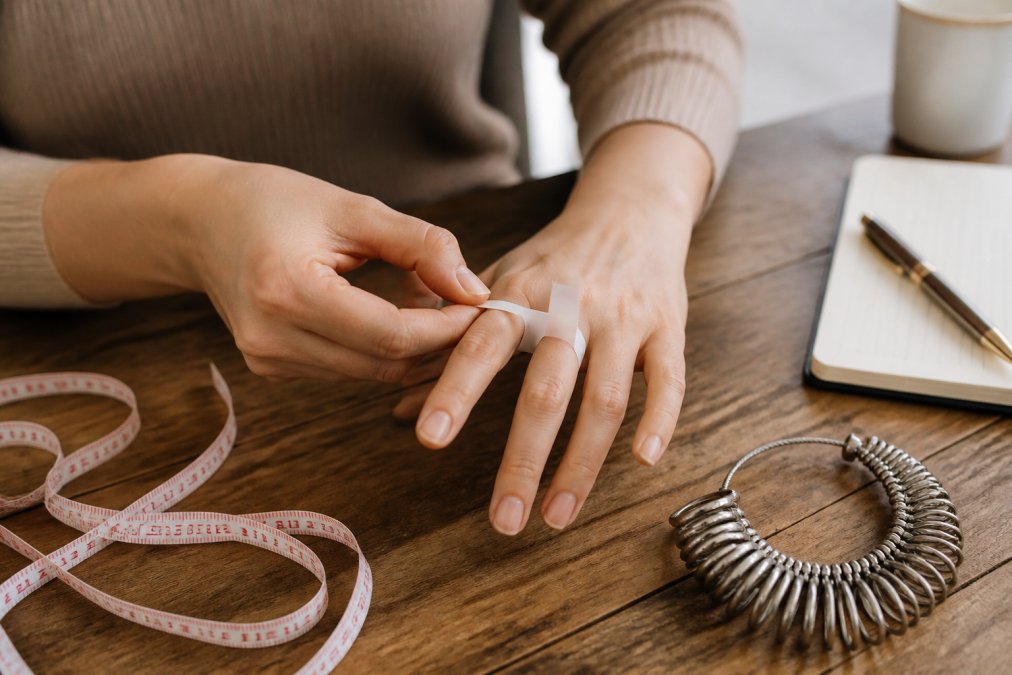
The most reliable at-home method is measuring an existing ring that already fits, or wrapping a strip of paper snugly around the base of the finger and marking where it overlaps. Measure at the end of the day, when fingers are at their largest, and measure two or three times for consistency.
Pro Tip
Order the size that fits today, not the size you hope fits later. Native Jewel includes complimentary resizing on every ring, so a small adjustment after the proposal costs you nothing but shipping time.
Engagement Ring Return Policy Tips Before You Check Out
Engagement ring return policy tips matter more online than in a store, because you can't inspect the ring across a counter before committing. Most guides tell you to "read the policy." The useful version is knowing what to look for and why each clause exists.

The Clauses That Actually Decide Your Outcome
- When the clock starts. A 30-day window that begins at purchase is very different from one that begins at delivery. On a custom or made-to-order ring, the production time can eat most of a purchase-date window before the ring even ships.
- Refund vs. store credit vs. exchange. Some retailers refund to the original payment method; others issue credit or allow exchange only. For a high-ticket purchase, a true refund is the standard worth holding out for.
- Restocking fees. A percentage-based restocking fee can quietly turn a "30-day return" into a partial refund.
- Condition requirements. Most policies require the ring to be unworn, with tags attached, in original packaging, and accompanied by the certification report. Lose the IGI report and the return can be refused.
- Who pays return shipping. Return shipping on an insured, signature-required package is not cheap. Confirm whether the retailer provides a prepaid, insured label or expects you to arrange and pay for one.
- Custom and resized pieces. Engraved, custom-designed, or resized rings are frequently excluded from returns. If you plan to resize, understand whether that removes your return option.
- Return vs. resize. These are not the same. A resize fixes fit; a return reverses the sale. A retailer that offers free resizing removes one of the most common reasons buyers return a ring in the first place.
How Returns Actually Work in Practice
A legitimate online return usually follows a specific sequence: you request a return authorization within the window, the retailer issues a prepaid insured shipping label, you ship the ring back with signature required, the retailer inspects it against the condition requirements, and the refund posts to your original payment method.
Watch Out
Never ship a ring back without a retailer-issued return authorization and an insured, signature-required label. A ring that disappears in transit without proof of delivery is your loss, not the retailer's, and most carriers exclude jewelry above a low declared-value threshold from standard coverage.
Questions to Ask Before You Enter Payment Details
- Does the return window start at purchase or delivery, and how many days is it?
- Is the refund full, to the original payment method, with no restocking fee?
- Does the retailer provide a prepaid, insured return label?
- Are custom, engraved, or resized rings returnable?
- What documentation must travel back with the ring?
- Is there a separate warranty or upgrade policy that survives the return window?
Native Jewel offers 30-day hassle-free returns, and because resizing is complimentary, a fit issue doesn't automatically become a return.
Choosing Metal, Setting, and Stone Shape for the Long Term
Precious metals and setting styles age differently, and the choice should follow how the ring will actually be worn, not how it photographs in a listing. When you buy online, you can't feel the weight of platinum or see how a halo catches light in person, so the decision has to be made from specs, video, and return terms rather than from a countertop impression.
Metal: Match the Alloy to the Wearer
Platinum is dense, naturally white, and holds a setting securely because prongs resist bending. It's also heavier on the finger and typically costs more than gold at the same size. 14K gold is the durability workhorse: the alloy is harder than 18K, so it resists scratching and everyday dents better, and it costs less. 18K gold is softer and richer in color, which some buyers prefer for yellow and rose gold, but it shows wear faster on a ring worn daily.
4.05ct Oval Lab Diamond Engagement Ring →
Setting: What Each Style Does to the Stone
Setting style changes the whole look and the stone's exposure to damage.
- Solitaire, one center stone, minimal metal, maximum focus. The trade-off is that high prongs can snag.
- Halo, a ring of small stones around the center, adding apparent size without a larger (and more expensive) center. The silhouette is busier and the small stones need periodic tightening.
- Pavé, small stones set along the band for continuous sparkle. Beautiful, but each stone is a potential point of loss and the band can't be resized as freely.
- Bezel, metal wraps the stone's edge, protecting it from impact. Ideal for active wearers, but it covers the girdle and can make the stone read slightly smaller.
- Three-stone and side-stone, add width and presence; more stones mean more inspection points over the ring's life.
Stone Shape: Brilliance vs. Elongation
Shape (the outline) is separate from cut (the light performance). Round brilliant cuts return the most light. Elongated shapes, oval, pear, marquise, emerald, radiant, stretch the finger visually and often face up larger per carat. Step cuts like emerald and asscher show clarity flaws more readily because they have fewer facets to scatter light.
| Choice | Best For | Trade-Off |
|---|---|---|
| Platinum | Daily wear, prong security | Higher cost, heavier feel |
| 14K gold | Durability, value | Less pure alloy, needs rhodium upkeep if white |
| 18K gold | Rich color | Softer, scratches more easily |
| Solitaire | Timeless look | Exposed high prongs |
| Halo | Maximum apparent size | Busier silhouette, more stones to maintain |
| Bezel | Active lifestyles | Covers stone edges |
| Round brilliant | Maximum brilliance | Highest price per carat |
| Oval / pear / radiant | Visual size, elongation | Bow-tie or windowing risk if poorly cut |
Pro Tip
When shopping online, ask for a 360-degree video of the actual stone, not a stock render.
How to Decide Online
Because you can't try the ring on, lean on three things: the return window, a video or virtual try-on to judge proportion on a hand, and the certification report to confirm the stone's cut grade.
The Buy Stone, Set Locally Workflow: A Hybrid Option
The buy stone, set locally workflow means purchasing a certified loose diamond online and having a local jeweler build the setting around it.
Secure Shipping, Insurance, and Post-Purchase Logistics
Watch Out
Skipping the signature requirement to make delivery "easier" is the mistake that costs people. A package left on a porch is not covered by most carriers' claims process, and you have no proof of delivery to fight with.
Native Jewel ships free on orders over $1999 and backs every diamond piece with a lifetime warranty on craftsmanship.
Resale Value and Liquidity: What Buyers Should Realistically Expect
Resale value on engagement rings is weaker than most buyers assume. Treat a ring as a keepsake, not an investment.
Key Takeaway
Buy the ring you want to wear for decades. Any resale figure is a bonus, never the reason to choose one stone over another.
Frequently Asked Questions
Is it safe to buy an engagement ring online?
Yes, when you buy from a jeweler that provides IGI-certified diamonds, a written return window, insured shipping, and a real resizing policy. Native Jewel includes 30-day returns, a lifetime warranty on craftsmanship, complimentary resizing, and free shipping on orders over $1999. Paying with a credit card also gives you a dispute path if the ring arrives damaged or does not match its listing.
How do I know if a lab-grown diamond is high quality?
Start with the grading report. A lab-grown diamond certification from IGI documents cut, color, clarity, and carat weight, so you can compare stones on paper instead of trusting a photo. Look for an Excellent cut grade, a colorless or near-colorless grade, and clarity that keeps the stone eye-clean. Native Jewel rings carry D color and VS1 clarity with Excellent cut, which is a strong combination for visible brilliance. Ask for the report number and verify it against the lab's online lookup.
What should I look for in an online jeweler's return policy?
A 30-day window is workable for most buyers, but read whether custom or resized pieces are excluded.
How do I determine the correct ring size when shopping online?
Native Jewel includes complimentary resizing, which takes pressure off getting it perfect on the first try.


