

Cart
1

Table of Contents
- Brilliant Earth vs Clean Origin: The Quick Comparison
- Pricing and Value: Where the Money Goes
- Certification and Grading: IGI vs GIA Reports
- How to Choose a Lab Grown Diamond That Holds Up
- Best Places to Buy Lab Grown Diamonds Online
- Returns, Warranties, and Post-Purchase Support
- Conclusion
- Frequently Asked Questions
Last Updated: September 30, 2026
Brilliant Earth vs Clean Origin: The Quick Comparison
Brilliant Earth and Clean Origin are two of the most searched names in lab-grown diamond jewelry, and shoppers comparing them usually want one thing: proof that a lower price does not mean lower quality. This guide from Native Jewel breaks down how both retailers approach pricing, certification, and support, and where a smaller, IGI-focused house can offer more personal service.
Both retailers built their businesses on lab-grown stones and ethical sourcing claims, which is why the brilliant earth vs clean origin question comes up so often in engagement ring forums. The difference rarely comes down to the diamond itself. It comes down to certification, metal quality, and what happens after the sale.

Key Takeaway
The diamond is rarely the weak point in a lab-grown purchase. The setting, the grading report, and the return window are where most buyers get surprised.
Pricing and Value: Where the Money Goes
Lab-grown diamond prices track the 4Cs and the certificate behind them, not the logo on the box. A comparable certified stone can carry a very different price tag depending on the retailer's overhead, marketing spend, and markup structure. Larger retailers often spend heavily on advertising, which shows up in the price you pay. Direct-to-consumer sellers trim that layer, though "cheaper" only matters if the grading and craftsmanship hold up.
That is the trade-off worth understanding. A lower price point is not automatically a red flag, and a higher one is not automatically a guarantee. Ask what the price includes: certification, metal purity, resizing, and warranty coverage. Those line items, not the headline number, decide real value.
Watch Out
A price that looks too low often skips something: an uncertified stone, a hollow setting, or a resizing fee buried in the fine print. Always ask what is included before comparing totals.
Certification and Grading: IGI vs GIA Reports
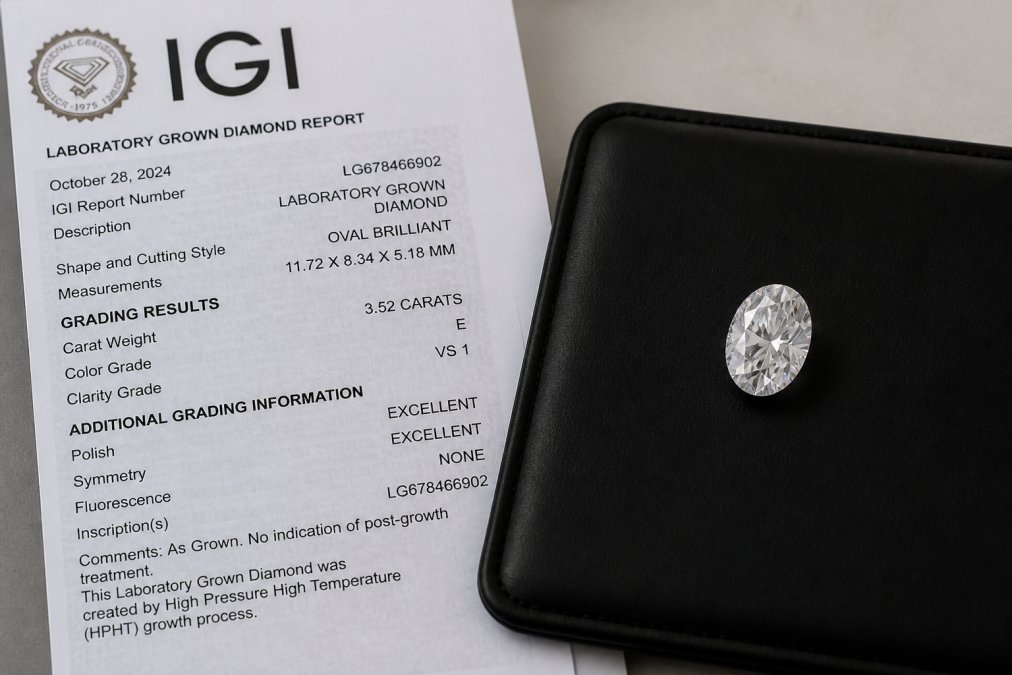
A grading report is the only independent proof of what you are buying. IGI and GIA are the two labs most shoppers encounter, and both document the four Cs: cut, color, clarity, and carat weight. The Gemological Institute of America's grading standards set the reference point many jewelers use, while IGI reports are common for lab-grown stones because the lab grades a high volume of them.
What matters is not which lab name sounds more prestigious. It is whether the report matches the stone in front of you and whether the retailer hands over the original document, not a photocopy. At Native Jewel, every lab-grown diamond ships with its IGI certification, so the stated color, clarity, and cut grades travel with the ring.
What a Lab-Grown Report Actually Contains
Beyond the 4Cs, a lab-grown diamond report typically includes:
- Growth method, HPHT (high-pressure, high-temperature) or CVD (chemical vapor deposition). This is disclosed on most modern reports and is the single most under-discussed line item in comparison shopping.
- Type classification, most lab-grown stones are Type IIa, which is chemically purer than roughly 98% of natural diamonds.
- Fluorescence, usually "none" or "faint" for lab-grown; strong fluorescence can affect appearance in some lighting.
- Inscription, a laser-inscribed report number on the girdle, which lets you match the physical stone to the paper.
- Comments section, where labs note treatments, growth remnants, or "as-grown" color that was not altered post-growth.
HPHT vs. CVD: Why Growth Method Matters
HPHT mimics the natural process by subjecting a carbon seed to extreme heat and pressure. It tends to produce stones with a slight blue or colorless hue and is often favored for larger, higher-color goods.
For the buyer, the practical implications are:
- Color stability, some CVD stones with post-growth treatment can shift color under certain conditions; HPHT stones are generally color-stable.
- Strain and striation, CVD stones can show internal strain patterns that a skilled grader notes in the comments; HPHT stones typically do not.
- Price, HPHT goods often carry a modest premium at the top color grades because they are harder to produce at scale in large sizes.
| What to Check | Why It Matters | Red Flag |
|---|---|---|
| Report issuer | Confirms independent grading | No report, or "in-house" grading only |
| Report number | Lets you verify the stone | Number does not match the certificate |
| Cut grade | Drives how much light returns | Cut grade left blank |
| Growth method | Affects color stability and price | Method not disclosed on the report |
| Type classification | Type IIa is the purest category | Type not stated |
| Metal stamp | Confirms gold purity | No 14K or 18K stamp inside the band |
Key Takeaway
Two stones with identical 4C grades can differ in growth method, type, and fluorescence, all of which appear on the report and none of which appear in a typical price comparison. Read the whole report, not just the top line.
How to Choose a Lab Grown Diamond That Holds Up
Buying well starts with the certificate, then the setting, then the metal. A stunning stone in a weak setting will loosen, and a beautiful setting around a poorly cut stone will look dull. Judge all three together, not one at a time.
4.05ct Oval Lab Diamond Engagement Ring →
The Four Cs in Plain Terms
Cut decides brilliance, so it deserves the most attention. Color and clarity matter, but a well-cut stone with slightly lower color can outshine a poorly cut one with a better grade. Carat weight is about size, not sparkle, and an elongated shape like an oval or pear reads larger than a round of the same weight.
Setting Quality and Metal Purity
Prong settings show more of the stone; bezel settings protect it. For metal, 14K gold holds up well in engagement rings worn every day.
Pro Tip
Ask how thick the band is at its thinnest point.
Best Places to Buy Lab Grown Diamonds Online
The best online sellers combine three things: certified stones, clear return terms, and real post-purchase support. Price alone is a weak signal. A retailer that publishes its certification process, states its metal purity, and answers resizing questions before you buy is usually the safer bet.
| Ring | Center Stone | Metal | Price |
|---|---|---|---|
| Oval Lab Diamond Ring | 3ct oval, D/VS1 | 14K white gold | $2,500.00 |
| Round Lab Diamond Ring | 3.00ct round, D/VS1 | 14K white gold | $3,500.00 |
| Pear Lab Diamond Ring | 3.05ct pear, D/VS1 | 14K white gold | $3,500.00 |
| Cushion Lab Diamond Ring | 3.00ct cushion, D/VS1 | 14K yellow gold | $3,500.00 |
| Radiant Lab Diamond Ring | 4.06ct radiant, D/VS1 | 14K yellow gold | $4,500.00 |
Returns, Warranties, and Post-Purchase Support
Return windows and warranties separate a confident seller from a cautious one, but the fine print matters more than the headline number. A 30-day return window is common, yet the clock usually starts at delivery, not order date, and most policies require the ring to be unworn, in original packaging, and accompanied by the grading report. Some retailers charge a restocking fee on custom or engraved pieces; others exclude resized rings entirely. Read the exclusions before you buy, not after.
Post-Purchase Maintenance and Upgrade Programs
- Confirm the return window start date and any restocking fee in writing before buying
- Check whether resizing is free, and within what size range
- Verify the warranty covers the setting, not only the stone, and whether annual inspections are required
- Keep the original grading report and receipt, most warranties require them
Conclusion
Buying a lab-grown diamond online comes down to trust: a real certificate, an honest price, and support that lasts past checkout. Native Jewel answers all three with IGI-certified lab-grown diamonds, handcrafted 14K gold settings, a lifetime warranty on diamond jewelry, and 30-day hassle-free returns. Get started with Native Jewel and choose a ring built to last a lifetime.
Frequently Asked Questions
Is Clean Origin jewelry legit?
Clean Origin sells lab-grown diamonds with independent grading, and its inventory is documented by certification reports from labs like IGI. Legitimacy comes down to paperwork: every stone should ship with a grading report matching its carat weight, color grade, and clarity. Ask for the report number before you buy, then verify it on the lab's website. That step works for any retailer, including Native Jewel, whose rings carry IGI-certified centers.
Which retailer offers better lab-grown diamond certification, Brilliant Earth or Clean Origin?
Both rely on independent labs, most commonly IGI, and some listings carry GIA grading reports. The brand matters less than the document itself. A useful report states carat weight, color grade, clarity, and cut quality, and includes a number you can check online. When comparing brilliant earth vs clean origin, request the certificate for the exact stone you are considering, because quality varies stone by stone within the same retailer.
How do the return policies compare between Brilliant Earth and Clean Origin?
Return windows and restocking terms differ, so read the fine print before ordering. Most online jewelers allow returns within a set period, but engraved, custom, or resized pieces are often excluded. Native Jewel keeps it simple with 30-day returns and complimentary resizing on every ring, including the 4.05ct Oval Lab Diamond Engagement Ring at $2,500, which removes the sizing risk that worries most first-time online buyers.
How do I choose a lab grown diamond without seeing it in person?
Start with the certificate, then the specifications. A 3.00ct round lab diamond graded D color, VS1 clarity, and Excellent cut will look bright and clean in almost any setting. Compare carat weight against the shape: an oval or pear spreads wider across the finger than a round of the same weight. Finally, confirm the return and resizing policy, since that protects you if the ring arrives differently than expected.
Are lab-grown diamonds a good value compared with mined diamonds?
Lab-grown diamonds share the same optical properties, chemical composition, and physical characteristics as mined stones, but they cost less because they are grown rather than extracted. That gap lets you put more budget into carat weight and cut quality. A 4.05ct oval ring with a 3ct D/VS1 center at $2,500 is one example of how far the money stretches when you buy lab-grown.


