

Cart
1
Table of Contents
- The 4Cs of Lab Grown Diamond Quality
- How to Read a Diamond Grading Report
- IGI vs GIA Lab Diamond Certification
- Best Lab Grown Diamond Clarity Grades
- CVD vs HPHT: How Growth Method Affects Quality
- Lab Grown Diamond Pricing and Resale Value in 2026
- Frequently Asked Questions
Last Updated: September 27, 2026
The 4Cs of Lab Grown Diamond Quality
Lab grown diamond quality is measured by the same four criteria used for mined stones: cut, color, clarity, and carat weight. These 4Cs determine how a diamond looks, performs in light, and what it costs. At Native Jewel, every piece is built around IGI-certified stones graded on exactly these terms, so you can compare any lab diamond using one shared language.
Most guides wrongly treat the 4Cs as equally weighted. Cut drives brilliance, fire, and scintillation more than any other factor, while color and clarity have diminishing returns past a threshold.
Cut Quality: The Biggest Factor in Brilliance
Cut quality is the only C controlled by human hands, and the largest determinant of how a diamond handles light. A well-cut stone returns light through the table and crown, producing brilliance (white light return), fire (rainbow dispersion), and scintillation (the flash pattern as the stone moves). A poorly cut stone leaks light through the pavilion and looks dull, no matter how flawless its clarity grade.
Pro Tip
Ask for the cut grade on the grading report, not the vendor's marketing language. "Ideal" and "super ideal" are seller terms, not laboratory grades. The report is the only cut assessment that travels with the stone.
Carat Weight and Why Spread Matters More
Carat weight measures mass, not visual size, and the two diverge across shapes. Spread, the surface area a stone presents from the top view, is what your eye registers.
| Shape | Visual Spread vs. Round | Best For | Typical Price Impact |
|---|---|---|---|
| Round | Baseline | Timeless brilliance | Highest per carat |
| Oval | Larger | Maximum presence | Moderate |
| Pear | Larger, elongated | Romantic silhouettes | Moderate |
| Cushion | Slightly smaller | Soft, romantic profile | Lower |
| Radiant | Comparable | Modern geometry | Lower |
How to Read a Diamond Grading Report
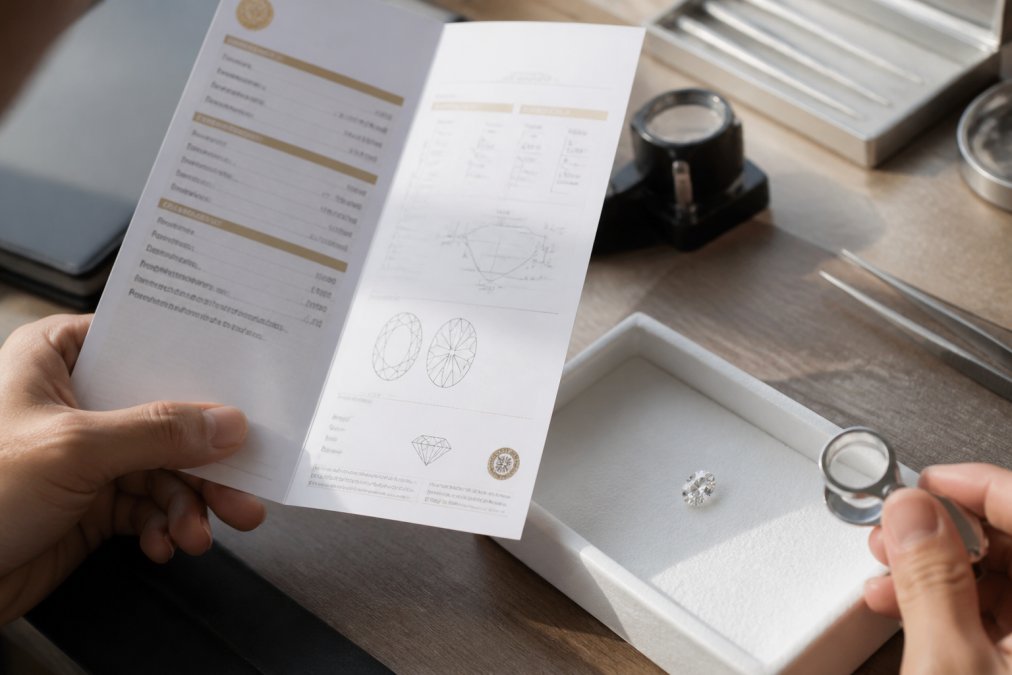
A diamond grading report is an independent laboratory's written assessment of a stone's measured characteristics, issued after physical examination. It is not an appraisal or a guarantee of beauty, but it lets you verify what you are buying before money changes hands.
IGI vs GIA Lab Diamond Certification
IGI and GIA are the two grading laboratories that matter most for lab grown diamonds, and both are reputable. The practical difference is volume and specialization: the International Gemological Institute's grading standards built much of its modern business around lab grown stones, while the Gemological Institute of America's grading scales established the universal color and clarity language the entire industry uses.
| Laboratory | Strength | Common With | Report Detail |
|---|---|---|---|
| IGI | Lab grown specialization | Lab grown market | Full proportions and growth method |
| GIA | Originator of the 4Cs scale | Mined and lab grown | Conservative grading, high recognition |
Watch Out
A "certificate of authenticity" printed by the retailer is not a grading report. It carries no independent verification and no resale weight. If the document does not come from a recognized laboratory with a verifiable report number, treat the stone as ungraded.
Best Lab Grown Diamond Clarity Grades
The best clarity grades for lab grown diamonds are VS1 and VS2, which look clean to the unaided eye at a lower cost than VVS or Flawless. Clarity measures internal inclusions and surface blemishes on a scale from Flawless to Included.
Here is how the grades translate in practice:
4.05ct Oval Lab Diamond Engagement Ring →
- Flawless (FL) and Internally Flawless (IF): No visible inclusions under 10x magnification. Rarest and most expensive.
- VVS1 and VVS2: Inclusions so small they are difficult to locate even under magnification. Premium pricing for a difference you cannot see.
- VS1 and VS2: Minor inclusions, invisible to the eye, easily located under magnification. The practical sweet spot.
- SI1 and SI2: Inclusions visible under magnification; SI2 may show eye-visible inclusions depending on placement.
- I1 to I3: Inclusions visible to the naked eye. Best avoided for a center stone.
CVD vs HPHT: How Growth Method Affects Quality
CVD and HPHT are the two methods used to grow diamonds in a laboratory, and both produce genuine diamonds with identical chemical composition, crystal structure, and refractive index to mined stones. The difference is how the carbon is assembled, which leaves measurable fingerprints a trained grader can read.
| Feature | HPHT | CVD |
|---|---|---|
| Growth environment | Metal solvent catalyst, high pressure | Carbon plasma, vacuum chamber |
| Typical color | Near-colorless, occasional blue tint | Near-colorless, occasional brown/gray tint |
| Common post-growth treatment | None or color treatment | Annealing to remove brown tint |
| Strain signature | Geometric or cross-shaped | Striae or banded |
| UV fluorescence | Often blue | Usually inert or weak |
| Relative supply | Smaller share of lab grown market | Larger share of lab grown market |
Pro Tip
If you are comparing two stones of identical 4Cs and one is CVD and one is HPHT, ask to see the strain and fluorescence entries on each report. A CVD stone with no strain notation and no treatment disclosure is the cleaner provenance story; an HPHT stone with a blue fluorescence note is not a defect, but it is worth knowing before you buy.
Key Takeaway
Growth method affects how a stone was made, not how it looks when finished. Judge the finished diamond on its 4Cs and its report, and treat the method, strain pattern, and fluorescence as provenance information that confirms authenticity.
Lab Grown Diamond Pricing and Resale Value in 2026
- Get an independent appraisal. Ask a credentialed appraiser who is not affiliated with the seller. The appraisal should list the stone's 4Cs, the setting's metal and stone content, and a replacement value.
- Insure it correctly. A homeowner or renter policy typically caps jewelry coverage at a low threshold and may require a deductible. A scheduled personal property rider, also called a floater, covers the piece at the appraised value with no deductible and covers loss, theft, and mysterious disappearance. Add the piece to the rider at purchase.
- Keep the paperwork together. Store the grading report, the appraisal, and the original receipt in one place, and keep a digital copy. Insurers ask for these at claim time.
- Re-appraise periodically. Metal prices and replacement costs shift. A re-appraisal every few years keeps your coverage aligned with what it would actually cost to replace the piece.
Watch Out
Do not rely on a seller-issued "appraisal" that inflates the value to make the sale look better. An inflated appraisal means you overpay for insurance and may face a claim dispute. Use an independent appraiser, and expect the appraised replacement value to reflect real retail replacement cost, not a fantasy number.
For buyers who want documented quality without the mined markup, the Federal Trade Commission's jewelry advertising guidance is worth reading before you shop, since it governs how lab grown diamonds may be described and marketed.
Key Takeaway
Treat a lab grown diamond as a beautiful consumer purchase, not an investment. Buy the stone you love, insure it properly with a scheduled rider, and keep the report and appraisal together so a future claim is simple.
Frequently Asked Questions
Which lab grown diamond brand has the best quality?
Quality depends on the specific stone, not the brand name. Look for a grading report from a recognized gemological laboratory that documents the 4Cs: cut, color, clarity, and carat weight. Brands that sell IGI-certified lab diamonds, like Native Jewel, give you a verifiable report for every center stone. Compare grades on the report, not marketing claims. A D-color, VS1 stone with an Excellent cut grade will outperform a poorly graded stone from any brand.
Is VS1 or VS2 better quality for lab grown diamonds?
VS1 is the higher grade. Both fall under "very slightly included," meaning inclusions are minor and difficult to see at 10x magnification. VS1 has fewer or less noticeable inclusions than VS2. In practice, the difference is often invisible to the naked eye, especially in stones under 1 carat. If budget matters, VS2 offers nearly identical visual quality. If you want the cleanest look documented on a grading report, VS1 is the safer pick.
How do I tell if a lab grown diamond is good quality?
Start with the grading report. Check the cut grade first (Excellent is ideal), then color (D through F is colorless), then clarity (VS1 or VS2 is a strong balance of quality and value). Verify the report number with the issuing lab. Ask whether the stone has fluorescence that affects appearance. A reputable seller will provide the IGI or GIA report before purchase. Native Jewel includes IGI certification with every lab diamond ring, so you can confirm the stated grades independently.
Are IGI-certified lab grown diamonds considered high quality?
Yes. IGI is one of the leading gemological laboratories for lab grown diamond grading and operates globally. An IGI report documents the same 4Cs as any major lab: cut, color, clarity, and carat weight, plus measurements and fluorescence. The certification itself does not make a diamond high quality; it verifies what the diamond actually is. A D/VS1 IGI-certified stone is high quality because of its grades, and the report lets you confirm those grades before you buy.
Why do some experts suggest avoiding certain lab grown diamonds?
The concern usually centers on poorly graded stones or those with growth-related issues that affect appearance. Some lab grown diamonds have strain patterns or fluorescence that can make them look hazy in certain lighting. Others are graded by less rigorous labs, so the stated grade may not match reality. The fix is simple: buy stones with reports from established labs like IGI or GIA, and check the report details, including fluorescence and comments, before committing.
What are the 4Cs of lab grown diamonds?
The 4Cs are cut, color, clarity, and carat weight. Cut determines how well the diamond returns light, which drives brilliance and fire. Color grades run from D (colorless) to Z (noticeable color). Clarity grades range from Flawless to Included, based on inclusions visible under 10x magnification. Carat weight measures the diamond itself. Lab grown diamonds are graded on the same 4Cs scale as natural diamonds, so the same quality standards apply.


