

Cart
0

Table of Contents
- Emerald Cut Engagement Ring Cost: What Drives the Price
- Emerald-Cut Diamond Price by Carat: 2026 Ranges
- Natural vs. Lab-Grown Emerald-Cut Diamond: Cost and Value
- Emerald-Cut Diamond Color and Clarity: What Each Grade Costs
- Emerald-Cut Engagement Ring Settings and Total Ring Cost
- How Emerald Cuts Compare in Price With Round Diamonds
- Hidden Costs and Purchase Safeguards
- Conclusion: What Emerald Cut Engagement Ring Cost Analysis Means for Your Budget
- Frequently Asked Questions
Last Updated: October 15, 2026
Emerald Cut Engagement Ring Cost: What Drives the Price
The emerald cut engagement ring cost is shaped by four variables: carat weight, diamond origin, color and clarity grades, and the setting you choose. At Native Jewel, we build every ring around IGI-certified lab-grown diamonds in 14K gold, which keeps pricing transparent and consistent.
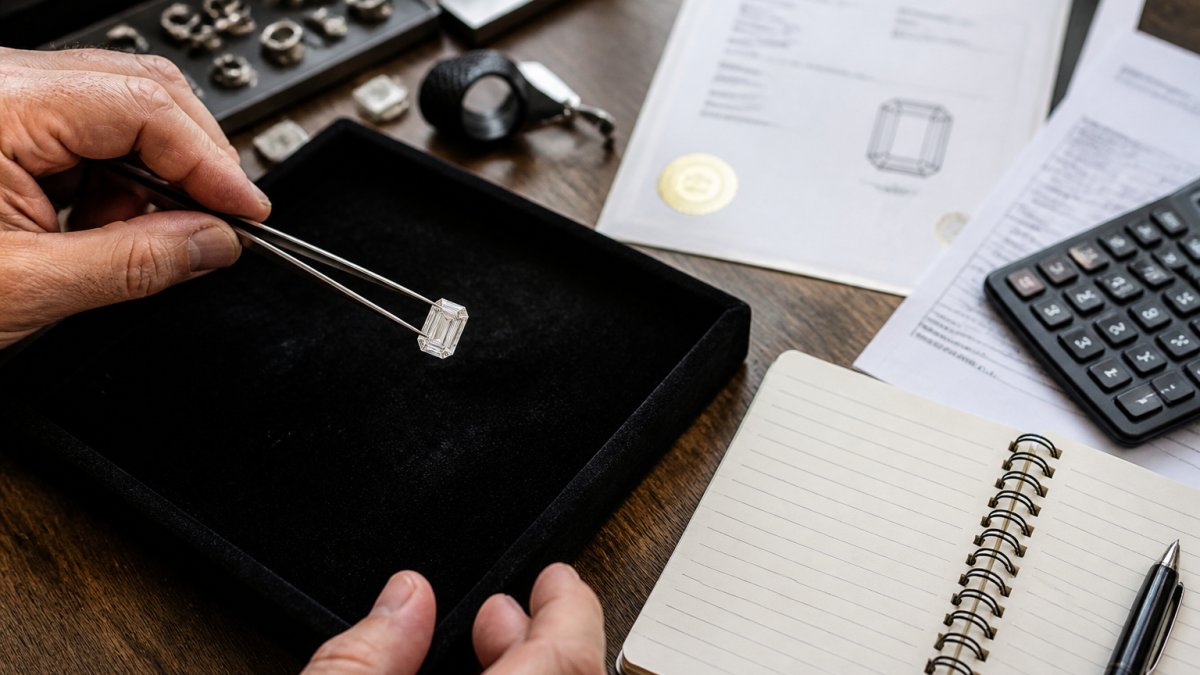
An emerald-cut diamond is a step-cut, rectangular or square stone with long parallel facets that produce broad flashes of light rather than fine sparkle. That geometry is why the cut's quality factors differ from a round brilliant.
How This Analysis Was Built
We priced this analysis around our own catalog and the specifications printed on each grading report, not around generic industry averages. Every figure below reflects an actual listed ring, its certified grades, and its metal type. That matters because most cost guides quote ranges that no specific stone can be matched to.
Key Takeaway
An emerald-cut engagement ring cost is only meaningful when you name the carat weight, origin, color grade, clarity grade, and metal. A price without those five details tells you nothing.
Emerald-Cut Diamond Price by Carat: 2026 Ranges
Carat weight is the single largest driver of emerald-cut diamond price by carat, and the relationship is not linear. A stone that weighs twice as much typically costs more than twice as much, because larger rough is scarcer.
| Center Stone | Listed Ring Price | Metal | Setting | Certification |
|---|---|---|---|---|
| 1.50 ct elongated emerald | $1,600 | 14K yellow gold | Solitaire | IGI |
| 2.00 ct emerald | $2,000 | 14K yellow gold | Solitaire | IGI |
| 2.00 ct elongated emerald | $2,500 | 14K white gold | Pavé | IGI |
| 2.05 ct elongated emerald | $2,500 | 14K yellow gold | Pavé | IGI |
The jump from 1.50 ct to 2.00 ct in a plain solitaire adds $400. Adding pavé side diamonds at the 2.00 ct mark adds another $500. Carat weight sets the floor; everything else stacks on top.

Natural vs. Lab-Grown Emerald-Cut Diamond: Cost and Value
Lab-grown diamonds cost substantially less than natural stones of equivalent size and grade, and the gap widens as carat weight climbs. A natural diamond and a lab-grown diamond share identical optical, physical, and chemical properties. The difference is origin, and origin is where the price separates.
For buyers weighing natural vs. lab-grown emerald-cut diamond options, the practical trade-off is this: natural stones carry a resale market and a scarcity premium; lab-grown stones let you put more of your budget into size and grade. The Federal Trade Commission's jewelry guides confirm that lab-grown diamonds are real diamonds and must be described as such.
Pro Tip
Because step cuts hide very little, put your budget into clarity before color. A VS1 stone in a D color grade reads cleaner through an emerald cut's open table than a lower-clarity stone with a higher color grade.
Emerald-Cut Diamond Color and Clarity: What Each Grade Costs
Clarity carries more weight in an emerald cut than in almost any other shape. The large, open table acts like a window, so visible inclusions show up immediately where a brilliant cut would scatter light over them. That is why VVS2 clarity and VS1 clarity command a premium in step cuts, and why a VS2 or SI1 stone that looks clean in a round brilliant can look cloudy through an emerald cut's table.
Color behaves the same way. The long facets show body color across broad planes, so an E color or D color stone reads noticeably whiter than a G or H in the same cut. In a step cut, color and clarity are not abstract grades, they are the two variables that decide whether the stone looks like glass or like a diamond.
A Transparent Price Matrix by Grade
Most cost guides give you a range you cannot match to a specific stone. The table below is the opposite: it separates comparable stones by carat, origin, color, and clarity so you can see exactly what each grade step costs. All figures are for IGI-certified lab-grown emerald cuts in a 14K gold solitaire setting, which isolates the center stone's contribution to price.
| Carat | Origin | Color | Clarity | Approx. Center-Stone Cost | Approx. Ring Price (14K Solitaire) |
|---|---|---|---|---|---|
| 1.50 ct | Lab-grown | D | VS1 | $1,200 | $1,600 |
| 1.50 ct | Lab-grown | G | VS2 | $900 | $1,300 |
| 2.00 ct | Lab-grown | D | VS1 | $1,600 | $2,000 |
| 2.00 ct | Lab-grown | G | VS2 | $1,200 | $1,600 |
| 2.00 ct | Natural | D | VS1 | $14,000+ | $14,400+ |
| 2.00 ct | Natural | G | VS2 | $9,000+ | $9,400+ |
Three patterns fall out of this matrix. First, moving from G/VS2 to D/VS1 adds roughly $300 to $400 at the 1.50 ct mark and $400 to $500 at the 2.00 ct mark in lab-grown, a real but manageable premium. Second, the same grade jump on a natural stone adds thousands, because natural supply is graded against a scarcity curve lab-grown does not share. Third, the gap between lab-grown and natural widens as carat climbs: at 1.50 ct the difference is roughly tenfold, and at 2.00 ct it is larger still.
Why Cut Quality Outranks Both
What most guides miss is that cut quality outranks color and clarity. A poorly proportioned emerald cut with a shallow depth percentage will leak light and look glassy regardless of how good the color grade is. A D/VS1 stone with a 58% depth and a wide table can look worse than a G/VS2 stone cut to proper proportions. Before you pay for a grade upgrade, confirm the proportions.
Key Takeaway
Grade premiums in an emerald cut are real but modest in lab-grown and steep in natural. Spend on clarity first, color second, and confirm cut proportions before you pay for either.
Emerald-Cut Engagement Ring Settings and Total Ring Cost
The setting is where total ring cost quietly climbs, and it is the one line item buyers can control most directly. A solitaire keeps the price down and lets the center stone carry the design. A halo setting or pavé band adds accent stones, more metalwork, and more labor. A three-stone setting adds two side stones and the labor to match them to the center. Each step changes both the look and the number.
Setting-by-Setting Cost Comparison
Most cost guides describe settings in words. The table below prices them, using a 2.00 ct lab-grown emerald cut (D/VS1, IGI-certified) as the constant center stone so the setting is the only variable.
2ct Emerald Lab Diamond Solitaire Engagement Ring | D/VS1 IGI | 14K Yellow Gold →
| Setting Type | 14K Yellow Gold | 14K White Gold | Platinum | What Drives the Difference |
|---|---|---|---|---|
| Solitaire (plain band) | $2,000 | $2,050 | $2,400 | Metal weight and labor only |
| Pavé band (accent stones) | $2,500 | $2,550 | $2,900 | Accent stones plus setting labor |
| Halo (accent stones around center) | $2,700 | $2,750 | $3,100 | More accent stones, tighter tolerances |
| Three-stone (two side stones) | $3,200 | $3,250 | $3,600 | Two matched side stones plus labor |
Four patterns matter here. First, the jump from solitaire to pavé is roughly $500 at this carat weight, and most of that is accent stones and the labor to set them, not metal. Second, platinum adds roughly $400 over 14K gold across every setting type, a consistent metal premium, not a setting premium.

Metal Type as a Real Line Item
Platinum costs more than 14K gold in most settings, and 18K gold carries a higher metal cost than 14K because it contains more gold by weight. Metal type is a real line item, not a rounding error. White gold also carries an ongoing cost that yellow gold and platinum do not: rhodium plating wears off over time and needs re-plating.
What Our Catalog Actually Lists
At Native Jewel, the spread is clear. Our 1.50ct elongated emerald solitaire in 14K yellow gold lists at $1,600. The 2ct emerald solitaire in 14K yellow gold lists at $2,000. Step up to a 2.80ct total weight pavé ring in 14K yellow gold or its 2.75ct white gold counterpart, and both land at $2,500. The pattern matches the table above: carat sets the floor, setting type adds the next layer.

Watch Out
Do not compare a pavé ring in white gold against a solitaire in yellow gold and call the difference a setting cost. Metal and setting are separate variables, and mixing them makes the comparison meaningless. Hold the center stone and metal constant, then compare settings.
Best For
Buyers who want a solitaire's clean lines and the lowest all-in price, or who want pavé or halo sparkle and are willing to pay $500 to $1,200 more for the accent stones and labor.
How Emerald Cuts Compare in Price With Round Diamonds
Emerald cuts typically cost less per carat than round brilliants of the same weight and grade. Round diamonds require more rough to produce, since cutting a round brilliant from an octahedral crystal wastes more material than cutting a step-cut rectangle. That waste is priced into every round stone.
The trade-off is light performance. A well-cut round brilliant returns more brilliance and fire. An emerald cut returns broader, more architectural flashes. Neither is better; they are different looks, and the emerald cut's lower price per carat is one reason it appeals to buyers who want size and clarity over maximum sparkle.
Watch Out
Do not judge an emerald cut by a photograph alone. Windowing and extinction are angle-dependent, and a stone that looks flat in one lighting setup can perform well in another. Ask for video in multiple lighting conditions before committing.
Hidden Costs and Purchase Safeguards
The listed price is not always the all-in price. Budget for resizing, future rhodium plating on white gold, insurance, and a professional appraisal. These are the total cost of ownership items that most cost analyses skip entirely.
Safeguards matter just as much. Insist on an IGI grading report or an equivalent certification from a recognized laboratory, and read the certificate number against the stone. A grading report is your only independent verification of color, clarity, and carat weight.
Best For
Buyers who want documented diamond quality, complimentary resizing, and a lifetime warranty on craftsmanship rather than a one-time transaction.
Conclusion: What Emerald Cut Engagement Ring Cost Analysis Means for Your Budget
The honest answer is that emerald cut engagement ring cost analysis rewards specificity. Name the carat weight, the origin, the grades, and the metal, and the number stops being a guess.
If you want the emerald cut's clean geometry without the natural-diamond premium, lab-grown is where your budget goes furthest. Native Jewel handcrafts each ring with IGI-certified lab-grown diamonds, includes complimentary resizing, and backs every piece with a lifetime warranty on craftsmanship and 30-day returns.
Frequently Asked Questions
What is the average cost of an emerald cut engagement ring?
There is no single average, because emerald cut engagement ring cost swings with carat, origin, and quality. A 1.50ct lab-grown emerald solitaire in 14K yellow gold runs $1,600, while a 2.05ct center with 0.75ct of pavé in 14K yellow gold runs $2,500. Natural diamonds at the same carat and grade typically cost several times more, so the origin you choose moves the number further than any other single decision.
How much does an emerald-cut diamond cost by carat?
Price per carat climbs steeply as stones get larger, and emerald cuts sit slightly below round brilliants at the same weight. A 1.50ct lab-grown emerald cut with D color and VS1 clarity can anchor a complete ring at $1,600, while a 2.00ct to 2.05ct stone with the same grades supports rings priced at $2,000 to $2,500. Clarity and color grades shift the per-carat figure up or down from there.
Is a lab-grown emerald-cut diamond less expensive than a natural diamond?
Yes, and the gap is widest in emerald cuts. Natural vs. lab-grown emerald-cut diamond pricing favors lab-grown because the two are chemically identical, both are certified, and the lab-grown supply is not constrained by mining. That is why a 2.00ct D/VS1 IGI-certified lab diamond solitaire in 14K yellow gold can be listed at $2,000, a level that natural stones of the same specification rarely reach.
Does the setting significantly affect the total cost?
The setting is the second-largest line item after the center stone. A plain solitaire keeps metal and labor costs low, while pavé side diamonds add 0.75ct of extra stones and hand-setting time. At Native Jewel, a 2.05ct emerald center with 0.75ct pavé in 14K yellow gold is $2,500, versus $2,000 for the 2.00ct solitaire, so the pavé upgrade adds roughly $500 at this quality level.
Deciding on an emerald cut means balancing carat, clarity, and setting against a number you can actually defend. Native Jewel builds each ring around IGI-certified lab-grown diamonds, 14K gold settings, and a lifetime warranty on craftsmanship, with complimentary resizing and 30-day returns included. Shop the collection and get a ring whose price you can trace line by line.


