

Cart
0
Last Updated: October 27, 2026
Quick Summary
The 4 Cs of diamonds are cut, color, clarity, and carat weight, the four grading factors that determine a diamond's quality and price. Cut controls sparkle, color grades how close a stone comes to colorless, clarity rates inclusions and blemishes, and carat is weight rather than visual size.
- Cut grades run from Excellent through Very Good, Good, Fair, and Poor.
- The color scale runs from D, completely colorless, down to Z with noticeable tint.
- Many VS and SI1 diamonds are eye-clean, so paying for VVS clarity is often wasted.
- A 1.00 ct round diamond typically measures about 6.4 mm across.
- Hold cut at Excellent, stop clarity at eye-clean, and let carat absorb the rest.
Table of Contents
- What Are the 4 Cs of Diamonds?
- Diamond Cut Grades Explained: The One That Controls Sparkle
- The Diamond Color Scale and What You Can Actually See
- Reading a Diamond Clarity Chart Without a Loupe
- Diamond Carat Size Chart: Weight, Spread, and Face-Up Size
- How to Compare Diamonds Using All Four Cs Together
- Which of the 4 Cs Matters Most on a Real Budget
- Choosing Your Diamond Ring at Native Jewel
- Frequently Asked Questions
What Are the 4 Cs of Diamonds?
The 4 Cs of diamonds are cut, color, clarity, and carat weight, the four grading factors that determine a diamond's quality and price. The framework explains why two diamonds of identical weight can carry wildly different value.
Diamond cut measures how well a stone's proportions, symmetry, and polish return light to your eye. Diamond color grades how close a stone comes to colorless on a letter scale. Diamond clarity rates internal inclusions and surface blemishes. Diamond carat is the stone's weight, not its visual size.
Why the 4 Cs Still Decide What You Pay
The 4 Cs remain the universal language of diamond grading because they translate physical traits into a comparable score, and a stone's price follows its grades almost mechanically.
The 4 Cs are not weighted equally in practice. Cut drives sparkle, and sparkle is what people actually notice across a room. Color and clarity have diminishing returns once the stone looks clean and white to the naked eye, while carat is the most visible and the easiest to overpay for.
Diamond Cut Grades Explained: The One That Controls Sparkle
Diamond cut grades explained in one sentence: cut is the grade that determines brilliance, fire, and scintillation, the three light behaviors that make a diamond sparkle. A well-cut stone reflects light back through the top; a poorly cut one leaks it out the sides and bottom.
The grading scale runs from Excellent down through Very Good, Good, Fair, and Poor. On a round brilliant, cut grade reflects proportions like table percentage, depth percentage, and girdle thickness, plus symmetry and polish, and those proportions govern the light performance your eye reads as sparkle.
Watch out: a stone with a flawless clarity grade and a Poor cut will look dull next to a lower-clarity, Excellent-cut diamond.
Why Fancy Shapes Rarely Get a Cut Grade
Most gemological laboratories assign a cut grade only to round brilliants. Fancy shapes such as pear, emerald, oval, and marquise receive polish and symmetry grades but typically no overall cut grade, because their proportions vary too widely for one standard.
That gap puts the burden on you. For fancy shapes, judge light performance by eye and lean on the grading report's polish and symmetry lines. Browse pear-shaped diamonds to see those shapes in real rings.
The Diamond Color Scale and What You Can Actually See
The diamond color scale grades a stone's lack of color from D, completely colorless, down to Z, with noticeable yellow or brown tint.
In a white-metal setting, most people cannot tell a D from an F, or an F from a G, without comparison stones side by side. The color grade becomes visible mainly against a bright white background or in larger stones.
Reading a Diamond Clarity Chart Without a Loupe
A diamond clarity chart ranks stones from Flawless and Internally Flawless, through VVS1 and VVS2, then VS1 and VS2, down to SI1, SI2, and the Included grades I1 through I3. The chart describes inclusions, internal characteristics, and blemishes, surface marks, and where they sit.
The term that matters most is eye-clean: a stone whose inclusions are not visible to the naked eye.
Diamond Carat Size Chart: Weight, Spread, and Face-Up Size
Carat is a measure of weight, not diameter, and two stones of equal carat can look different in size. A diamond carat size chart helps, but spread, the distance across the top of the stone, is what your eye actually reads. A shallow stone can face up larger than a deep one of the same weight.
| Carat Weight | Typical Round Diameter | Visual Impression | Notes |
|---|---|---|---|
| 1.00 ct | About 6.4 mm | Classic solitaire size | Popular entry point |
| 1.50 ct | About 7.3 mm | Noticeably larger | Strong value tier |
| 2.00 ct | About 8.1 mm | Substantial presence | Our most requested size |
| 3.00 ct | About 9.3 mm | Bold, statement scale | Premium tier |
How to Compare Diamonds Using All Four Cs Together
Comparing diamonds means reading all four grades as one system, not four separate scores. Start with cut, set a color floor you can actually see, accept the lowest eye-clean clarity, then choose carat last.
Read the Grading Report Before You Read the Price
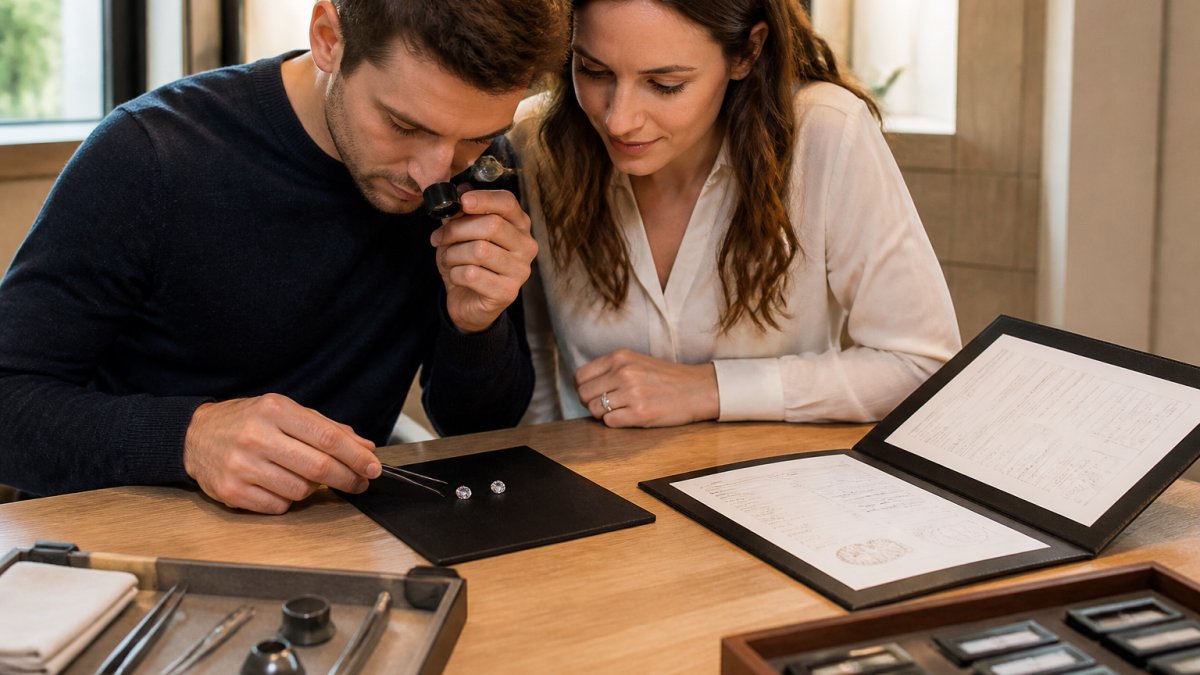
A grading report is the stone's transcript, and it tells you more than the four headline grades. Look first at the issuing laboratory. The Gemological Institute of America (GIA) and the International Gemological Institute (IGI) are the two names you will see most often, and their scales are comparable, but grading consistency and reputation differ by laboratory and by stone type. Lab-grown stones are more often graded by IGI while natural stones are more often graded by GIA, so confirm which laboratory issued the report and whether the seller discloses it up front.
Then read the details the headline grades hide:
- Measurements and proportions. Table percentage, depth percentage, crown angle, and pavilion angle explain why two Excellent-cut stones can still differ in sparkle.
- Fluorescence. A faint or medium blue fluorescence note is usually harmless, but strong fluorescence can make a stone look milky in some lighting.
- Clarity plot. The diagram shows where inclusions sit. An inclusion under the table is more visible than one near the girdle, so two VS2 stones are not automatically equal.
Verify the report number against the laboratory's online lookup, and confirm the number engraved on the girdle matches the paper. A report that cannot be verified is not a report you should rely on.
3 Carat Round Solitaire Engagement Ring | 14K Yellow Gold | D/VS1 IGI Certified →
Compare Stones Side by Side, Not in Isolation
The eye adapts. A G-color stone viewed alone looks white; viewed next to a D-color stone it looks warm. That is why side-by-side comparison in the same lighting is the only honest test.
Online, the limits are real: photographs are usually lit and edited to flatter, and video compression hides fire and scintillation. Use online imagery to screen candidates and confirm proportions and spread, then rely on a return policy and an independent appraisal to confirm what arrives.
Use This Checklist When You Compare Two Stones
- Confirm the cut grade is Excellent or Very Good on rounds, and read polish and symmetry on fancy shapes
- Compare color grades side by side in the same lighting, not from memory
- Verify the clarity grade is eye-clean face-up and check the clarity plot for inclusion placement
Pro Tip
When two stones have the same grades, the tiebreakers are proportions, inclusion placement, fluorescence, and the issuing laboratory. Those details are where the real difference in appearance and value lives.
Lab-Grown vs. Natural: The 4 Cs Apply the Same Way
Cut, color, clarity, and carat are graded identically on lab-grown and natural diamonds. The framework does not change; origin, price, and resale considerations do. Lab-grown stones typically cost far less at the same grades, which means your budget stretches further up the 4 Cs scale, while natural stones carry a resale market that lab-grown stones generally do not. You can see how the grades translate to cost in our lab-grown vs natural diamond price comparison.
Which of the 4 Cs Matters Most on a Real Budget
Cut matters most on a real budget, because it controls the sparkle everyone notices, and it cannot be fixed later. Our recommended priority order is cut first, then carat and color balanced against each other, then clarity last, since eye-clean stones are widely available. Here is how the four grades actually interact when money is finite.
How the 4 Cs Drive Rarity and Value
Each C moves price on its own curve, and the curves are not equal. Cut is the cheapest grade to get right and the most expensive to get wrong, because a poorly cut stone leaks light no setting can rescue.
Rarity compounds the effect. Flawless and D-color stones are scarce, and scarcity is priced in. The practical takeaway is that the highest grade in any single C is rarely the best use of a budget; the best use is the grade where appearance stops improving and price keeps climbing.
Realistic Trade-Off Examples
These illustrative patterns reflect how the grades typically trade against each other at a given budget:
- Drop one color grade, keep the cut. Moving from D to G on a round brilliant in a white-metal setting is often invisible face-up, and the savings can fund an Excellent cut or a larger carat.
- Drop one clarity grade, keep the color. Moving from VS1 to SI1 on a small stone is often eye-clean, and the difference funds a better cut or a higher color grade.
- Keep the cut, stretch the carat. Holding cut at Excellent and accepting an eye-clean SI1 with a G color is the most common way buyers reach the next carat tier without paying for grades no one sees.
Watch Out
The highest grade is not automatically the best buy. A D-color, VVS1 stone with a Good cut can look less brilliant than a G-color, VS2 stone with an Excellent cut, and the second stone usually costs less. Spend where the eye can see the difference.
A Practical Balancing Method
A practical approach many of our customers use: hold cut at Excellent, choose an eye-clean VS or SI1 clarity, pick a color grade that suits the metal, and put the remaining budget into carat. In yellow or rose gold, a slightly lower color grade often looks indistinguishable from a colorless one, so the metal choice itself becomes a budget lever.
Key Takeaway
Cut first, then let color follow the metal, clarity stop at eye-clean, and carat absorb what is left. That sequence is the difference between a stone that looks expensive and one that merely grades well.
Choosing Your Diamond Ring at Native Jewel
Choosing a diamond ring comes down to matching the 4 Cs to your budget and the setting you love. Native Jewel offers IGI-certified lab-grown diamond pieces in handcrafted 14K gold, with a lifetime warranty on all diamond jewelry and 30-day hassle-free returns.
Before you buy, it helps to know how to clean diamond jewelry with household items safely so the ring stays brilliant for years. And if online buying gives you pause, read whether it is safe to buy fine jewelry online for the verification steps that protect your purchase.
Our customers notice the difference. As Lily put it, "The sparkle is incredible, the setting feels premium, and the craftsmanship is exceptional."
Frequently Asked Questions
What are the 4 Cs of diamonds?
The 4 Cs are cut, color, clarity, and carat weight, the four factors gemological laboratories grade and buyers use to compare stones. Cut covers proportions, symmetry, and polish and drives brilliance. Color runs from D (colorless) to Z on the diamond color scale. Clarity describes inclusions and blemishes on a diamond clarity chart from Flawless to Included. Carat is weight, not face-up size. Together they set diamond quality, appearance, and price.
Which of the 4 Cs matters most when choosing a diamond?
Cut matters most for how a diamond looks. A well-cut stone with excellent proportions returns more light, so it shows more brilliance, fire, and scintillation than a poorly cut stone of higher color or clarity. On a fixed budget, protect the cut grade first, then drop color to near-colorless or clarity to eye-clean before sacrificing cut. Carat comes last because spread can be adjusted with shape and setting.
What is the difference between diamond cut and diamond shape?
Shape is the outline: round brilliant, emerald, oval, pear, cushion. Cut is how well the stone is proportioned, polished, and symmetrical within that shape. A round brilliant and an emerald cut are different shapes; both can be excellently or poorly cut. Round brilliants receive a cut grade on most grading reports, while many fancy shapes do not, so you judge those by proportions, table percentage, depth, and the grading report's comments.
How does diamond color affect its appearance?
The diamond color scale runs D to Z, with D completely colorless and letters further down showing a warm tint. Most people cannot see tint above about G or H when a stone is face-up in a setting, especially in yellow or rose gold. Color shows more in large stones and in step cuts like emerald, where broad flat facets reveal body color. Setting metal and lighting change perception as much as one or two color grades.
How does carat weight affect a diamond's size?
Carat is weight, and a diamond carat size chart shows the approximate millimeter spread for each weight. Two stones of the same carat can look different sizes because cut depth varies: a deep stone hides weight in the pavilion, while a shallow-spread stone faces up larger. Carat also affects price nonlinearly, since prices jump at round numbers like 1.00, 1.50, and 2.00 carats. Slightly under those marks often saves money with no visible difference.
How should I balance the 4 Cs when choosing a lab-grown diamond?
Balance the 4 Cs by deciding what you want to see with your eyes. Start with an excellent cut, then choose near-colorless color and eye-clean clarity, since lab-grown diamonds are widely available in higher grades for less than natural stones. Spend the remainder on carat or on the setting. A well-cut 1.50-carat D/VS1 stone can outperform a poorly cut 2-carat stone in sparkle.
Can a diamond look larger or brighter without a higher carat weight?
Yes. A shallower cut with a wider table can face up larger than a deeper stone of the same carat weight, which is why the diamond carat size chart is a guide, not a guarantee. Brilliance comes from cut quality and light performance, not weight. An elongated shape such as an emerald or oval also covers more finger length per carat. A thin halo or bezel can add visual size without adding carat.
The 4 Cs reward buyers who know where to spend and where to save. Native Jewel makes that easier with IGI-certified lab-grown diamonds, handcrafted 14K gold settings, a lifetime warranty on craftsmanship, complimentary resizing, and free shipping. Get started with Native Jewel and choose a ring graded for brilliance, not just weight.


