

Cart
1
Last Updated: November 6, 2026
Quick Summary
There is no single average engagement ring cost, because published figures vary by survey and calculation method. Couples should set a budget they can comfortably afford, then weigh carat weight, metal, and setting to find a ring within it. The all-in spend also includes the wedding band, sales tax, and insurance.
- Published engagement ring cost averages differ by survey, sample, and whether wedding bands are included.
- Carat weight is the largest price driver, and price per carat rises as stone size increases.
- Lab-grown diamonds are typically priced lower than natural diamonds of similar size and grade.
- Plan for sales tax, insurance, resizing, and maintenance on top of the ring price.
Table of Contents
- How These Averages Are Calculated and Why They Vary
- How Much Should an Engagement Ring Cost? Budget Scenarios
- Average Engagement Ring Cost Per Carat: How Carat Weight Sets the Price
- What Drives the Price: Lab-Grown vs. Natural, Setting, and Metal
- What a 10K Engagement Ring Gets You
- Average Wedding Ring Cost and the Total Cost of Ownership
- Choosing Your Ring Within Your Budget at Native Jewel
- Frequently Asked Questions
Most couples asking what an engagement ring costs want a single number, and the honest answer is that the U.S. average varies widely depending on whose survey you read, how the figure is calculated, and which stone and metal you choose. Native Jewel has built this guide around the price drivers couples actually control, so you can set a realistic budget before you start shopping. Our goal is to help you understand what a ring typically costs and what your money can buy at each level.

The Knot Jewelry and Engagement Study
How These Averages Are Calculated and Why They Vary
Published averages are typically drawn from consumer surveys, which ask couples what they spent and then report a mean or median. Those methods differ in sample size, who responds, and whether figures include the wedding band, so two reputable sources can land far apart in the same year. We recommend treating any single average as a rough reference point rather than a target.
Carat weight, stone origin, metal, and setting account for most of the spread. A plain 14K gold solitaire and a platinum halo with a large center stone sit at very different price points, even though both are engagement rings.
How Much Should an Engagement Ring Cost? Budget Scenarios
A workable budget starts with what you can comfortably spend, not with an industry average. Many couples set a range first and then shop within it, which keeps the search focused and avoids financing a ring they cannot afford.
Thinking in scenarios makes the trade-offs clearer. A lower budget usually means a smaller center stone or a lab-grown diamond, which delivers more size for the money. A higher budget opens room for a larger stone, a more intricate setting, or platinum. Our 1.50ct round lab diamond pavé ring, priced at $1,900.00 in 14K yellow gold, is one example of a mid-range option that pairs a certified center stone with a pavé band.
[PRODUCT: 1.50ct Round Lab Diamond Pavé Engagement Ring | 14K Yellow Gold | D/VS1 | IGI Certified | https://www.nativejewel.co/products/1-50ct-round-lab-diamond-solitaire-engagement-ring-14k-yellow-gold-d-vs1-igi-certified]
Average Engagement Ring Cost Per Carat: How Carat Weight Sets the Price
Carat weight is the largest single driver of an engagement ring's price, but the relationship is not linear. A 1-carat diamond does not cost twice a 0.50-carat diamond of the same color, clarity, and cut, it typically costs considerably more, because larger rough stones are rarer and yield fewer finished gems per carat of rough. Most jewelers describe this as a per-carat price curve: the price per carat climbs as weight increases, and it climbs fastest at the round-number thresholds shoppers gravitate toward.
A useful way to see the curve is to compare stones of the same grade at different weights. A 0.50-carat round lab-grown diamond at a given color and clarity might carry a per-carat price of X, a 1.00-carat stone of the same grade a higher per-carat price, and a 1.50-carat stone higher still. The exact multipliers move with market conditions, but the pattern is consistent: budget-conscious shoppers often get more visual size for the money by choosing a weight just under a threshold (0.90 carat instead of 1.00, for example) rather than at or above it.
Cut quality is the second half of the carat equation. Two stones of identical weight and grade can look very different in size and sparkle depending on cut, a well-cut stone returns more light and can appear larger than a poorly cut stone of the same carat weight. That is why comparing rings by total price alone hides the real trade-off: you are always comparing weight, cut, color, and clarity together, not weight in isolation.
Shape matters too. Elongated shapes such as oval, emerald, and pear tend to face up larger per carat than round brilliants, because more of the stone's weight sits above the finger rather than in the depth of the pavilion. A 1.50-carat oval can read as visually larger than a 1.50-carat round, which is one reason shoppers prioritizing size often gravitate toward elongated cuts.
Total carat weight (TCW) adds another layer when a band is set with diamonds. A ring described as 2.25 carats may pair a 1.50-carat certified center stone with 0.75 carat of pavé accents, and the accent stones are typically smaller, lower-grade melee that cost far less per carat than the center. When you compare rings, separate the center-stone carat weight from the total carat weight so you are comparing like with like.
Our 2.25ct round lab diamond engagement ring, with a 1.50ct certified center and 0.75ct of pavé accents, shows how total carat weight adds up when the band is set with diamonds.
What Drives the Price: Lab-Grown vs. Natural, Setting, and Metal
Lab-grown diamonds are typically priced lower than natural diamonds of similar size and grade, which can let couples choose a larger or higher-grade stone for the same budget. Setting and metal then shape the final cost. Pavé bands add sparkle and cost more than plain bands, and platinum generally costs more than 14K gold.
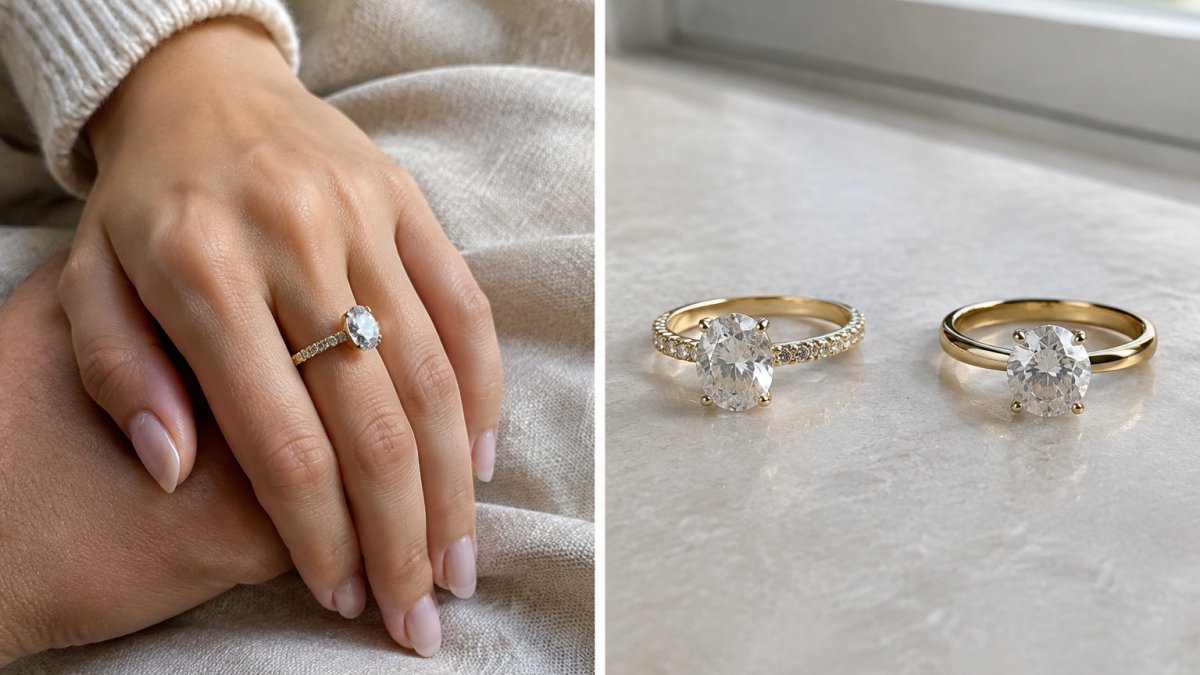
Our 1.50ct elongated emerald lab diamond ring in 14K yellow gold is priced at $1,600.00.
1.50ct Round Lab Diamond Pavé Engagement Ring | 14K Yellow Gold | D/VS1 | IGI →
The main factors that move an engagement ring's price are summarised below.
| Price driver | Effect on cost | Note |
|---|---|---|
| Lab-grown vs. natural | Lab-grown typically priced lower | Similar size and grade |
| Pavé band | Adds sparkle, costs more | Compared with a plain band |
| Platinum vs. 14K gold | Platinum generally costs more | Metal choice shifts the total |
| Elongated emerald ring example | $1,600.00 | 1.50ct, 14K yellow gold |
What a 10K Engagement Ring Gets You
Native Jewel focuses on 14K gold, a choice for couples who want warmth and everyday wear in a fine jewelry piece.
Average Wedding Ring Cost and the Total Cost of Ownership
The engagement ring is only part of the total spend, and the all-in number is what actually matters for your budget. Most couples add a wedding band, and the band's cost depends on metal and whether it carries diamonds. A plain 14K gold band sits at the low end; a diamond-accented band in platinum sits at the high end.
Beyond the two rings, plan for the costs that show up after the purchase:
- Sales tax. Sales tax on jewelry varies by jurisdiction, so check the rate that applies where you take delivery before setting your budget.
- Insurance. Jewelry insurance is usually priced as an annual premium based on the ring's appraised value, and homeowners or renters policies may cover jewelry only up to a sublimit below the ring's value.
- Resizing. Ring sizing is sometimes free at purchase and sometimes charged later, and the cost depends on the metal and whether the band has pavé or engraving that must be disturbed. Bands with diamonds set all the way around are the hardest to resize.
- Maintenance and repair. Prongs wear down, stones loosen, and settings need periodic inspection. A routine check and tighten is often inexpensive or free, but replacing a lost stone or re-tipping prongs is a real cost. Budget a small annual allowance for care rather than treating the ring as a one-time purchase.
- Appraisal. An independent appraisal is often required for insurance and is usually a separate fee.
Sales tax and insurance are added on top of the ring price, so compare the total against your budget. That is the number to compare against your budget, not the sticker price alone.
Native Jewel includes complimentary resizing with our engagement rings and offers a lifetime warranty on craftsmanship. Even so, taxes, insurance, and routine care sit outside most warranties, so build them into your plan from the start.
Watch out: a homeowners or renters policy may pay less than a ring's full value if it is lost or stolen, so confirm any jewelry sublimit before assuming you are covered.
Choosing Your Ring Within Your Budget at Native Jewel
Start with your budget, then decide which trade-off matters most: stone size, metal, or setting. Our collection of IGI-certified lab-grown diamond engagement rings in 14K gold is built for couples who want certified quality. Free shipping applies to orders over $1,999, and a 30-day hassle-free return window is offered.
When you are ready to compare styles, explore our full range of rings and find the one that fits your budget and your story.
Frequently Asked Questions
What is the average engagement ring cost in the United States? Published averages vary by survey and methodology, so there is no single definitive figure. Treat any average as a rough reference and set your own budget based on the stone size, metal, and setting you prefer.
How much should you spend on an engagement ring? There is no fixed rule. Many couples set a range they can comfortably afford first, then choose a ring within it.
Is a lab-grown diamond engagement ring cheaper? Lab-grown diamonds are typically priced lower than natural diamonds of similar size and grade, which can help you choose a larger or higher-quality stone for the same budget.
Frequently Asked Questions
How much should a man spend on an engagement ring?
There is no fixed rule, but many couples in the United States choose a budget based on what they can comfortably pay without debt. Some people use the older three-month-salary guideline as a starting point, while others prioritize a set budget and then shop within it. Lab-grown diamonds let you put more of that budget into carat weight, metal, or setting. Native Jewel's 1.50ct elongated emerald lab diamond ring is priced at $1,600.00. Decide your number before you shop, then compare rings that fit it.
Is $5,000 a reasonable amount to spend on an engagement ring?
A $5,000 budget is well within the range many couples spend in the United States, and it can buy a substantial lab-grown center stone in 14K gold. At Native Jewel, the 1.50ct round lab diamond solitaire in 14K yellow gold, with a D color and VS1 clarity grade and IGI certification, is priced at $1,900.00, . Compare the total ring price against your budget, including any sizing or delivery costs, before deciding.
How does a lab-grown diamond affect the cost of an engagement ring?
Lab-grown diamonds are typically priced lower than natural diamonds of similar size, cut, color, and clarity, so the same budget can buy a larger or higher-grade stone. Native Jewel's lab-grown rings are IGI certified, which documents the stone's grading. At $1,900.00, the 1.50ct round pavé ring with a 14K yellow gold band shows how a certified 1.50-carat center can fit a mid-range budget. Ask any seller for the grading report and the certificate number before you buy.
What is the average engagement ring cost per carat?
Price per carat rises as carat weight increases, because larger stones are rarer and the price per carat is not constant. Dividing a ring's price by its center stone weight gives a rough per-carat figure, but this includes the metal and setting. At Native Jewel, the 1.50ct round lab diamond ring is priced at $1,900.00. Use this method to compare rings with the same stone shape and quality.


