

Cart
0

Quick Summary
To identify lab grown diamonds, start with the grading report: check that the report number matches the stone, the shape and carat weight match the listing, and the origin statement explicitly says lab-grown. Visual inspection alone cannot reliably reveal origin, so paperwork and, for doubtful stones, an independent gemological lab are the dependable routes.
- Confirm the report number matches the stone, packaging and any girdle inscription.
- Look for an explicit lab-grown or synthetic origin statement on the grading report.
- Visual inspection cannot reliably tell lab grown diamonds from natural ones.
- Consumer testers separate diamond from simulants but cannot confirm lab origin.
- Use an independent gemological lab for major purchases or stones with missing paperwork.
Table of Contents
- What Separates a Lab Grown Diamond From a Natural One
- Step 1: Check the Grading Report First
- Step 2: Look for a Laser Inscription on the Girdle
- Step 3: What Visual Inspection Can and Cannot Reveal
- Step 4: Using a Lab-Grown Diamond Tester Correctly
- Step 5: When to Use a Professional Gemological Lab
- Booking Your Verified Purchase at Native Jewel
- Frequently Asked Questions
What Separates a Lab Grown Diamond From a Natural One
Lab grown diamonds are real diamonds. Our quality guide to what lab grown grades mean explains how color, clarity and cut apply to lab-created stones. They share the same crystal structure, hardness and chemical makeup as mined stones, and they are created in a controlled lab rather than underground. Because the physical properties match, a lab grown diamond cannot be told apart from a natural one by looking alone.
That is why this guide focuses on paperwork and proof rather than guesswork, because knowing how to identify lab grown diamonds starts with the documents behind the stone. Native Jewel, which sells IGI-certified lab grown diamonds, is one place to start learning what to check. Most of the difference comes down to origin, and origin is recorded on a grading report and, in many cases, on the stone itself.
- Natural diamonds form over billions of years in the earth.
- Lab grown diamonds are grown in weeks using high-pressure, high-temperature (HPHT) or chemical vapor deposition (CVD) methods.
- Both types are graded on the same scale: color, clarity, cut and carat weight.
The origin is the key question. A report should state clearly whether a stone is lab grown.
Step 1: Check the Grading Report First
The fastest way to learn whether a diamond is lab grown is to read its grading report, but only if you know which lines to read. Learn how to verify an IGI certification step by step before you rely on the paperwork. Reputable labs such as the Gemological Institute of America grading reports and International Gemological Institute grading reports issue reports that look similar at a glance, so the origin callout is what separates a lab-grown document from a mined-diamond one. See which certifying labs issue reports for lab-grown diamonds for a full list.
Start by confirming four things, in this order:
- Report number matches the stone. The number on the report should match the number on the packaging, the invoice, and, where present, the laser inscription on the girdle. A mismatch is the single most common red flag in resale and online listings.
- Shape and carat weight match the listing. A 3.00 ct oval on the report should be a 3.00 ct oval in the listing. Small discrepancies are normal (measurements are taken to hundredths of a carat), but a full shape change is not.
- Origin statement is explicit. Look for wording such as "Laboratory-Grown," "Lab Grown," or "Synthetic" next to the diamond description. GIA and IGI both use a dedicated origin line on lab-grown reports; a report that is silent on origin should be treated as incomplete.
- Grading scale is the same. Color, clarity, cut and carat weight are graded on the same scale for both origins, so a D/VS1 lab-grown stone and a D/VS1 mined stone read identically on those four lines. Origin is the only line that changes.
Reading the Origin Statement
The origin statement is usually a single line, but its placement matters. On lab-grown reports the origin statement is usually easy to locate in the grading results or description block. If the seller sends only a photo of the stone and a screenshot of the 4Cs, ask for the full report PDF, the origin line is easy to crop out of a screenshot.
Watch out: A report that lists "CVD" or "HPHT" as the growth method is confirming lab origin, not casting doubt on it, those are the two standard growth processes, and their presence on a report is a feature, not a flaw.
Matching the Report to the Stone
Paperwork only proves origin if it belongs to the stone in front of you. Before you buy, ask the seller to confirm the report number in writing and, for stones over roughly one carat, to photograph the girdle inscription under magnification. If the seller cannot or will not produce that match, treat the report as unverified regardless of how official it looks.
The grading report is the quickest place to confirm origin, and these four checks cover the lines that matter most.
| Check | What to confirm | Red flag |
|---|---|---|
| Report number | Matches stone, packaging and inscription | Number mismatch |
| Shape and carat | Matches the listing | Full shape change |
| Origin statement | Explicitly says lab-grown or synthetic | Silent on origin |
| Grading scale | Same color, clarity, cut and carat scale | Scale differs from stated grade |
Step 2: Look for a Laser Inscription on the Girdle
Many lab grown diamonds carry a laser inscription on the girdle, the thin band around the widest part of the stone. The inscription is usually the report number, and it can be read with a 10x loupe or a microscope. Matching it to the paperwork confirms that the stone and the report belong together.
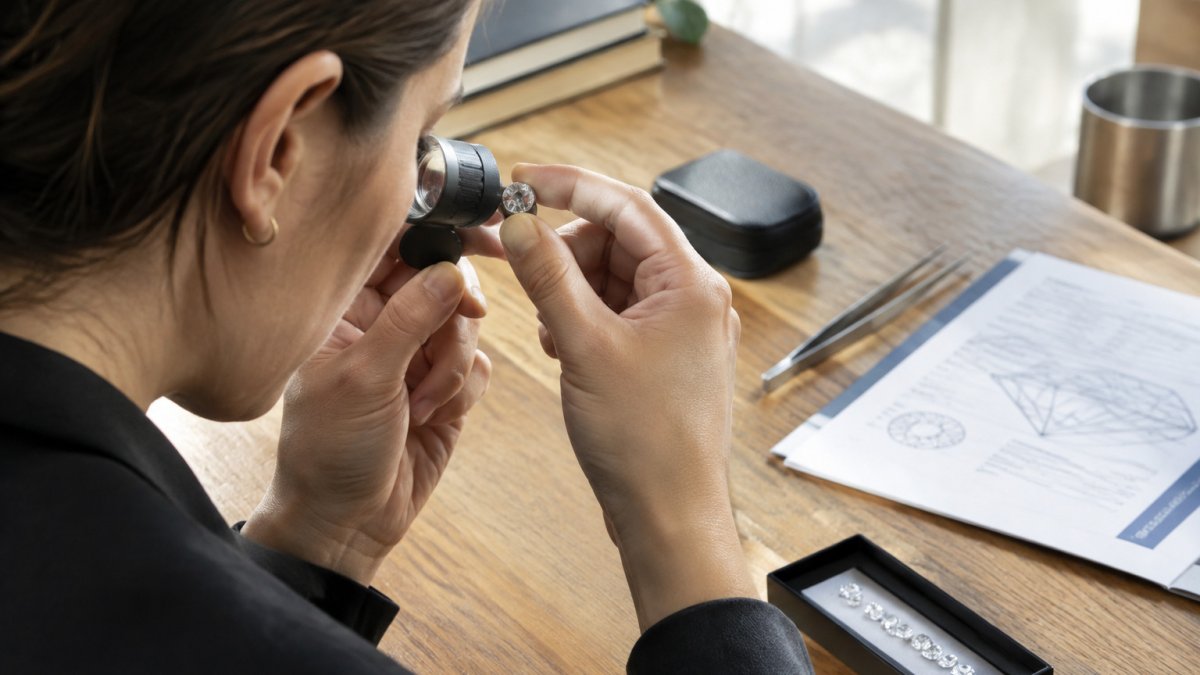
Not every diamond is inscribed, so a missing inscription does not prove anything on its own. Use it as one more check alongside the grading report.
Jeweler examining a loose diamond under a loupe at a bright wooden workbench, with a small magnifier and grading paperwork nearby.
Step 3: What Visual Inspection Can and Cannot Reveal
Visual checks can tell you about cut quality, brilliance and obvious flaws. They cannot reliably tell a lab grown diamond from a natural one. A well-cut stone looks the same whatever its origin, so looking at sparkle is not a test of origin.
Use your eyes to confirm the basics:
- Check that the stone is clean, with no chips on the edges
- Look at how evenly the facets reflect light
- Confirm the setting holds the stone firmly
Step 4: Using a Lab-Grown Diamond Tester Correctly
Some buyers use a consumer diamond tester, which measures how a stone conducts heat or electricity. Testers can help separate diamonds from simulants such as cubic zirconia or moissanite, but they generally cannot confirm whether a diamond is lab grown or mined. Read the instructions carefully and test only loose stones or unset diamonds where the tip can touch the surface.
Limitations of Consumer Diamond Testers
- They separate diamond from non-diamond, not lab grown from natural
- Results depend on the tester's calibration and the stone's setting
- A tester cannot replace a grading report
Step 5: When to Use a Professional Gemological Lab
For a major purchase, or any stone whose paperwork is missing or doubtful, an independent gemological laboratory is the only definitive route. This is the step most consumer guides skip, and it is where the real answer to "how to identify lab grown diamonds" lives: origin is confirmed by instruments, not by eye.
What the Equipment Actually Does
Professional identification relies on the fact that lab-grown and natural diamonds share optical and physical properties but differ in trace-level chemistry and growth structure. The common tools fall into three tiers:
- Screening devices. Benchtop screening devices from several manufacturers can flag whether a stone is natural or lab grown by measuring absorption and luminescence behavior. They are fast and are used by jewelers at the counter, but they are screening tools, a "refer" result means the stone needs deeper testing, not that it is fake.
- Spectroscopy. Fourier-transform infrared (FTIR) spectroscopy detects nitrogen aggregation patterns and hydrogen impurities that differ between natural and lab-grown diamonds; photoluminescence (PL) spectroscopy at liquid-nitrogen temperatures picks up the silicon-vacancy and nitrogen-vacancy defects characteristic of CVD growth. These are the methods a grading lab uses to state origin with confidence.
- Growth-structure imaging. Cross-polarized light and cathodoluminescence reveal the layered growth patterns of CVD diamonds and the metallic-flux inclusions of HPHT stones, which natural diamonds do not show.
When the Cost and Wait Are Worth It
Independent lab assessment fees and turnaround times vary by laboratory, stone size and service level, so check current rates directly with the lab before you send a stone. That is easy to justify in three situations: a stone bought secondhand or at auction with no report, a report whose number does not match the stone, and any purchase where the price is far below the going rate for a comparable natural diamond. For a new stone from a reputable seller with a current IGI or GIA report, the report itself is usually sufficient and a second lab trip is optional.
What the Lab Will and Will Not Tell You
A lab can confirm origin, detect treatments such as fracture filling or color enhancement, and verify that a report belongs to a given stone. It will not appraise the stone for resale value or grade it against a different lab's standards, those are separate services. Ask specifically for an origin determination and a report verification, and get the scope in writing before you ship the stone.
Watch out: Do not ship a diamond to a lab without insured, trackable delivery and a written scope of work, an uninsured loose stone in transit is an unrecoverable loss, and a vague request can come back with a grading report that never actually addresses origin.
Booking Your Verified Purchase at Native Jewel
When you buy from Native Jewel, each IGI-certified lab grown diamond ships with its report, so you can complete the checks above on your own. Our IGI certification explained page covers what the report means. For a verified stone set in fine jewelry, browse the lab grown diamond engagement rings collection.
Start with the 3ct Oval Lab Diamond Engagement Ring in 14K White Gold, priced at $3,600.00. Its 3ct oval center is IGI certified, graded D color and VS1 clarity. You can also see the 1.50ct Round Lab Diamond Solitaire Engagement Ring in 14K yellow gold at $1,900.00, which features a D/VS1 IGI-certified center stone.

Watch out: Do not rely on sparkle or a seller's word alone. Always match the report number and origin statement before you buy.
Frequently Asked Questions
Can you tell if a diamond is lab-grown just by looking at it?
Not reliably. Lab-grown and natural diamonds share the same chemical composition, hardness, and optical behavior, so a casual look rarely reveals the difference. Visual inspection can spot obvious clues such as unusual color zoning or cut irregularities, but it cannot confirm origin. Use the grading report, a laser inscription check, and when needed a professional gemological lab to verify. Native Jewel's lab-grown diamonds are IGI-certified, so the report documents origin for each stone.
Can a diamond tester tell if a diamond is lab-grown?
Some can, but results vary. Many consumer testers measure thermal or electrical conductivity, and some lab-grown diamonds, particularly those with specific growth histories, can read like natural stones. Testers are useful for screening out simulants such as cubic zirconia, yet they should not be the final word on origin. For a definitive answer, pair any tester result with a grading report and a professional examination.
Do lab-grown diamonds have a laser inscription?
Many do. Reputable grading labs and growers often laser-inscribe a serial number or identifying code on the girdle, the thin band around the stone's widest point. The inscription is usually visible only under magnification, around 10x. Match the inscription number to the one on the grading report to confirm the stone is the one described. If no inscription or report exists, ask the seller for documentation before buying.
How do you check a diamond's grading report?
Confirm the issuing lab, the report number, and the stated origin. Check that the carat weight, color, clarity, and cut grade match the listing, and verify the report number on the lab's website. Look for the words 'laboratory-grown' or 'lab grown' in the origin section. Native Jewel's IGI-certified diamonds come with reports you can verify directly with IGI.


