

Cart
0
Table of Contents
- The Short Answer: GIA Does Not Grade Lab-Grown Diamonds
- Why GIA Stopped Certifying Lab-Grown Diamonds
- IGI vs GIA Lab-Grown Diamond Certification: What You Need to Know
- How to Read a Diamond Grading Report for Lab-Grown Stones
- Are Lab-Grown Diamonds Real? Understanding the Science and Standards
- Verifying Your Lab-Grown Diamond's Certification and Authenticity
- What This Means for Your Purchase and Resale Value
- Frequently Asked Questions
Last Updated: October 1, 2026
The Short Answer: GIA Does Not Grade Lab-Grown Diamonds
No, are lab grown diamonds certified by GIA is not possible, the Gemological Institute of America stopped grading lab-grown diamonds in 2021 and does not issue certifications for them. If you're shopping for lab-grown diamonds, you won't find a GIA report. Instead, the International Gemological Institute (IGI) has become the primary certifier for laboratory-created stones in the United States market. At Native Jewel, we work exclusively with IGI-certified lab-grown diamonds.
This distinction matters because GIA's exit created a certification gap that IGI now fills. Understanding this shift is crucial for engagement ring purchases, where authenticity and resale value are genuine concerns.
Why GIA Stopped Certifying Lab-Grown Diamonds
GIA's 2021 decision to discontinue lab-grown grading was the culmination of a decade-long shift. The institute had built its reputation on natural diamonds and recognized that extending authority to synthetics risked diluting that brand position in the eyes of the natural diamond industry.
GIA cited three reasons for its exit. First, lab-grown diamonds exhibit different optical characteristics (fluorescence patterns, nitrogen distribution, growth striations) depending on creation method (HPHT or CVD), making a single grading standard problematic. Second, separate grading systems would fragment GIA's authority. Third, the natural diamond industry, GIA's primary stakeholder, viewed lab-grown certification as a competitive threat.
By 2019, GIA signaled its exit by issuing fewer lab-grown reports. In 2021, it formally discontinued lab-grown grading services as production accelerated (40% annual growth from 2015-2020) and retailers scaled their lab-grown offerings. Rather than compete in a commoditizing segment, GIA ceded the market.
This opened the door for the International Gemological Institute (IGI), which had graded lab-grown diamonds since 2014. IGI treated synthetics as a distinct category with adapted protocols acknowledging creation method and origin. As lab-grown market share climbed from 2% in 2015 to over 10% by 2024, IGI doubled down on certification.
For consumers: GIA reports for lab-grown diamonds dated before 2021 are legitimate. Any dated 2021 or later do not exist. Today's lab-grown reports come from IGI, HRD, or AGS (which began offering lab-grown grading in 2019).
Watch Out
If a seller claims their lab-grown diamonds carry a GIA certification dated 2021 or later, that's a red flag. GIA does not grade lab-grown diamonds. Request an IGI, HRD, or AGS report instead, and verify the report number on the certifier's database before purchasing.
IGI vs GIA Lab-Grown Diamond Certification: What You Need to Know
| Aspect | GIA | IGI |
|---|---|---|
| Lab-Grown Grading | Discontinued (2021) | Active, primary certifier |
| Natural Diamond Authority | Industry gold standard | Respected alternative |
| Lab-Grown Report Availability | None | Standard for synthetic diamonds |
| Grading Terminology | 4 Cs (Carat, Color, Clarity, Cut) | 4 Cs adapted for lab-grown |
| Report Verification | N/A for lab-grown | Online database lookup available |
IGI's certification carries weight because it adapted grading methodology for lab-grown stones. IGI reports document the 4 Cs, origin, and creation method (HPHT or CVD), reflecting the different fluorescence and internal characteristics of lab-grown diamonds.
Native Jewel's collection features IGI-certified lab-grown diamonds because IGI is the recognized standard. Our 3ct oval and 3.05ct pear-cut options arrive with full IGI documentation.

Pro Tip
When shopping for lab-grown diamonds, always request the IGI report number and verify it directly on IGI's website before completing your purchase. This single step confirms authenticity and protects you from misrepresented stones.
How to Read a Diamond Grading Report for Lab-Grown Stones
An IGI report begins with a unique report number, your verification key. Enter it into IGI's online database to confirm the report is legitimate and matches the stone.
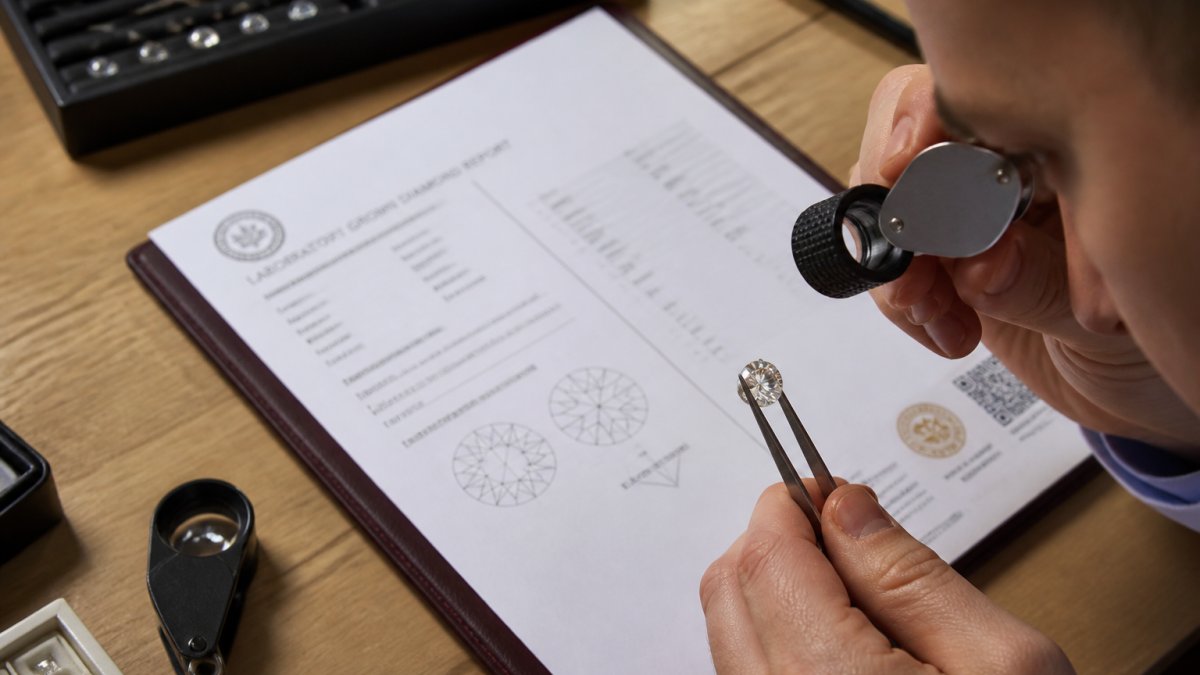
The 4 Cs appear prominently: carat weight in decimal format, color from D (colorless) to Z, clarity from Flawless to Included (VS1 is a value sweet spot), and cut grade (Excellent to Poor) reflecting light interaction.
The origin statement distinguishes lab-grown reports, explicitly identifying the stone as "laboratory-grown" or "synthetic" and noting creation method (HPHT or CVD). The report includes a laser inscription number engraved on the diamond's girdle, tying the physical stone to its report and preventing fraud.
Reports include a plotted diagram showing inclusion locations under magnification, helping you understand the clarity grade. A VS1 diamond's pinpoint inclusions won't affect brilliance but are visible to a trained gemologist.
Are Lab-Grown Diamonds Real? Understanding the Science and Standards
Lab-grown diamonds are chemically, physically, and optically identical to natural diamonds, same carbon lattice structure, same 10 Mohs hardness score, indistinguishable under standard microscopy.
The difference lies in origin and formation time. Natural diamonds formed over billions of years under extreme pressure deep in the earth. Lab-grown diamonds form in controlled laboratory environments in weeks or months. The American Gem Society, the Federal Trade Commission, and major gemological institutions all recognize lab-grown diamonds as real diamonds, not simulants like cubic zirconia or moissanite.
This distinction has real implications. A cubic zirconia looks brilliant initially but clouds over in months due to surface scratching and refractive index differences. Lab-grown diamonds maintain their sparkle indefinitely because their optical properties are identical to natural diamonds. They'll pass a diamond tester, hold their clarity, and resist scratching just as effectively as any mined stone.
4.05ct Oval Lab Diamond Engagement Ring | 3ct Center | D/VS1 IGI Certified →
The "real diamond" question often masks a deeper concern: resale value. Lab-grown diamonds do trade at lower resale prices than comparable natural diamonds. This isn't because they're inferior, it's because lab-grown supply is growing while natural diamond supply is fixed. If you're buying an engagement ring with the expectation of selling it later at similar value, that's a realistic consideration worth acknowledging upfront.
Key Takeaway
Lab-grown diamonds are chemically real diamonds. They're not cubic zirconia or costume jewelry. The resale value difference reflects market supply dynamics, not quality or durability.
Verifying Your Lab-Grown Diamond's Certification and Authenticity
Before finalizing any purchase, take three concrete steps to verify authenticity. First, request the IGI report number from the seller. This 10-digit code is your verification key. Go directly to IGI's website and enter the report number into their report verification database. The system will display the report details, carat weight, color, clarity, cut, and origin statement. If the information matches what the seller told you, you've confirmed the report is legitimate.
Second, examine the laser inscription if possible. Most IGI-certified lab-grown diamonds have the report number laser-inscribed on the girdle. This microscopic engraving serves as a tamper-evident security feature. If a stone has an IGI report but no matching laser inscription, that's suspicious.
Third, request documentation of the stone's origin and creation method. Legitimate sellers provide this information readily. Native Jewel includes complete IGI documentation with every lab-grown diamond ring, along with our lifetime warranty on craftsmanship. This transparency isn't just good business, it's the standard you should expect.
If a seller resists providing the IGI report number, claims the report is "in transit," or offers vague assurances instead of concrete verification, walk away. The certification exists precisely to protect you. Any legitimate lab-grown diamond comes with full documentation.
What This Means for Your Purchase and Resale Value
The absence of GIA certification for lab-grown diamonds has concrete implications for your buying decision, but the deeper issue is understanding how certification affects resale liquidity and insurance coverage, two areas where lab-grown diamonds behave differently than natural diamonds regardless of certification quality.
Resale Value and Market Liquidity
Certified lab-grown diamonds typically resell for less than comparable natural diamonds with identical specifications. This discount exists for two reasons: supply and perception. Lab-grown diamond production is expanding, which increases supply and suppresses resale prices. Perception matters too, many buyers still prefer natural diamonds for engagement rings, viewing lab-grown stones as a budget alternative rather than an equivalent product.
Uncertified lab-grown diamonds trade at even steeper discounts because buyers cannot verify quality claims. Without an IGI, HRD, or AGS report, a seller's assertion that a stone is "VS1 clarity" or "D color" is unverifiable. This uncertainty creates a liquidity problem: fewer buyers will purchase an uncertified stone, and those who do demand significant discounts to offset the risk of misrepresentation.
The certification itself doesn't prevent the resale discount, it prevents a deeper discount caused by verification uncertainty. When you purchase a certified lab-grown diamond, you're accepting the market's lower resale value for lab-grown stones, but you're protecting yourself from the additional penalty that comes with an unverifiable claim.
Insurance and Coverage Implications
Insurance companies treat lab-grown and natural diamonds differently, and certification is the mechanism that makes coverage possible. Most homeowners' and renters' insurance policies do not automatically cover jewelry above a certain threshold.
The Resale vs. Insurance Trade-Off
Key Takeaway
Certification doesn't eliminate the resale discount for lab-grown diamonds, that's a market reality driven by supply and buyer preference. What certification does is prevent an additional discount caused by verification uncertainty, and it enables insurance coverage that protects your investment. For engagement rings, that combination is essential.
Frequently Asked Questions
Does GIA still grade lab-grown diamonds?
No. GIA stopped certifying lab-grown diamonds in 2019. The Gemological Institute of America focuses exclusively on natural diamonds. For lab-grown diamond grading reports, IGI (International Gemological Institute) is the leading certification body. IGI uses the same rigorous grading standards for lab-grown diamonds, evaluating color, clarity, cut, and carat weight, ensuring your stone's quality is independently verified and documented.
What is the difference between a GIA and IGI lab-grown diamond report?
GIA does not issue lab-grown diamond reports. IGI specializes in grading lab-grown diamonds using identical quality assessment criteria. Both organizations evaluate the 4 Cs (color, clarity, cut, carat weight), but IGI's report specifically identifies the diamond as laboratory-grown and includes security features like laser inscription and report number verification. This distinction protects consumers and ensures transparency about diamond origin.
Are lab-grown diamonds considered real diamonds?
Yes. Lab-grown diamonds are chemically, physically, and optically identical to natural diamonds. They possess the same carbon crystal structure and physical properties. The only difference is origin: lab diamonds are created in controlled laboratory environments in weeks or months, while natural diamonds form over billions of years underground. Certification bodies like IGI recognize lab-grown diamonds as genuine diamonds, not simulants like cubic zirconia.
How can I verify that my lab-grown diamond report is authentic?
Every IGI-certified lab-grown diamond includes a unique report number and laser inscription on the diamond's girdle. You can verify authenticity by checking the IGI report database online using your report number. Authentic reports include security features, detailed grading specifications, and the diamond's origin designation. Native Jewel provides IGI-certified diamonds with full documentation.


