

Cart
0
Quick Summary
Ethical jewelry generally costs more than conventional jewelry, because responsible sourcing, fair wages, and traceable supply chains each add cost before the stone is set. The premium concentrates in labor, certification, and aftercare rather than in the stone or metal themselves.
- Stone and metal costs are largely set by commodity and lab markets, not by ethical sourcing.
- The ethical premium shows up mainly in labor, certification, and aftercare line items.
- Lab-grown diamonds can lower the price of an ethically minded purchase, since they typically sell for less per carat.
- Recycled gold is not automatically cheaper, and its sourcing claims need the same documentation scrutiny as mined gold.
- Ask sellers which standard backs their claims and which line items the ethical premium covers.
Table of Contents
- What Makes Jewelry Ethical, and Why It Changes the Price
- Where the Price Premium Comes From: A Cost Breakdown
- Benefits of Lab-Grown Diamonds on Price and Value
- Cost of Recycled Gold vs Mined Gold
- Comparing Native Jewel's Ethical Pieces by Price and Specification
- How to Verify Ethical Jewelry Certifications Before You Pay
- Choosing Your Ring: Value Over the Long Term
- Frequently Asked Questions
What Makes Jewelry Ethical, and Why It Changes the Price
Last Updated: November 4, 2026
Ethical jewelry generally costs more than conventional jewelry, and the reason is traceable at each stage of production.
Does ethical jewelry cost more? In most cases, yes. A piece is generally considered ethical when its materials are responsibly sourced, its makers are fairly paid, and its supply chain can be traced. Each of those commitments adds cost before a single stone is set.
Federal Trade Commission guidance on jewelry marketing claims is a useful starting point when you want to understand how sourcing claims are regulated in the United States.
Conventional jewelry prices often leave out the cost of sourcing. Ethical pieces carry it openly. Once you understand where the money goes, the price difference becomes much easier to evaluate.
Where the Price Premium Comes From: A Cost Breakdown
Most articles answer "does ethical jewelry cost more" with a single sentence: labor and materials cost more. That is true but not useful when you are standing at a checkout page. The premium is easier to accept when you can see which line items move and by how much. Below is a hypothetical breakdown for a 1.50ct lab-grown diamond solitaire in 14K gold, the same specification Native Jewel lists at $1,900.00, showing how an ethical supply chain shifts cost between categories. The percentages are illustrative ranges, not a quote from any single seller, but they reflect the pattern most transparent brands describe.
Line-Item Breakdown: Conventional vs. Ethical Supply Chain
| Cost Category | Conventional Mass-Market Share | Traceable/Ethical Share | What Changes |
|---|---|---|---|
| Center stone | 35-45% | 30-40% | Lab-grown stones cost less per carat than mined; certification adds a fixed fee per stone |
| Metal (14K gold) | 20-30% | 20-30% | Metal value is set by market; recycled refining adds handling cost |
| Labor and setting | 8-12% | 12-20% | Fair wages, safe workshops, and smaller batch runs raise labor share |
| Certification and audit | 1-3% | 3-6% | IGI grading plus supply-chain audits are paid per piece or per shipment |
| Marketing and retail margin | 20-30% | 15-25% | Smaller brands often spend less on wholesale distribution |
| Warranty and aftercare | 0-2% | 2-4% | Lifetime craftsmanship warranties carry a reserved cost |
Two patterns stand out. First, the stone and metal are not where the ethical premium lives, those costs are largely set by commodity markets and lab pricing. Second, the premium concentrates in labor, certification, and aftercare, which are exactly the categories conventional pricing tends to compress.
Why Labor Is the Biggest Lever
Fair wages and safe working conditions raise the cost of extracting gold and stones. Artisanal and small-scale mining often supports families, but operations that pay fairly and meet safety standards cost more to run. Those costs flow into the finished price. A common pattern is that traceable gold carries a refining and documentation premium over spot price, and that premium is passed through rather than absorbed.
Why Mass Production Keeps Conventional Prices Low
Large manufacturers buy in bulk, cut corners on sourcing, and automate production. Those efficiencies lower the price per piece. Ethical makers produce in smaller runs and verify every input, which limits how far prices can fall. The trade-off is real: a mass-market ring can undercut a traceable ring on sticker price while leaving sourcing costs off the balance sheet.
Certification and Auditing: A Fixed Cost Per Piece
Gemological grading and supply-chain audits are not free. IGI grading is billed per stone, and the certificate number is what lets a buyer verify color, clarity, cut, and carat weight independently. Supply-chain audits, whether through a membership organization or a third-party auditor, are billed per facility or per shipment. On a $1,900.00 ring, those fees are a small percentage, but on a $300.00 piece they would be prohibitive, which is one reason very cheap jewelry rarely carries verifiable certification.
Watch out: a brand that quotes a single "ethical premium" percentage without breaking it into categories is usually summarizing, not disclosing. Ask which line items the premium covers.
Benefits of Lab-Grown Diamonds on Price and Value
Lab-grown diamonds are one of the most practical ways to lower the price of an ethically minded purchase. They are chemically and physically identical to mined diamonds, and they typically sell for less per carat.
Native Jewel's lab-grown options show what that looks like in practice. Its 1.50ct round solitaire in 14K yellow gold, with a D color and VS1 clarity grade documented by IGI, is listed at $1,900.00. Its 2ct round solitaire in the same metal is listed at $2,200.00.
The IGI certification documents each stone's grading, and the lifetime warranty on craftsmanship covers the piece over time.
Cost of Recycled Gold vs Mined Gold
Recycled gold and mined gold can look identical, yet they differ in sourcing and cost. Compare them directly in a side-by-side look at recycled and mined gold for engagement rings. Recycled gold comes from existing jewelry, industrial scrap, and electronics, which reduces demand for new extraction. Mined gold requires new extraction, with the labor and environmental costs that come with it. That much is consensus. The more useful question, and the one most overviews skip, is whether recycled gold is genuinely more sustainable or simply a greener label on the same metal.
The Recycled Gold Controversy
The case against treating recycled gold as automatically ethical rests on three mechanisms.
First, gold is fungible. Once refined, recycled and newly mined gold are chemically indistinguishable, and most refiners pool both into the same bullion stream. A brand can buy recycled-certified metal, but the underlying market does not shrink mine output one-for-one when it does.
Second, recycling is energy-intensive. Refining scrap gold to investment grade requires heat, chemicals, and transport. The environmental benefit over mining is real but not absolute, and it depends on the energy source and the distance the scrap travels.
1.50ct Round Lab Diamond Solitaire Engagement Ring | 14K Yellow Gold | D/VS1 IGI →
Third, traceability is harder than the label suggests. A "100% recycled" claim can be accurate at the refiner level while the original source of that scrap remains unknown. The claim describes the input stream, not the full chain of custody.
None of this makes recycled gold a bad choice. It makes it a choice that deserves the same documentation scrutiny as mined gold.
What Actually Drives the Price Difference
Recycled gold is not automatically cheaper to buy. The metal's market value is the same, and refining and handling costs add to the final price. The difference lies in what the purchase avoids: new extraction. In practice, the price gap between recycled and mined gold in a finished piece is usually small relative to the stone and labor, which is why the sourcing question matters more than the metal label.
How to Evaluate a Recycled Gold Claim
Ask the seller questions like these and expect written answers:
- Which standard backs the recycled claim, a named certification or a self-declaration?
- At what point in the chain is the recycled content verified, refiner, manufacturer, or retailer?
- Is the alloy (the 14K or 18K mix) also traceable, or only the fine gold?
- Does the brand disclose the energy source used in refining?
A common pattern is that brands with strong answers publish them; brands with weak answers repeat the word "recycled" without a standard behind it.
Watch out: "recycled" and "responsibly sourced" are not interchangeable. A piece can be one without the other, and a brand that uses both terms should be able to explain how each is verified.
Comparing Native Jewel's Ethical Pieces by Price and Specification
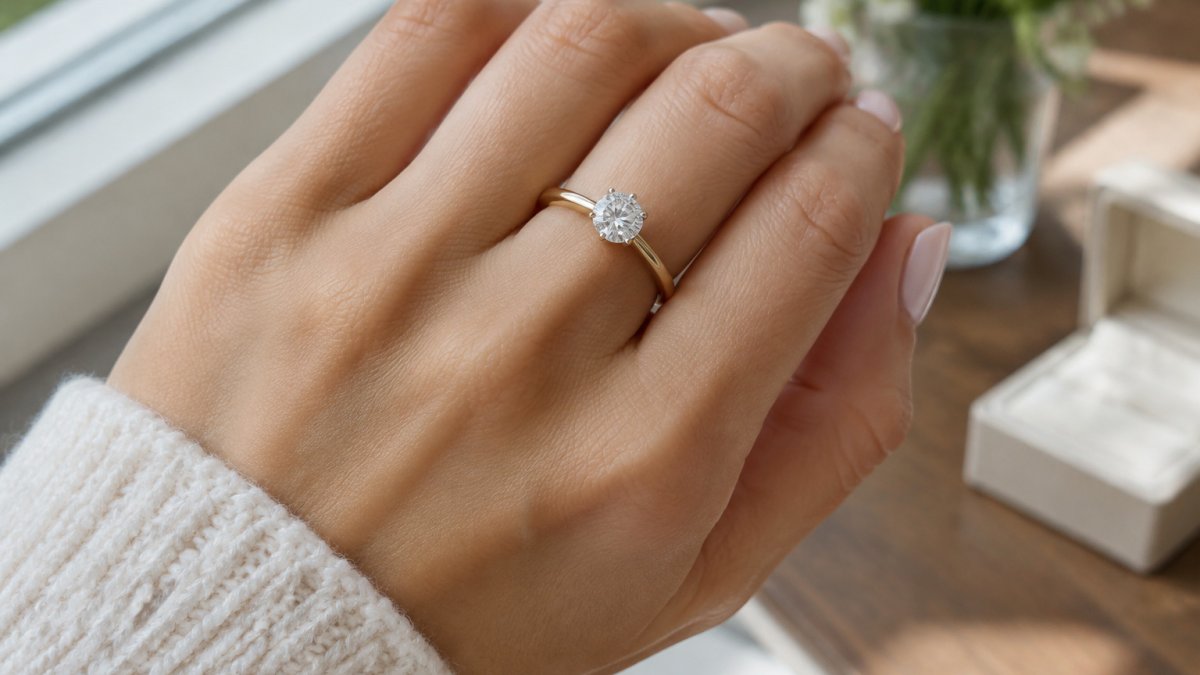
Native Jewel's current engagement ring listings give a clear picture of how price tracks with specification. Prices below are the listed starting prices in USD.
| Ring | Center Stone | Metal | Listed Price |
|---|---|---|---|
| 1.50ct Round Solitaire | 1.50ct round lab diamond, D/VS1, IGI | 14K yellow gold | $1,900.00 |
| 1.50ct Round Pavé | 1.50ct round lab diamond, D/VS1, IGI | 14K yellow gold | $1,900.00 |
| 1.50ct Elongated Emerald | 1.50ct elongated emerald lab diamond, D/VS1, IGI | 14K yellow gold | $1,600.00 |
| 2ct Oval Solitaire | 2ct oval lab diamond, D/VS1, IGI | 14K yellow gold | $2,100.00 |
| 2ct Round Solitaire | 2.00ct round lab diamond, D/VS1, IGI | 14K yellow gold | $2,200.00 |
The 1.50ct elongated emerald is the lowest listed price in this group. The 2ct round solitaire is the highest. Shoppers who want a plain band with the diamond as the focus will find the solitaire styles most direct. Those who prefer added sparkle can compare the pavé band at the same listed price as the round solitaire.
How to Verify Ethical Jewelry Certifications Before You Pay
Before buying, confirm what each certification covers. Native Jewel's center stones are documented by IGI, the International Gemological Institute, which grades diamonds for color, clarity, cut, and carat weight. Ask for the certificate number and check it against the lab's records.
Certification covers the stone, not the whole supply chain. See which certifications lab-grown diamonds typically receive to know what to ask for. Ask separately how the gold was sourced and how the workshop operates. Written answers to those questions are more useful than general sustainability claims.
Watch for vague wording such as "eco-friendly" or "conflict-free" without supporting documentation. Specific claims backed by a named certificate are far easier to check.
Choosing Your Ring: Value Over the Long Term
Price matters, but so does how long a piece will last. Native Jewel's lifetime warranty on craftsmanship adds protection beyond the purchase date.
When you compare options, weigh the listed price against the center stone's specifications, the setting, and the warranty. A ring you wear for decades spreads its cost over many years.
Browse Native Jewel's current engagement rings to compare specifications and prices side by side.
Frequently Asked Questions
Why is ethical jewelry often more expensive?
Ethical jewelry usually carries a higher price because responsible sourcing costs more at each stage. Certified mines and fair-wage labor add expense that mass producers often skip, and traceable materials require documentation that is costly to maintain. Recycled metals and lab-grown stones avoid some of these costs, but the premium still reflects the verification work behind each piece.
Are lab-grown diamonds cheaper than mined diamonds?
Yes, lab-grown diamonds generally sell for less than comparable mined diamonds because they are produced in controlled facilities rather than extracted from the ground. The center stone is documented by IGI, which provides a grading report that confirms color, clarity and carat weight. Native Jewel's 2ct round lab-grown solitaire, graded D color and VS1 clarity, is priced at $2,200.00 in 14K yellow gold. Buyers should compare grading reports, not just the listed price, when weighing two stones.
Does 14K gold cost more when it is ethically sourced?
Ethically sourced 14K gold can cost more than conventional gold, depending on the supplier's documentation and the metal's origin. Recycled gold is one route, and it often costs less than newly mined gold while carrying a lower environmental footprint. The price difference is tied to traceability rather than purity alone, since 14K gold contains 58.3 percent pure gold. Native Jewel's 14K yellow gold engagement rings are priced from $1,600.00 to $2,200.00 depending on the center stone.
How can I tell if my jewelry is truly ethical?
Start by asking the seller for specific documentation rather than general claims about sustainability. For diamonds, request the IGI grading report, which confirms the stone's characteristics and lab origin. For metals, ask whether the gold is recycled or responsibly mined and whether the supplier can trace its source. Compare what the seller provides against a clear written policy. Native Jewel lists IGI certification for its diamonds and a lifetime warranty on craftsmanship.
Shop rings and explore lab diamond solitaires to find the ring that fits your budget and your standards.


