

Cart
0

Quick Summary
To curate a minimalist jewelry collection, start by auditing the jewelry you already own and noting the pieces you reach for most often. Then build around eight to twelve versatile pieces in one or two metals, adding new items slowly and only when you can justify each one.
- Track your last month of outfits to see which pieces you wear most often.
- Most people do well with eight to twelve pieces for everyday rotation.
- 14K gold contains 58.3% pure gold alloyed for hardness and everyday durability.
- Divide a piece's price by its expected total wears to measure cost-per-wear.
- Store each piece in its own compartment so harder materials don't scratch softer ones.
Table of Contents
- Defining Your Personal Style Before You Buy
- Auditing the Jewelry You Already Own
- Must-Have Classic Jewelry Pieces for a Capsule Collection
- Choosing Materials: Why 14K Gold Works for Everyday Wear
- Lab-Grown Diamonds and Sustainable Sourcing in a Minimalist Collection
- Building a Fine Jewelry Collection One Piece at a Time
- How to Store Fine Jewelry to Prevent Scratching
- Start With One Piece You Will Wear Every Day
- Frequently Asked Questions
How to Curate a Minimalist Jewelry Collection
Last Updated: November 4, 2026
Defining Your Personal Style Before You Buy
Curating a minimalist jewelry collection starts with knowing what you actually wear, not what looks good on a mood board.
Look at your last month of outfits. Which pieces came back to you most often?
Write those findings down. A short list of three to five words, such as "clean," "warm," or "understated," gives you a filter for every future purchase.
Auditing the Jewelry You Already Own
Before buying anything new, sort everything you own into three groups: pieces you wear weekly, pieces you wear occasionally, and pieces that sit in a box. The third group is where a minimalist collection usually starts to form.
A common mistake is treating sentimental pieces and daily-wear pieces as one category. Keep the meaningful items, but evaluate them separately from what you actually reach for each morning.
Check condition as well. Tarnished, bent, or loose pieces either need repair or should be retired. Mixing neglected pieces into a capsule only dilutes the collection.
Must-Have Classic Jewelry Pieces for a Capsule Collection
A capsule jewelry collection is built from a small number of versatile pieces that work together. The goal is coverage: every outfit should have an option that fits.
Essential Pieces Worth Building Around
Most minimalist collections rest on a few foundational categories:
- A simple stud or small hoop for daily wear
- A fine chain in a length that sits well with your neckline
- A solitaire ring that suits everyday use
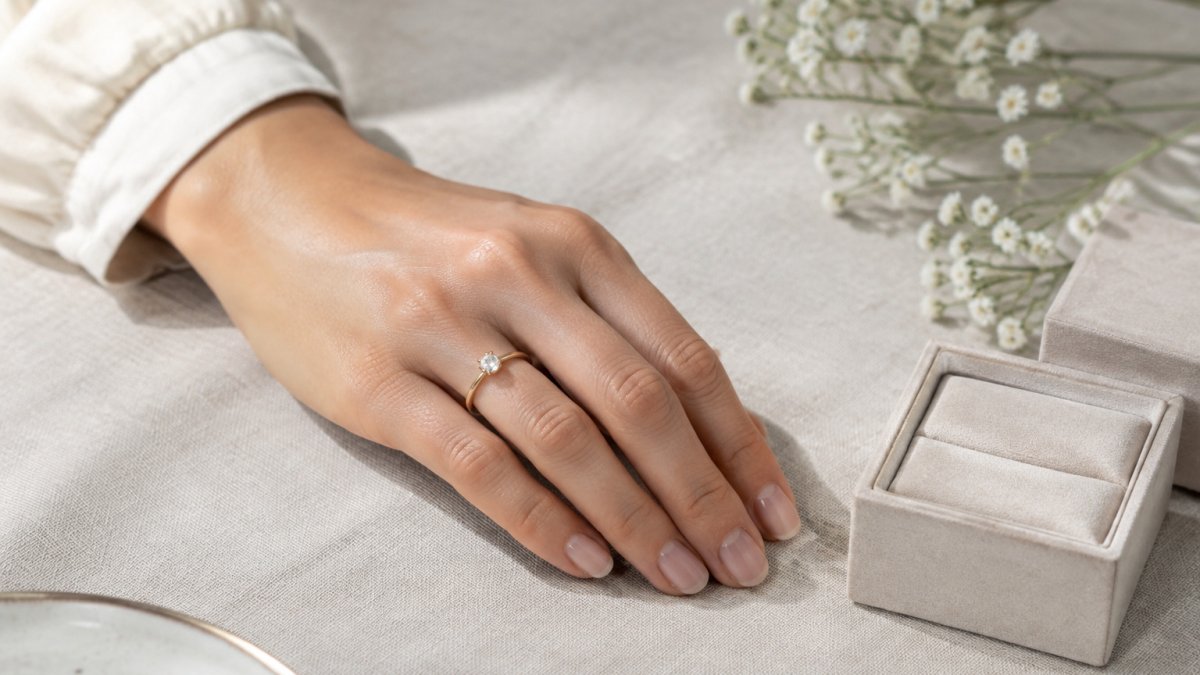
Each of these pieces should coordinate with the others in metal and tone. A single center stone in 14K yellow gold, such as the 2ct Round Lab Diamond Solitaire Engagement Ring at $2,200.00, can anchor a daily look without competing with other pieces.

How Many Pieces a Capsule Really Needs
Most people do well with eight to twelve pieces for everyday rotation. Fewer than that can feel limiting; more than that tends to drift back toward clutter. Count only what you wear regularly, and revisit the number each season.
Choosing Materials: Why 14K Gold Works for Everyday Wear
Material choice matters more in a minimalist collection because you wear fewer pieces more often.
14K gold is a practical choice for everyday use because of its durability and rich color. You can explore options in our 14K gold solitaire engagement rings if a ring is your daily anchor piece.

Keep expectations realistic: no gold is scratch-proof, and surface marks on daily pieces are normal. For practical ways to keep your daily piece from getting scratched, see how to prevent scratches on gold jewelry.
Mixing Metals or Sticking to One
Mixing metals is acceptable in a minimalist collection, but it works best with a deliberate rule. For a detailed walkthrough, read the complete guide to mixing gold and silver jewelry. Many shoppers choose one dominant metal and add a single accent in a second tone.
If you already own silver and gold, consider which metal you wear most and let it set the palette for future purchases.
Skin Sensitivity and Hypoallergenic Options
Skin sensitivity is a common reason people abandon otherwise favorite pieces. For specific gold pieces that resist tarnish and suit sensitive skin, see the best gold jewelry for sensitive skin that won't tarnish. Check the metal composition of any piece before buying, and ask for documentation if irritation has been an issue for you.
The article's key material facts are easier to compare at a glance.
| Material or point | Key fact | Note |
|---|---|---|
| 14K gold | 58.3% pure gold | Alloyed for hardness |
| Everyday wear | Resists wear better | Better than higher-karat gold |
| Lab-grown diamonds | Chemically and optically identical | Disclosed as lab-grown by sellers |
| Native Jewel diamonds | IGI-certified | Documents color, clarity, cut |
| Surface marks | Normal on daily pieces | Consistent care matters most |
Lab-Grown Diamonds and Sustainable Sourcing in a Minimalist Collection
Lab-grown diamonds are chemically and optically identical to mined diamonds, and many minimalist shoppers choose them for ethical and sustainability reasons. Federal Trade Commission guidance on diamond origin disclosures requires sellers to clearly disclose when a diamond is lab-grown rather than natural, so look for that clarity from any retailer.
When evaluating sustainable sourcing, ask for certification from a recognized grading lab. Native Jewel's lab-grown diamonds are IGI-certified, which gives you a documented record of the stone's color, clarity, and cut.
3 Carat Round Solitaire Engagement Ring | 14K Yellow Gold | D/VS1 IGI Certified →
Building a Fine Jewelry Collection One Piece at a Time
Building slowly is the core principle of minimalism. Add one piece at a time, and only after you have worn your current pieces enough to know what is missing. The practical question is not "Do I like this?" but "Will I still reach for this in three years?" A cost-per-wear framework answers that question with a number instead of a feeling.
Calculating Cost-Per-Wear
Cost-per-wear is a practical way to judge whether a purchase is worth it. Divide the price of a piece by the number of times you expect to wear it.
Use the same formula to decide which pieces to keep, repair, or let go. A piece worn fewer than 12 times a year may not justify its space in a minimalist collection, regardless of price.
A Step-by-Step Cost-Per-Wear Framework
- Estimate realistic wears per year. Be honest: a statement ring may get 10 wears; a daily chain may get 300. Do not use best-case numbers.
- Set a useful life. Fine jewelry in 14K gold can last a long time with care. Estimate a realistic useful life for each piece based on how it is made and worn.
- Divide price by total wears. Total wears = wears per year × useful life. A $2,000 ring at 300 wears/year × 10 years = 3,000 wears, or about $0.67 per wear. A $150 plated necklace at 100 wears/year × 1.5 years = 150 wears, or $1.00 per wear.
- Compare against a threshold. Some shoppers set their own per-wear ceiling for everyday and occasion pieces. These are guidelines, not rules, adjust to your budget.
- Re-run the math after a year. If actual wears are far below your estimate, the piece is a candidate for resale, gifting, or retirement.
Where Cost-Per-Wear Breaks Down
Cost-per-wear is a decision aid, not a verdict. It undervalues sentimental pieces, which may justify their place on meaning rather than math. It also assumes you can predict your habits, which most people cannot do perfectly.
Watch out: using a low cost-per-wear to justify a purchase you would not otherwise make is the most common way this framework backfires. The formula should filter decisions, not create them.
Applying the Framework to Repairs and Resale
Run the same math on repairs. If a $120 repair extends a $600 ring's life by five years of daily wear, the added cost-per-wear is negligible and the repair is usually worth it. If the repair costs more than the piece's resale value and you rarely wear it, let it go. For resale, compare the expected sale price against the cost-per-wear you have already captured, a piece worn daily for years has already returned its value even if resale is low.
How to Store Fine Jewelry to Prevent Scratching
Storage is where many collections lose their value. A minimalist collection is small enough that a deliberate storage system is cheap and easy, and it is the single best defense against the scratches, tangles, and tarnish that make people replace pieces they already own.
The Core Principle: Separate by Hardness
Diamonds are harder than gold and softer gemstones and can scratch them. Every piece should have its own compartment, pouch, or slot so harder materials never rub against softer ones. A shared dish or a single tangled chain is the fastest route to dull stones and hairline scratches on gold.
A Simple Storage System for a Small Collection
- A lined jewelry box with individual compartments for daily-wear pieces, one slot per item, felt or velvet lining.
- Soft pouches for travel and for pieces that share a box; never stack two rings in one pouch.
- A separate tray or roll for chains, hung or laid flat to prevent kinks.
Humidity, Tarnish, and Air Exposure
Tarnish is a chemical reaction with sulfur compounds and moisture in the air, not a sign of poor quality. Tarnish is more common on some metals than on others.
Watch out: storing jewelry in an open dish on a bathroom counter exposes it to daily humidity spikes and perfume overspray, two of the most common causes of premature tarnish and dull diamonds.
Travel Storage
A small zip pouch or a dedicated travel case with individual slots prevents chains from tangling and rings from scratching each other in a bag. Keep one pouch per piece and pack jewelry last, after toiletries are sealed.
What Not to Do
- Do not store pearls or opals in airtight containers; they need some humidity.
- Do not hang heavy pieces from thin chains.
- Do not store pieces with loose stones, repair first, then store.
A Five-Minute Weekly Reset
A minimalist collection stays minimal only with maintenance. Once a week, return every piece to its slot, wipe daily-wear pieces with a soft cloth, and check clasps and settings. This five-minute habit prevents the slow drift back into clutter and catches loose stones before they become lost stones.
Start With One Piece You Will Wear Every Day
The best minimalist collections begin with a single piece you reach for without thinking. Choose one everyday item, wear it for a month, and let that experience guide your next purchase. Our 2ct round solitaire in 14K yellow gold and 3 carat round solitaire with IGI certification are good places to start if a ring is your anchor.

Frequently Asked Questions
What are the essential pieces for a minimalist jewelry collection?
A minimalist collection usually starts with a small set of versatile pieces: a solitaire ring, a pair of stud earrings, a simple chain necklace, and one everyday bracelet or band. Choose designs with clean lines that layer well and pair with most of your wardrobe. Native Jewel's 14K yellow gold solitaire rings, such as the 2ct Round Lab Diamond Solitaire Engagement Ring at $2,200.00, are a good anchor piece because the single center stone works with nearly any outfit. Build the rest around that core.
How do you choose high-quality materials for everyday jewelry?
Look for solid 14K gold rather than gold-plated or vermeil pieces if you want jewelry that lasts through daily wear. Check that diamonds come with a grading report, such as IGI certification, which documents color, clarity, cut, and carat weight. Ask whether the brand offers a warranty on craftsmanship. Native Jewel includes a lifetime warranty on craftsmanship and an IGI report with its lab-grown diamond pieces, which gives you documentation to compare against any other seller.
How many pieces should be in a minimalist jewelry capsule?
Most people find that 10 to 15 pieces cover their daily needs without crowding a jewelry box. The right number depends on how often you dress up, how many metals you wear, and how active your routine is. Start with the pieces you already wear most and add only when a gap appears in your rotation. A smaller, well-chosen collection is easier to care for and easier to dress around.
How do you store fine jewelry to prevent scratching?
Store each piece separately in a soft pouch or a lined compartment so that diamonds and gold do not rub against each other. Keep rings in a dedicated slot and avoid tossing them into a loose dish. Remove jewelry before swimming, exercising, cleaning, or applying lotion and perfume. Keep the box in a dry area away from direct sunlight, since humidity and heat can dull the finish over time.
Are lab-grown diamonds a good choice for a minimalist collection?
Lab-grown diamonds are chemically and optically identical to mined diamonds. Their value lies in the stone's quality and documentation rather than its origin. For a minimalist collection, a single IGI-certified lab-grown diamond in a classic setting offers brilliance and an ethical sourcing story without a large markup. Confirm the grading report before purchase, and compare clarity and color on the certificate rather than relying on the label alone.
What is the difference between costume and fine jewelry for a capsule collection?
Costume jewelry is usually made from base metals with a thin plating and set with glass or simulated stones. It can look good initially but tends to tarnish, flake, or change color with wear. Fine jewelry is made from solid precious metal, such as 14K gold, and set with real or lab-grown gemstones. Because it holds up to daily wear, fine jewelry suits a capsule collection where each piece is worn often and needs to last for years.
Does 14K gold hold up better than 18K for everyday wear?
14K gold contains 58.3 percent pure gold mixed with harder alloy metals, which makes it more resistant to scratches and dents than 18K gold, which is 75 percent pure. That extra strength is why 14K is a practical choice for rings and bracelets worn daily. Native Jewel offers its fine jewelry in 14K gold, and its lifetime warranty on diamond jewelry and 30-day returns give you a way to test a piece before committing.


