

Cart
0
Last Updated: November 11, 2026
Quick Summary
To measure ring size at home, wrap a flexible tape or paper strip around the base of the finger, just above the knuckle, mark where it overlaps, then read the length in millimeters. Take two or three readings in the evening, average them, and compare the result to a sizing chart.
- Measure in the late afternoon or evening, when fingers are typically at their fullest.
- Wrap the tape at the base of the finger, not over the knuckle.
- Set light tension so the tape leaves no deep pressure mark.
- Measure the knuckle too, since a ring must pass over it to fit.
- Wider bands may need a slightly larger size than thinner bands.
Table of Contents
- Why Measuring Your Ring Size at Home Matters Before You Buy
- What You Need to Measure Ring Size at Home
- Step-by-Step: How to Measure Ring Size at Home with Tape Measure
- Ring Size Chart in CM and US Sizes
- Using a Printable Ring Sizer for Accurate Results
- Why Finger Size Changes and How Knuckles and Ring Width Affect Fit
- How to Know Your Ring Size Without Measuring
- Book Your Custom Fit Before Ordering Your Native Jewel Ring
- Frequently Asked Questions
Why Measuring Your Ring Size at Home Matters Before You Buy
Getting your ring size right is the most important step in buying a ring online. A common pattern is a shopper who finds the perfect design, orders it, and then receives a ring that fits too tight or too loose. Measuring at home first saves time, money, and the disappointment of a wrong size.
A ring that sits too snug can leave marks and feel uncomfortable by afternoon. A ring that spins or slides off can get lost. Because a ring is worn all day, every day, a good fit matters more than most buyers expect.
Measuring your own finger at home is simple. You need almost nothing, and you can do it in about five minutes.
What You Need to Measure Ring Size at Home
You do not need special equipment to measure your ring size. Most of what you need is already in your home.
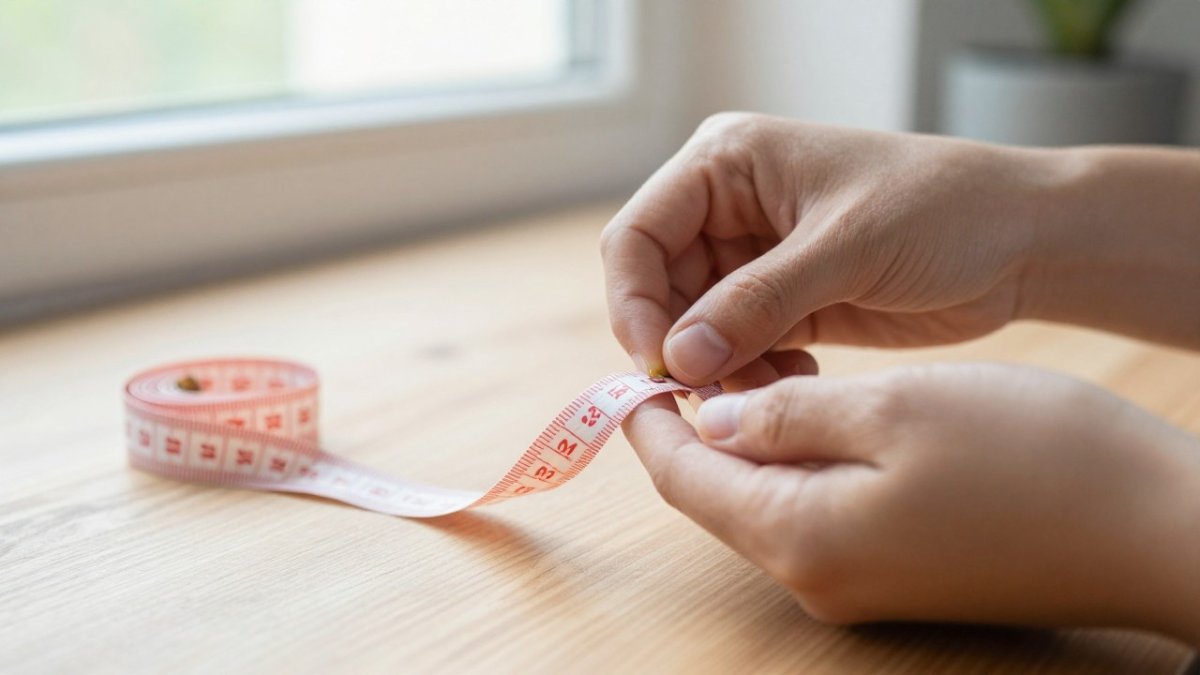
- A flexible measuring tape or a strip of paper: A cloth tape works best, but a thin strip of paper works too.
- A ruler: A standard ruler marked in millimeters gives the most accurate reading.
- A pen or marker: Use it to mark the paper where it overlaps.
- A printable ring sizer: Many jewelers offer a printable PDF you can use as a guide.
- A ring that already fits: If you have one, you can measure it directly.
Keep the measuring tools close and work at a table or desk. Having everything ready makes the process faster and less error-prone.
Step-by-Step: How to Measure Ring Size at Home with Tape Measure
Follow these steps in order. Each one addresses a specific source of error that commonly produces a ring that is off by a half size or more.
-
Pick the correct finger and hand. The left ring finger is the most common choice for engagement and wedding rings, but the ring should be measured on the finger and hand where it will actually be worn. Fingers can differ in size even on the same hand, so do not assume the ring finger matches the middle finger.
-
Choose a consistent time of day. Measure in the late afternoon or evening, when fingers are typically at their fullest. Avoid measuring straight after a hot shower, heavy exercise, a salty meal, or time in a very cold room, because each can shift circumference enough to matter.
-
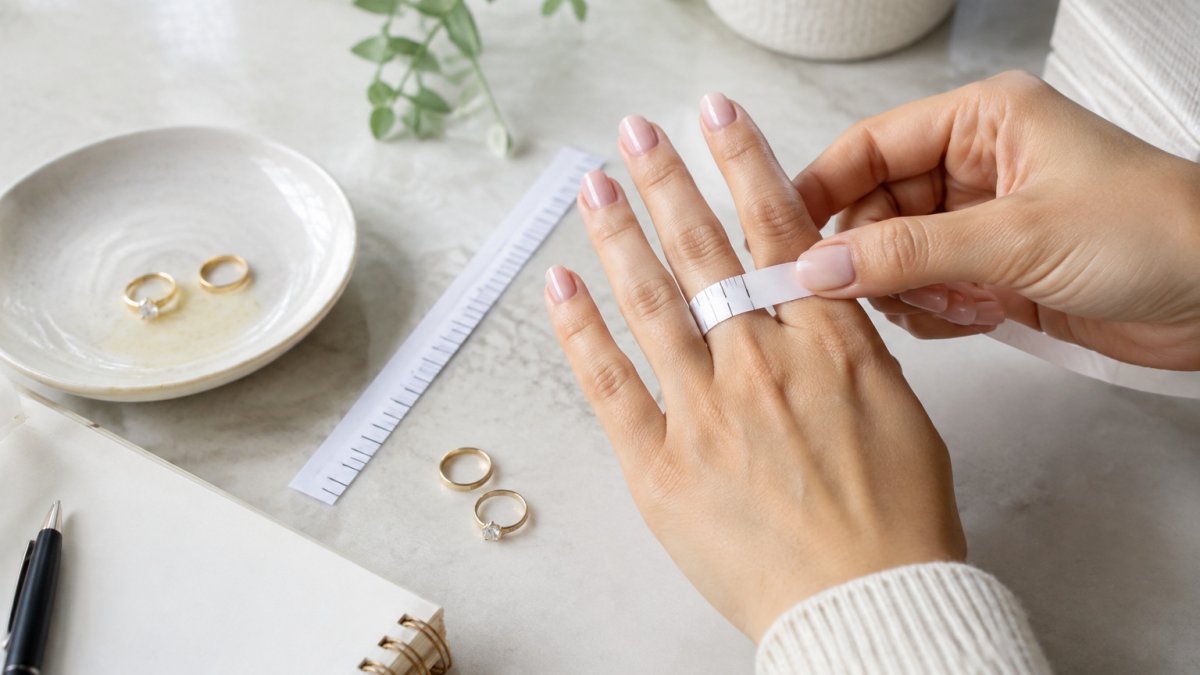
Wrap the tape at the base of the finger. Position the tape where the ring would rest, just above the knuckle, not over the knuckle itself. The base is the reference point for how the ring will sit when worn.
-
Set the tension. The tape should slide on with light resistance and should not leave a pressure mark. Too loose and the reading will be large; too tight and it will be small. Check the skin under the tape after removing it. A faint line is acceptable; a deep indentation means the tape was too tight.
-
Mark the overlap and read the length. Note where the two ends meet, lay the tape flat, and read the length in millimeters. That length is the circumference. Record the reading immediately so you do not rely on memory.
-
Measure the knuckle as well. Wrap the tape over the knuckle using the same tension and record that number. If it is noticeably larger than the base reading, this matters for fit and should be considered when choosing the final size.
-
Repeat and average. Take at least two or three readings, then average them. If the readings differ by more than a millimeter, measure again at a different point in the day and compare.
-
Check against a sizing chart. Use the chart below to convert the circumference to a US size. If the number falls between two sizes, consider the width of the band you intend to wear before you decide.
Watch out: measuring a finger that is cold, freshly swollen, or temporarily changed by illness will give a reading that does not represent your normal fit, so re-measure once the finger has returned to its usual state.
Ring Size Chart in CM and US Sizes
The chart below lists common circumference and diameter measurements alongside US ring sizes. Use it to convert your measurement.
| US Ring Size | Circumference (mm) | Diameter (mm) |
|---|---|---|
| 4 | 47.1 | 15.0 |
| 5 | 49.3 | 15.7 |
| 6 | 51.9 | 16.5 |
| 7 | 54.4 | 17.3 |
| 8 | 56.7 | 18.1 |
| 9 | 59.5 | 18.9 |
| 10 | 61.9 | 19.7 |
If your measurement falls between two sizes, you are "between sizes." In that case, choose the size that matches your measurement most closely, then consider the width of the band before you decide.
Using a Printable Ring Sizer for Accurate Results
A printable ring sizer is a helpful tool. It gives you a quick way to check your size without doing any math.
- Print the sizer at 100% scale so the lines stay true. Do not use "fit to page."
- Wrap the printed strip around your finger and check where the marked edge lines up.
- Compare the result against your string or tape measurement.
Printers can slightly change the scale of a page, so always check that a printed 1-inch line measures exactly 1 inch before you rely on it.
Why Finger Size Changes and How Knuckles and Ring Width Affect Fit
Your finger size is not a fixed number. Circumference shifts with temperature, humidity, sodium intake, hydration, exercise, and time of day. Fingers tend to be largest in the late afternoon or evening, after a day of activity and standing, and smallest in cool morning conditions. A measurement taken in a cold room can come out a half size smaller than the same finger measured after a warm shower or a long walk. This is why the measurement advice in this guide recommends evening readings and repeated trials.
Two physical features matter more than most sizing guides admit: the knuckle and the width of the band.
Knuckle size. A ring has to pass over the knuckle before it settles at the base of the finger. The knuckle is usually wider than the base, so a ring sized only to the base can feel fine at the table and then refuse to slide past the joint. To check this, measure the circumference at the knuckle with the same tape method, then compare it to the base measurement. If the knuckle reads noticeably larger, the ring will need extra room to clear the joint. The knuckle is often wider than the base, though individual hands vary widely. Watch out: a ring sized to the knuckle alone will be loose at the base and may spin or slide off, so the goal is a compromise measurement, often with a slightly larger size chosen and a sizing or fit check before the ring is finalized.
Band width. A wide band covers more of the finger's surface, and the inside of the ring has to clear the same circumference over a larger area. This means a wide band sits tighter than a thin band cut to the identical inside diameter. Many jewelers suggest that wider bands may need a slightly larger size than thinner bands cut to the same measurement. The reason is that the inner diameter of a wide band must be a bit larger to slide on comfortably, while a thin band of the same size fits looser. If you measured with a thin strip of paper or a thin string and then plan to wear a wide band, the measurement alone will mislead you.
The practical takeaway is to measure the base and the knuckle, note the width of the band you intend to wear, and then adjust. If you are buying online, note the width you plan to wear and whether you have a large knuckle when you place your order.
How to Know Your Ring Size Without Measuring
Sometimes you cannot measure at home. In that case, you have a few other options.
- Borrow a ring: Ask a partner or friend for a ring that already fits the correct finger, then measure it.
- Check an existing ring: Look for a ring you already wear on the same finger and measure its inside diameter.
- Ask a jewelry professional: A jeweler can measure your finger in person, often at no cost.
Each of these methods gives you a reliable starting point without needing a tape measure at home.
Book Your Custom Fit Before Ordering Your Native Jewel Ring
Once you have your measurement, you are ready to shop. If you want a ring made exactly for your finger, book a custom fit before you order. A custom fit helps you confirm your size and width so you order with confidence.
Once your ring arrives, you may want to know how existing rings are resized if your measurement turns out to be slightly off. Our guide on resizing an engagement ring explains the process step by step.
If you are weighing whether a custom piece fits your budget and plans, our article on whether a custom engagement ring is worth it walks through the decision. And if your ring will be worn with a stacked band, our guide to wedding bands for low-profile engagement rings shows how width affects fit.
Measure carefully, use the chart, and check your size before you buy. A few minutes of preparation gives you a ring that feels right from the first day.
Frequently Asked Questions
What is the easiest way to measure ring size at home?
The easiest method is the paper strip or string method. Wrap a thin strip of paper or string around the base of the finger where the ring will sit, mark where it overlaps, then measure that length with a ruler. Compare the result to a printable ring sizer or chart to find your US size. Measure at the end of the day, when fingers are typically at their largest, so the ring stays comfortable in warm weather and during activity.
How do I measure my ring size with a tape measure?
Wrap a flexible tape measure snugly around the base of your finger, without pulling it tight. Read the measurement in millimeters at the point where the tape overlaps. Use a ring size chart in cm to convert that circumference to a US ring size. Measure more than once and average the results, because small measurement errors can shift you by a half size.
Can I find my ring size without measuring?
Yes, if you have a ring that already fits the finger you plan to wear it on, you can measure that ring instead of your finger. Place it on a ruler and measure the inside diameter or circumference, then match it to a conversion chart. Many people also use a ring they wear on the same hand, which is a practical shortcut when you cannot take an accurate measurement.


