

Cart
0
Last Updated: November 9, 2026
Quick Summary
Style vintage-inspired engagement rings by identifying the era the design borrows from, then dressing to match its mood: lacy Edwardian pieces want soft, romantic clothing while bold Art Deco rings want clean lines and contrast. Let the ring anchor the outfit, and keep only one zone of detail heavy at a time.
- Victorian designs are ornate and romantic, often yellow gold with intricate detail.
- Keep one hand to two rings maximum when either ring carries heavy detail.
- Match the wedding band profile to the ring's underside gap for a proper fit.
- Put the hardest, plainest band closest to the engagement ring to absorb friction.
- Vintage style rings under $1,000 are realistic with lab-grown diamonds and 14K gold.
Which vintage era fits your style?Explore 14K gold, IGI-certified lab-grown diamond rings handcrafted for everyday elegance.
Shop Vintage Rings
Table of Contents
- Start With the Ring's Era, Not the Outfit
- Popular Vintage Engagement Ring Settings and What They Say About Style
- Why Vintage Style Engagement Rings in Gold Flatter Most Skin Tones
- How to Mix Vintage and Modern Ring Styles Without Clashing
- Pairing Wedding Bands With a Vintage-Inspired Ring
- Everyday Styling: Outfits, Occasions, and Jewelry Pairings
- Vintage Style Engagement Rings Under $1,000: What to Expect
- Choose Your Vintage-Inspired Ring at Native Jewel
- Frequently Asked Questions
Start With the Ring's Era, Not the Outfit
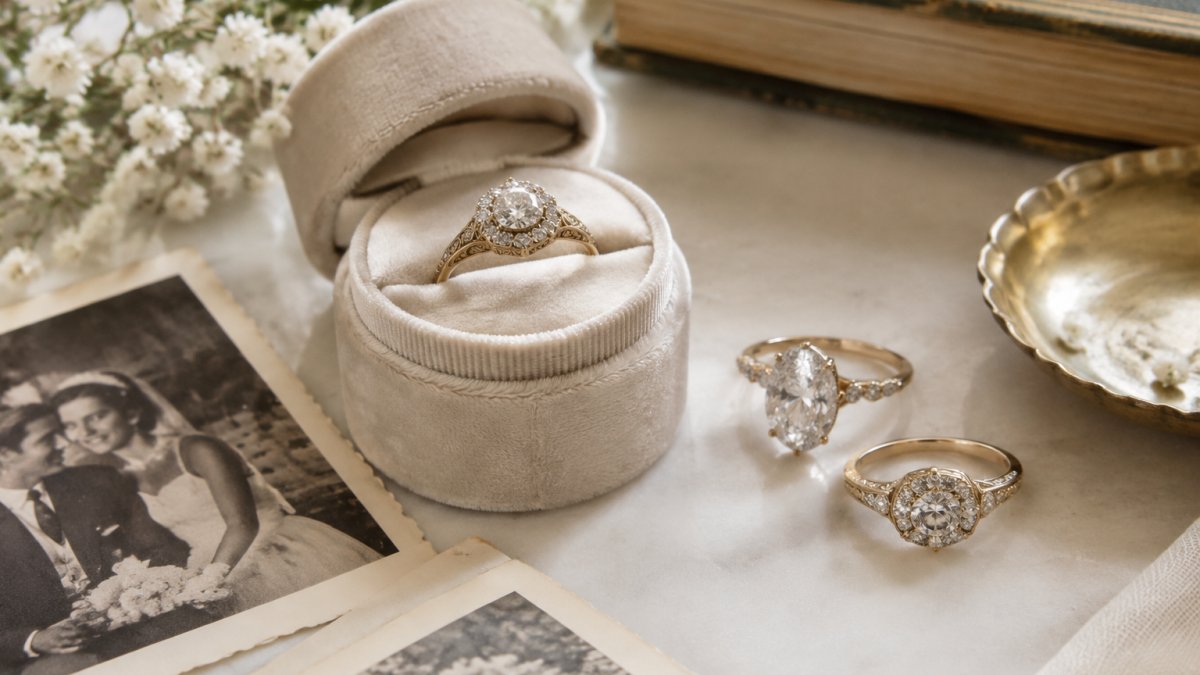
The fastest way to style vintage-inspired engagement rings is to identify the era the design borrows from, then dress to match its mood. A lacy Edwardian piece wants soft, romantic clothing.
Your ring is the anchor. Everything else supports it.
Here's the short version of each era's personality:
- Victorian: ornate, romantic, often yellow gold with intricate detail
- Edwardian: delicate, lacy, platinum-toned and light
- Art Deco: geometric, symmetrical, architectural
Most vintage-style settings mix two eras, so pick the one that dominates. A ring with a strong halo and milgrain leans Edwardian even if the band is modern. Once you name the era, the styling questions get simple.
Popular Vintage Engagement Ring Settings and What They Say About Style
Popular vintage engagement ring settings fall into two families: decorative metalwork and stone-forward settings. Each one signals a different style, so knowing the setting tells you what to wear with it.
Filigree, Milgrain, and Halo Details
Filigree is fine, curled metalwork that gives a ring a handmade, lacy texture. Milgrain is the tiny beaded edge along the band.
These details read as feminine and romantic. They pair well with soft fabrics, delicate jewelry, and lower necklines.
For a deeper comparison of halo versus plain looks, read our guide to solitaire vs halo engagement ring pros and cons.
Bezel, Prong, and Pavé Settings
- Prong settings hold the stone with thin metal claws and show the most diamond. They suit almost any style.
- Bezel settings wrap the stone in a metal rim. They look modern and protect the edges, which helps with daily wear.
- Pavé settings line the band with tiny diamonds. They add sparkle and a delicate, vintage feel.
Pavé is the most vintage-leaning of the three. A reader weighing it against a plain band can compare both in our breakdown of modern pavé setting vs solitaire.
Each vintage setting family signals a different style, so the setting itself tells you what to wear with it.
| Setting | What it is | Style signal |
|---|---|---|
| Filigree | Fine, curled metalwork with handmade, lacy texture | Feminine and romantic |
| Milgrain | Tiny beaded edge along the band | Feminine and romantic |
| Halo | Ring of small stones circling the center stone | Feminine and romantic |
| Prong | Thin metal claws holding the stone, shows most diamond | Suits almost any style |
| Bezel | Metal rim wrapping the stone, protects the edges | Modern, good for daily wear |
| Pavé | Band lined with tiny diamonds | Sparkle and delicate, vintage feel |
Why Vintage Style Engagement Rings in Gold Flatter Most Skin Tones
Gold is the most forgiving metal for warm styling, and vintage style engagement rings in gold suit many skin tones. Yellow gold brings out warm undertones.
This is why so many vintage designs were made in gold in the first place.
A quick rule we share with shoppers:
- Warm undertones: yellow or rose gold
- Cool undertones: white gold or platinum
- Neutral undertones: any of the three
If you plan to wear the ring daily, 14K gold is a practical choice. Our article on whether 14K gold is worth it for daily wear covers durability in more detail.
How to Mix Vintage and Modern Ring Styles Without Clashing
Mixing vintage and modern ring styles works when one piece leads and the other supports. Pick a single anchor, then let everything else stay quiet.
Here is how to mix without a clash:
- Choose one hero piece, usually the engagement ring.
- Keep the second ring simpler in shape and metal.
- Repeat one element, such as the metal color or a stone shape.
- Avoid stacking two heavily detailed rings on the same hand.
- Match the finish, not the era.
A sculptural modern band next to a lacy vintage ring can look sharp. Two ornate rings on one finger usually fight each other.
What most guides miss is that contrast needs a shared thread. That thread is often the metal.
Pairing Wedding Bands With a Vintage-Inspired Ring
The best wedding band for a vintage-inspired ring follows the curve of the engagement ring and stays lower in profile. A ring with a halo or a low-set stone needs a band that curves around it, not one that sits flat and rubs.
Match the Band Profile to the Ring's Underside
The single most useful measurement is the gap between the ring's underside and your finger. A low-set or halo ring usually leaves no room for a straight band, so the band needs a curve, a notch, or a shadow profile.
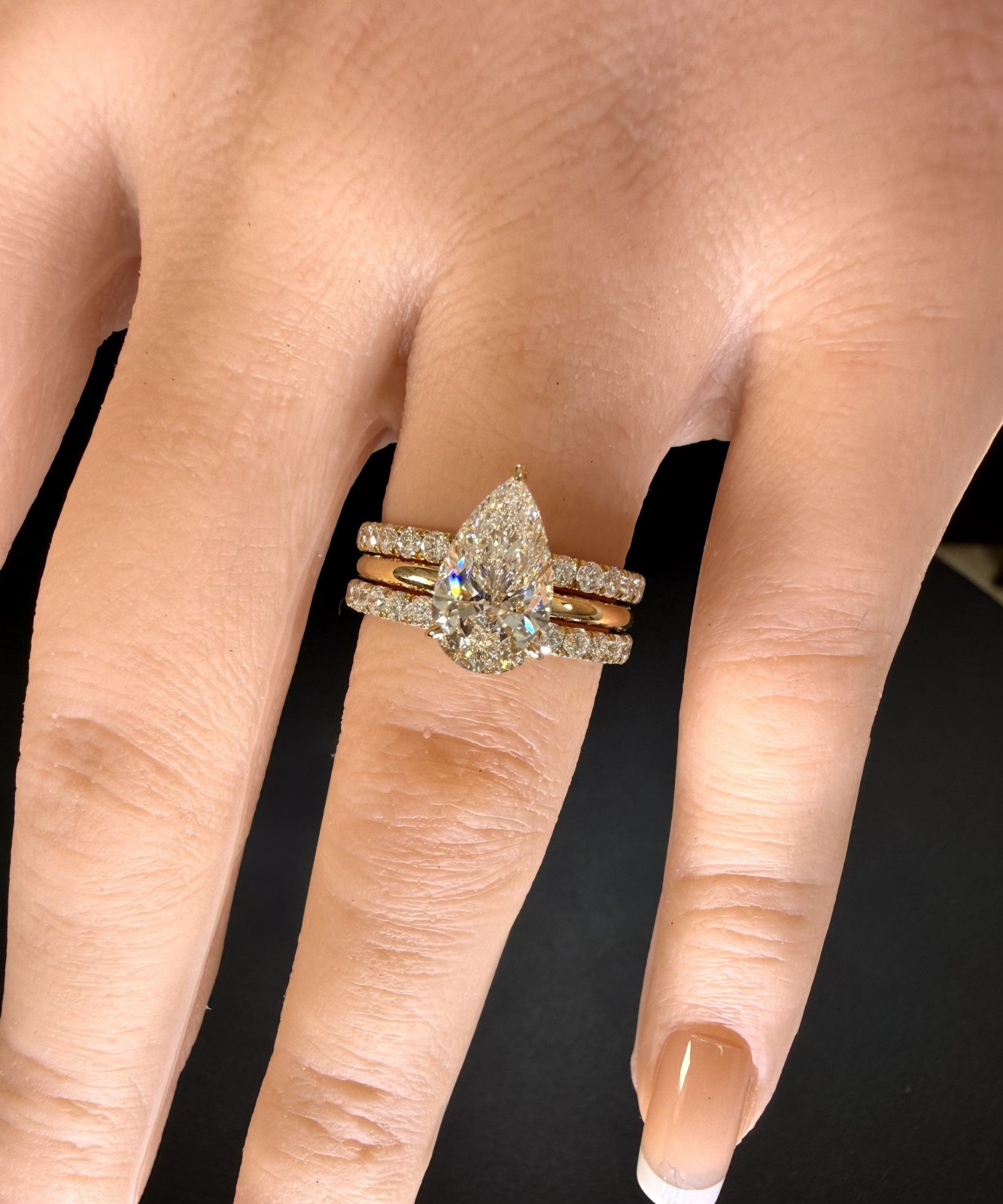
- Curved band: bends around a halo or low stone. Best for low-profile rings.
- Shadow band: sits flush and mirrors the ring's outline. Best when you want a seamless look.
- Notched band: cut to fit around a protruding setting. Best for unusual shapes.
Asymmetrical and sculptural bands also work when the engagement ring is simple. Skip a thick band against a very lacy ring, since it can overwhelm the detail.
Metal Matching and Stacking Order
Matching metal is the safest route, but mixing is workable if you repeat the metal at least twice in the stack.
Stacking order matters for wear. Put the hardest, plainest band closest to the engagement ring to absorb friction, and keep pavé or gemstone bands on the outside. This reduces abrasion on the engagement ring's detail and lowers the chance of stone loss on the band.
Balancing an Ornate Ring With Other Jewelry
An ornate engagement ring plus an ornate band plus a statement bracelet is the most common over-styled look.
On the other hand, a simple solitaire can carry a wider, more decorative band and a cocktail ring without competing.
For a closer look at fit and pairing, our guide to a wedding band for a low profile engagement ring walks through the options.
Everyday Styling: Outfits, Occasions, and Jewelry Pairings
Everyday styling comes down to matching the ring's detail level to your outfit, then balancing scale across your hand and neckline. Most guides stop at "keep it simple." The useful version is a set of rules you can apply in the mirror in under a minute.
The Three-Balance Rule
Treat every outfit as three zones: the ring hand, the neckline, and the ears. Only one zone should carry heavy detail at a time. If your ring has filigree, milgrain, and a halo, keep the neckline clean and the earrings small. If the ring is a simple solitaire, you can add a statement earring or a layered necklace without competing.
A common pattern among stylists is to repeat one shape rather than one era. A round halo ring pairs cleanly with round studs. A marquise or pear ring echoes well with a teardrop earring. Repeating the silhouette reads as intentional; repeating the era often reads as costume.
Workwear and Casual Days
For work, let the ring be the one decorative element. Pair it with a plain knit, a crisp shirt, or a simple blazer.
On casual days, lean into soft fabrics and neutral tones. Denim, cotton, and linen all sit well beside gold.
Watch out: high-profile settings and exposed prongs snag on loose knits and open-weave fabrics, so check the setting height before you build a daily wardrobe around a ring.
Evening and Formal Occasions
Evening looks let you add sparkle. A pavé or diamond band stacked with the engagement ring works for dinners and events. Keep the neckline and the ring from competing: if the dress is detailed, keep jewelry light.
For formal events, match your metal across pieces. Gold ring, gold earrings, gold bracelet. The set reads polished rather than random. If you wear a cocktail ring on the other hand, keep it a different scale from the engagement ring so the two do not read as a matched pair.
Jewelry Pairings by Ring Detail Level
- Heavy detail (filigree, halo, milgrain): small studs, a thin chain, no bangle on the ring hand.
- Medium detail (pavé band, small halo): one medium piece, such as a pendant or a slim bracelet.
- Simple (solitaire, bezel): you can carry a statement earring or a layered necklace.
Seasonal and Fabric Considerations
Summer weight fabrics and short sleeves put more visual weight on the hand, so a delicate ring can disappear against a bare arm. A slightly wider band or a stacked look holds its own. Winter layers do the opposite: a heavy sweater sleeve frames the ring, so a lacy, low-profile design reads better than a tall setting that catches on cuffs.
A Quick Decision Framework
- Name the ring's dominant detail level.
- Pick the outfit zone that will carry detail.
- Repeat one shape, not one era.
- Check the setting height against the day's fabrics.
- Match metal across visible pieces.
That five-step check takes less time than choosing a lipstick and prevents the most common styling mistakes.
Vintage Style Engagement Rings Under $1,000: What to Expect
Vintage style engagement rings under $1,000 are realistic when you choose lab-grown diamonds and 14K gold. The savings come from the stone, not from cutting corners on the metal.
What your budget buys:
- A smaller center stone, often under one carat
- 14K gold instead of 18K
- Simpler settings, with less pavé
Trade-offs to expect at this price:
- Fewer intricate details like heavy filigree
- Smaller halos
- Less hand-finishing on the band
To see what real options look like at this level, browse our picks for affordable 14K gold engagement rings. If your budget stretches further, a marquise or toi et moi design gives you far more presence for the money.
Choose Your Vintage-Inspired Ring at Native Jewel
Styling a vintage-inspired ring starts with the ring itself, so choose a design you will love for decades. Native Jewel offers 14K gold rings set with IGI-certified lab-grown diamonds, and diamond jewelry carries a lifetime warranty.
Three designs worth a look:
- The 3.75ct marquise lab diamond ring brings a vintage silhouette with a fine pavé trail.
- The 1.50ct marquise solitaire keeps the look clean and lets the stone speak.
- The toi et moi emerald and pear ring pairs two stones in the oldest romantic setting in jewelry.
Rings listed on our site include complimentary resizing, 30-day returns, and free shipping on orders over $1999.


Your ring should feel like yours the moment you put it on, not after three outfits of guessing. Start with the era, match the metal to your skin, and let the details guide the rest. Shop the Native Jewel collection and find a vintage-inspired ring built to be worn every day.
Frequently Asked Questions
Are vintage-inspired engagement rings still in style?
Yes. Vintage-inspired engagement rings remain a popular choice because the details that define them, such as milgrain, filigree, and halo settings, read as timeless rather than trendy. The style works across decades because it borrows from Edwardian, Victorian, Art Deco, and Retro eras rather than chasing one season's look. Choosing a vintage-inspired ring also means you can pair it with modern or antique jewelry later without the design feeling dated.
What are some popular vintage engagement ring settings?
The most popular vintage engagement ring settings include the halo, which frames the center stone in a ring of smaller diamonds, the bezel, which wraps metal around the stone for a smooth profile, and the prong setting, which lifts the stone for maximum light. Filigree and milgrain detailing often appear on the band, while pavé adds sparkle along the shoulders. Each setting changes how the ring sits on the hand and how easily it pairs with a wedding band.
How do you pair a wedding band with a vintage-inspired engagement ring?
Start by matching the band's curve to the ring's profile. A contoured or curved band sits flush against a halo or cluster setting, while a straight band works with a low-profile solitaire. Shadow bands, which follow the engagement ring's shape, and slim pavé bands are common choices. Keep the metal consistent with the engagement ring, and try both rings on together before committing so the fit and proportion feel right.
Can you mix vintage and modern ring styles?
Yes, and the easiest way is to let one piece lead. If the engagement ring is ornate, keep the wedding band plain or use a thin modern band in the same metal. If the engagement ring is a simple solitaire, a vintage-inspired band with milgrain or engraving adds contrast. Stacking a modern plain band with a vintage-style ring also works when the metals match and the widths stay balanced.


